Dimension 1: Data Readiness
Data is the foundation of every AI application. Without quality data, even the best AI tools will produce unreliable results.
Evaluate your data completeness. Do you have records for the process you want to automate? How far back does your data go? AI models perform better with more historical data. If you are looking at customer service automation, do you have logs of past conversations? For sales forecasting, do you have at least 12 months of transaction records? A home services company we assessed had 3 years of CRM data but only 6 months of it was consistently formatted. That meant their effective data history was much shorter than they assumed.
Assess data quality. Pull a sample of 100 records from your target process. Check for missing fields, inconsistent formatting, duplicate entries, and outdated information. If more than 20% of your sample has quality issues, you need a data cleanup project before AI implementation. One e-commerce startup found that 34% of their customer records had missing phone numbers and 18% had duplicate email addresses. Cleaning that data took 3 weeks but made their AI-powered email personalization system 2.5x more effective than it would have been on dirty data.
Check data accessibility. Where does your data live? If it is scattered across spreadsheets, email threads, paper files, and multiple software tools, you need a consolidation plan. AI tools need programmatic access to your data, which means it needs to be in a database, CRM, or structured file format. Our CRM and MarTech consulting helps businesses centralize their data before AI implementation.
Review data volume. Some AI applications need thousands of examples to work well. Others can operate on smaller datasets. Customer service chatbots need hundreds of conversation examples. Simple workflow automation might only need your process documentation and a few dozen rule definitions.
Data readiness score. Rate yourself 1-5 on each factor (completeness, quality, accessibility, volume). A total score below 12 out of 20 means you should invest in data infrastructure before AI tools.
Dimension 2: Process Readiness
AI works best when it automates well-defined processes. If your processes are chaotic, AI will automate the chaos.
Document your target processes. Can you write step-by-step instructions for the process you want to automate? If a new employee could not follow your documentation to complete the task, AI will struggle too. AI does not invent processes. It executes and accelerates existing ones. A marketing agency we worked with wanted to automate their client reporting but realized they had no standardized report template. Each account manager built reports differently. They needed to standardize before automating.
Identify decision points. Where in the process does someone make a judgment call? Simple decision points with clear rules are easy to automate. Complex decisions that require context, experience, and intuition are harder. Map every decision point and classify it as rule-based or judgment-based. For example, "If the lead score is above 80, route to sales" is rule-based. "Determine whether this prospect is a good cultural fit" is judgment-based.
Measure process consistency. Does the same process happen the same way every time? Or does it vary by person, customer, or situation? High-variance processes need more customization in their AI implementation. Start with your most consistent processes. A SaaS company found that their onboarding process had 14 variations depending on which team member handled it. Standardizing to 3 variations took one month and made their chatbot development project dramatically simpler.
Check for exceptions. Every process has edge cases. How many exceptions occur per 100 instances? If exceptions are rare (less than 5%), AI can handle the standard flow and route exceptions to humans. If exceptions are common (more than 20%), you may need to standardize the process first.
Dimension 3: Team Readiness
Your team will determine whether AI adoption succeeds or fails. Technology is the easy part. People are the hard part.
Gauge leadership commitment. Does your leadership team understand what AI can and cannot do? Are they willing to invest time, not just money, in the transition? AI implementation requires executive attention during the first 90 days. A retail startup's CEO delegated their entire AI project to a junior manager. Without executive sponsorship, the project lost priority within 6 weeks and stalled completely by month 3.
Assess team sentiment. Talk to the people who will work alongside AI tools. Are they excited, neutral, or fearful? Fear usually stems from misunderstanding. Address concerns directly. Explain that AI handles repetitive work so they can focus on higher-value tasks. A customer service team we worked with went from 70% skeptical to 85% positive after seeing a demo where the AI drafted responses that they could edit, rather than replacing them entirely.
Identify your AI champion. You need at least one person on your team who will own the AI initiative. This person does not need to be technical. They need to be organized, curious, and persistent. They will coordinate between your team, any vendors, and leadership.
Evaluate digital literacy. Your team does not need to understand machine learning. They need to be comfortable with software tools, data entry, and following new workflows. If your team struggles with your current software, adding AI tools will compound the frustration. Consider a basic digital skills assessment before layering on AI capabilities.
Dimension 4: Technical Readiness
You do not need a server room or engineering team. But you do need certain technical foundations in place.
Internet and infrastructure. Most AI tools are cloud-based. Reliable internet is a baseline requirement. If your team experiences frequent outages or slow connections, fix that first. A remote-first startup discovered that three team members had internet speeds below 10 Mbps, which caused constant timeouts with their AI transcription tool.
Software ecosystem. What tools does your business run on? Do they have APIs or integration capabilities? Modern CRMs, accounting tools, and project management platforms usually support integrations. Legacy or highly customized systems may not. Check whether your core tools appear on integration platforms like Zapier or Make, or whether they offer REST APIs. Our business software development services can build custom connectors for systems that lack native integrations.
Security posture. AI tools will process your business data, sometimes including customer information. Do you have basic security measures in place? Password management, access controls, data backup, and privacy policies are prerequisites. Review our AI security best practices for a detailed security checklist.
IT support. Who handles technical issues today? Whether it is an internal person, an outsourced provider, or you, make sure you have a plan for supporting the new AI tools once they are deployed. Budget 2 to 4 hours per week for AI tool management during the first quarter.
Dimension 5: Strategic Readiness
AI should serve your business strategy, not the other way around.
Clear business objectives. What specific outcomes do you want from AI? "Be more innovative" is not an objective. "Reduce customer response time from 4 hours to 30 minutes" is. "Increase qualified lead volume by 40% without adding headcount" is. Your AI investments should connect directly to revenue growth, cost reduction, or customer satisfaction improvements. Our lead generation services start with exactly this kind of objective setting.
Budget and timeline expectations. Do you have a realistic budget for AI implementation? Expect $200 to $2,000 per month for tools and potentially $5,000 to $20,000 for initial custom integration work. Do you have a realistic timeline? Plan for 3 to 6 months before meaningful results. Companies that expect instant transformation end up abandoning good tools before they have time to calibrate.
Risk tolerance. AI is not perfect. It will make mistakes, especially early on. Are you prepared for a learning curve? Can your business absorb some errors during the transition period? A B2B startup deployed an AI email responder but pulled it after one week because of two awkward responses. If they had run it in "draft mode" (AI suggests, humans approve) for the first month, those issues would have been caught harmlessly.
Competitive landscape. Are your competitors already using AI? If so, urgency increases. If not, you have an opportunity to gain a first-mover advantage in your market. In industries like real estate, insurance, and professional services, early AI adopters are capturing disproportionate market share through faster response times and better conversion optimization.
Scoring Your AI Readiness
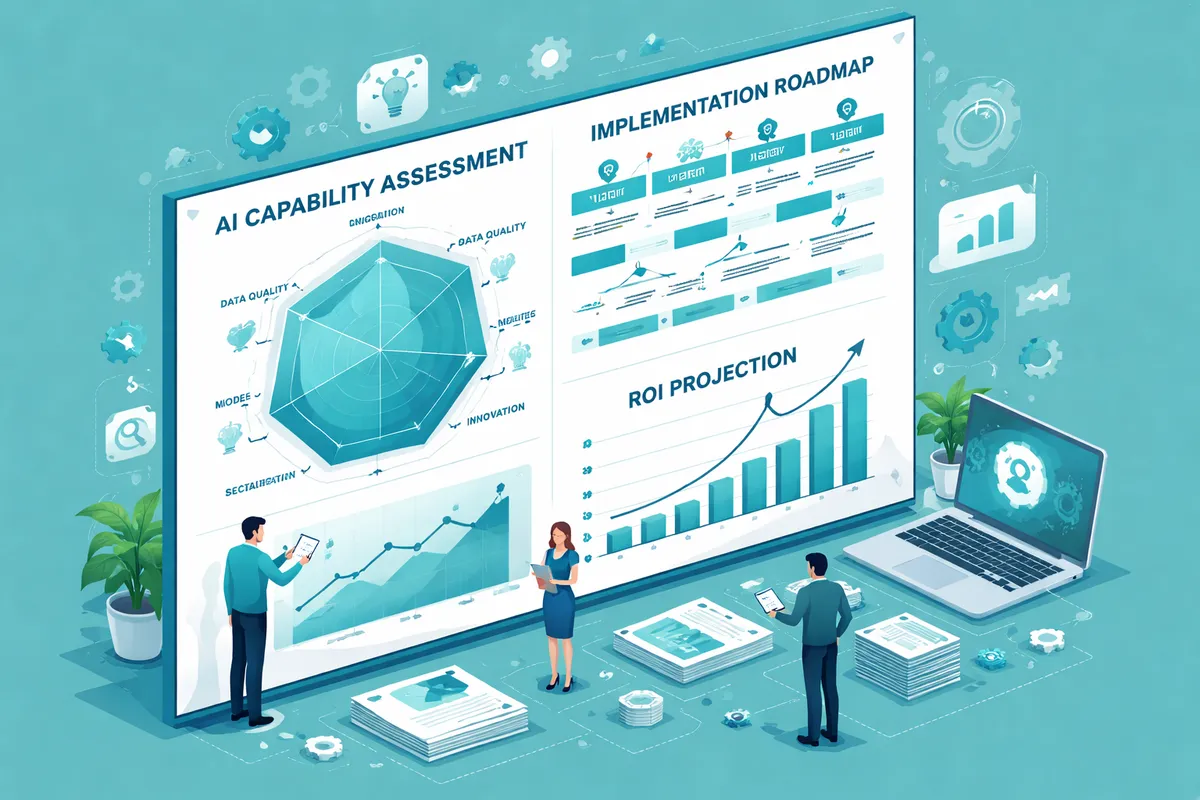
Rate each dimension on a scale of 1-5, where 1 is "not ready" and 5 is "fully prepared."
- Score 20-25: You are ready to start a pilot project. Focus on identifying your highest-impact opportunity and move forward. Consider our custom AI solutions for implementation.
- Score 15-19: You are close. Address your weakest dimension first. This usually takes 1 to 3 months of focused preparation.
- Score 10-14: You need foundational work. Prioritize data organization and process documentation before evaluating AI tools.
- Score below 10: Focus on digital transformation basics first. Modernize your software stack, improve data practices, and build team comfort with technology.
Common Mistakes in AI Readiness
Overestimating data quality. Business owners consistently overrate their data. Pull actual samples and check. What feels organized often has significant quality issues when you look closely. We have seen businesses claim "clean CRM data" that turned out to have 40% incomplete records.
Underestimating change management. Even a team that says they are excited about AI will resist when daily workflows change. Plan for a transition period and provide ongoing support. Budget 10 to 15% of your total AI investment for training and change management.
Waiting for perfect readiness. You will never score 25 out of 25. Perfect readiness is a myth that delays progress. A score of 15 with a plan to address gaps is good enough to start a controlled pilot project.
Ignoring the strategy dimension. Businesses that implement AI without clear objectives end up with expensive tools that nobody uses. Always start with the business problem, not the technology.
Skipping the security review. AI tools process sensitive data. Businesses that skip security evaluation expose themselves to data breaches and compliance violations. Our AI customer service implementations always include a security audit as part of the readiness process.
How Running Start Digital Can Help
We conduct comprehensive AI readiness assessments that evaluate your data, processes, team, technology, and strategy. You get a scored report with specific recommendations and a prioritized action plan. Our assessments have helped over 40 businesses identify the right starting point for AI adoption, saving an average of $12,000 in avoided missteps.
Whether you need content marketing automation, predictive analytics, or a full AI document processing system, the readiness assessment ensures you start from a position of strength. Contact us to schedule yours.
Frequently Asked Questions
### How long does an AI readiness assessment take? A thorough self-assessment takes 2 to 4 hours using the framework in this guide. A professional assessment conducted by a consultant typically takes 1 to 2 weeks, including stakeholder interviews, data sampling, and technical infrastructure review. The professional version produces a scored report with specific recommendations ranked by impact and effort.
### Can a very small business (under 10 employees) benefit from AI? Absolutely. Smaller businesses often see faster ROI because decisions happen faster and implementation is simpler. The key is choosing tools that match your scale. A 5-person company does not need enterprise AI. It needs targeted automation for its biggest time sinks. We have seen 3-person agencies save 15 hours per week with basic content and scheduling automation.
### What if my business has very little historical data? You can still benefit from AI. Many tools like chatbots, content generators, and scheduling assistants work with minimal historical data. They use pre-trained models that learn from your inputs over time. Data-heavy applications like predictive analytics will need you to build a data foundation first, which typically takes 3 to 6 months of consistent data collection.
### Should I hire an AI consultant or do the assessment myself? Start with the self-assessment in this guide. If you score above 15, you can likely begin a pilot project on your own with off-the-shelf tools. If you score below 15 or want a more rigorous evaluation, a consultant can identify blind spots and create a faster path to readiness. The investment in a professional assessment (typically $2,000 to $5,000) often saves 5 to 10x that amount in avoided mistakes.
### What is the biggest sign that a business is NOT ready for AI? The clearest red flag is undefined processes. If your team cannot describe how a task gets done consistently, AI cannot automate it. Document and standardize your processes first. The second biggest red flag is scattered data with no central system of record.
### Does AI readiness differ by industry? The five dimensions apply universally, but the specifics vary. Retail businesses typically have strong transaction data but weak process documentation. Professional services firms have strong processes but scattered data. Healthcare and financial services face additional regulatory requirements around data handling. Your industry context shapes which dimensions need the most attention and which compliance standards apply.