AI Tools That Are Working Right Now
AI Color Matching and Visualization
Color selection is where customers get stuck. They stare at paint chips, second-guess decisions, and delay projects because they cannot visualize how a color will look in their space. This indecision directly impacts your revenue. Delayed decisions mean delayed starts, and some customers never move forward at all.
AI color visualization solves this by letting customers upload a photo of their room and see any paint color applied to the walls instantly. The AI handles the complex rendering work. It understands which surfaces are walls versus trim, accounts for lighting conditions in the photo, and applies the color with realistic shading and shadow effects.
The customer sees their actual room with the new color, not a generic sample. They can compare multiple options side by side, try accent walls, and explore complementary trim colors. This experience does three things. It accelerates the decision, increases customer confidence, and creates an emotional connection to the finished result that makes them more likely to choose you.
For exterior painting, the visualization is even more powerful. Customers can see their entire home in different color schemes. The AI renders siding, trim, shutters, doors, and accent elements independently so customers can mix and match until they find the combination they love.
The technology also supports professional color matching. When a customer wants to match an existing color or a color they saw somewhere, the AI can analyze a photo and recommend the closest matching paint formulas across major brands. See our chatbot development services for customer-facing tools.
Automated Surface Area Calculation from Photos
Accurate surface area calculation is the foundation of accurate estimates. Manual measurement is time-consuming and inconsistent. Different estimators measure differently, accounting for windows, doors, and other openings in different ways. The result is pricing inconsistency that either costs you margin or loses you jobs.
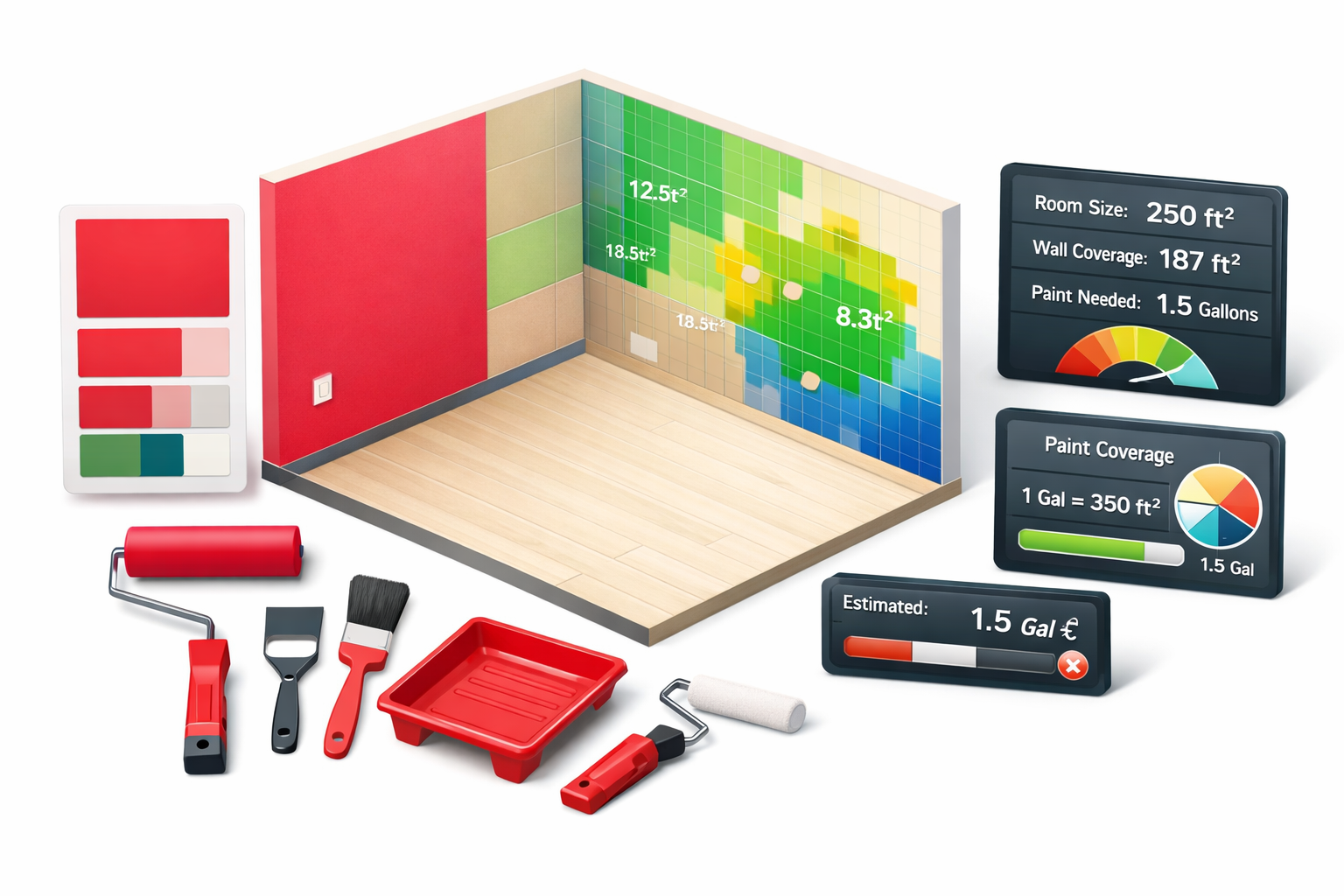
AI surface area tools analyze photos to calculate paintable surface area with remarkable accuracy. For interior rooms, the customer or estimator takes photos from the corners of the room, and the AI reconstructs the room geometry. It identifies and deducts windows, doors, built-ins, and other non-paintable surfaces. It calculates wall area, ceiling area, and trim linear footage separately.
For exteriors, the AI works from photos taken from multiple angles around the property. It identifies and measures siding, trim, fascia, soffit, doors, windows, and other elements. It accounts for gable ends, dormers, and other architectural features that complicate manual measurement.
The result is a detailed surface breakdown that drives accurate material calculations and consistent pricing. When every estimate uses the same measurement methodology, your pricing becomes predictable and defensible. Explore our document processing automation.
Scheduling Optimization for Multi-Day Projects
Painting projects have unique scheduling constraints that generic scheduling tools do not handle well. Interior projects require coordination around occupancy. Exterior projects depend on weather windows. Multi-coat applications require drying time between coats. Prep work and finish work require different skill levels and sometimes different crews.
AI scheduling for painting companies optimizes around all of these variables. The system knows that exterior latex needs 4 hours of dry time between coats and temperatures above 50 degrees. It knows that an interior project in an occupied home needs to sequence rooms to minimize disruption. It knows that your senior crew handles detail work and your production crew handles volume.
When weather forces an exterior crew indoors, the AI reschedules affected projects and reassigns crews to interior work that is available. When a project runs ahead of schedule, it identifies the next job that can be pulled forward. The system sends notifications to customers about schedule changes automatically, maintaining communication without consuming your time. See our booking and scheduling automation.
Material Quantity Estimation
Material waste is a direct hit to profit margin. Over-ordering means leftover product that may never be used. Under-ordering means emergency supply runs that disrupt workflow and sometimes result in batch inconsistencies.
AI material estimation integrates with the surface area calculation to generate precise material quantities for every job. The system accounts for surface texture and porosity (smooth drywall versus textured versus bare wood), application method (brush, roller, spray), number of coats, and product-specific coverage rates.
The AI generates a complete material list including primer, paint, caulk, tape, plastic, and sundries. It adjusts quantities based on your historical usage patterns. If your crews consistently use 10 percent more product than manufacturer specifications on textured surfaces, the AI incorporates that adjustment into future estimates.
For companies purchasing from specific suppliers, the AI can match your material list to available products and package sizes to minimize waste. It recommends the most cost-effective combination of gallon and five-gallon containers based on the exact quantity needed.
Quality Inspection with Photo AI
Quality control in painting is subjective and inconsistent. What one inspector considers acceptable, another might flag. Customer expectations vary, and disagreements about quality create friction, callbacks, and negative reviews.
AI quality inspection tools add objectivity to the process. A crew leader or quality inspector photographs the completed work, and the AI analyzes the images for common quality issues. Missed spots, uneven coverage, drips and runs, crooked cut lines, paint on unwanted surfaces, and improper masking.
The AI compares the finished work against standards you define. It flags specific areas that need attention before the customer walkthrough. This catches problems while the crew is still on site, eliminating the cost and inconvenience of a callback.
Over time, the system generates quality metrics by crew, by project type, and by product. You can identify which crews need training on specific techniques and which products perform better in specific applications. Explore our computer vision solutions.
Customer Follow-Up Automation for Maintenance Repaints
The most profitable job is one from an existing customer. Exterior paint typically needs refreshing every 5 to 8 years. Interior spaces get repainted every 7 to 10 years. Most painting companies do nothing to capture this repeat business.
AI customer follow-up automation tracks every completed project and initiates communication at the right time. The system knows when each project was completed, what products were used, and their expected lifespan. Three years after an exterior project, the AI sends a personalized check-in. Five years out, it sends a maintenance reminder with a touch-up inspection offer. At repaint timing, the system delivers updated pricing and a reminder of the positive experience.
This automated nurture generates warm leads that close at significantly higher rates than cold outreach. The AI ensures you stay top of mind at the moment customers are ready to buy again. See our AI customer service tools.
What Custom AI Integration Looks Like
Individual AI tools address specific parts of your painting business. Custom integration connects them into a seamless workflow from lead to completed project to repeat customer.
Here is what an integrated AI workflow looks like for a painting company. A lead submits a request through your website. The AI pulls up the property's aerial imagery and generates exterior measurements, or sends the customer a link to upload room photos for interior work. Simultaneously, the customer accesses the color visualization tool to explore options.
The AI combines measurements, color selections, and surface data to generate a complete estimate. Your estimator reviews it, makes adjustments, and sends the proposal. If accepted, the AI schedules the project, generates the material order, and sends the customer automated updates as work progresses. After completion, the project enters the follow-up system for future maintenance communication.
Running Start Digital builds these integrated systems for painting companies by connecting your CRM, estimating tools, scheduling system, and customer communication into an AI-powered workflow that matches your specific business process. Explore our workflow automation services.
Results You Can Expect
Painting companies implementing AI across their business are achieving measurable improvements in profitability and growth.
Estimating speed. AI measurement and proposal generation reduce estimate time from 2 to 4 hours to 30 to 45 minutes per job. Your team produces more estimates per day with less travel.
Close rates. AI color visualization increases proposal acceptance by 15 to 30 percent. Customers who can see the end result are more confident in their decision and more committed to moving forward.
Material savings. AI quantity estimation reduces material waste by 15 to 25 percent. Accurate calculations eliminate over-ordering and reduce emergency supply runs.
Crew utilization. AI scheduling optimization increases productive time by 10 to 20 percent. Better routing, weather-responsive scheduling, and automated crew assignment keep teams working instead of waiting.
Quality consistency. AI quality inspection reduces callbacks by 30 to 50 percent. Catching issues before the customer walkthrough saves time, money, and reputation.
Repeat business. Automated follow-up generates 20 to 35 percent more repeat and referral business. Customers who receive timely, personalized maintenance reminders return at higher rates than those who are left to remember on their own.
The painting companies that invest in AI now are building a scalable operation that grows without proportionally increasing overhead. Every process that AI handles is one fewer bottleneck as you add crews and take on more work. Explore our predictive analytics tools for business forecasting.
Frequently Asked Questions
How accurate is AI surface area calculation from photos?
AI surface area calculation from photos achieves 90 to 95 percent accuracy in most conditions. Interior rooms with standard rectangular geometry produce the most accurate results. Complex architectural features, very high ceilings, and unusual room shapes may require manual verification. For most residential and commercial projects, the AI measurement is accurate enough to produce competitive estimates without a site visit.
Does AI color visualization work for all paint brands?
Most AI visualization platforms include color libraries from major paint brands including Benjamin Moore, Sherwin-Williams, PPG, Behr, and Farrow and Ball. Custom colors can be added by entering the formula or scanning a sample. The visualization accuracy depends on the quality of the uploaded photo and the calibration of the customer's screen, so it is a close approximation rather than a perfect color match. It is accurate enough to narrow choices and build confidence.
Can AI scheduling handle weather-dependent exterior work?
Yes, this is one of the strongest use cases. AI scheduling integrates weather forecast data and adjusts exterior project schedules automatically. The system knows the temperature, humidity, and precipitation thresholds for different paint products and will not schedule exterior work when conditions fall outside acceptable ranges. When weather forces a schedule change, the AI reschedules affected projects and reassigns crews to available interior work.
Will customers trust AI-generated estimates without a site visit?
Customer comfort with remote estimates has increased significantly. Many customers prefer the convenience of not scheduling a site visit. The key is transparency. Present the AI measurement methodology, show the detailed surface breakdown, and offer a site verification visit if the customer wants one. Most companies find that 60 to 70 percent of residential customers are comfortable with AI-generated estimates, especially when paired with the color visualization experience.
What does AI quality inspection actually catch?
AI quality inspection analyzes photos of completed work for visible defects including missed coverage, drips and runs, uneven sheen, paint on non-target surfaces, masking tape residue, crooked cut lines, and insufficient coverage on edges and corners. It does not replace a human walkthrough for subjective quality assessment, but it catches the objective defects that cause callbacks. Think of it as a second set of eyes that never gets tired or rushed at the end of a long day. Learn about our business software integration options.
How do we get started with AI for our painting company?
Start with the tool that addresses your biggest pain point. If your close rate is low, start with color visualization. If estimating takes too much time, start with AI measurement. If scheduling is chaotic, start with AI scheduling. Each tool can be implemented independently and provides standalone value. Once you have one tool running, adding integrations between tools creates compounding benefits. Running Start Digital can assess your operation and recommend the implementation sequence that delivers the fastest ROI.