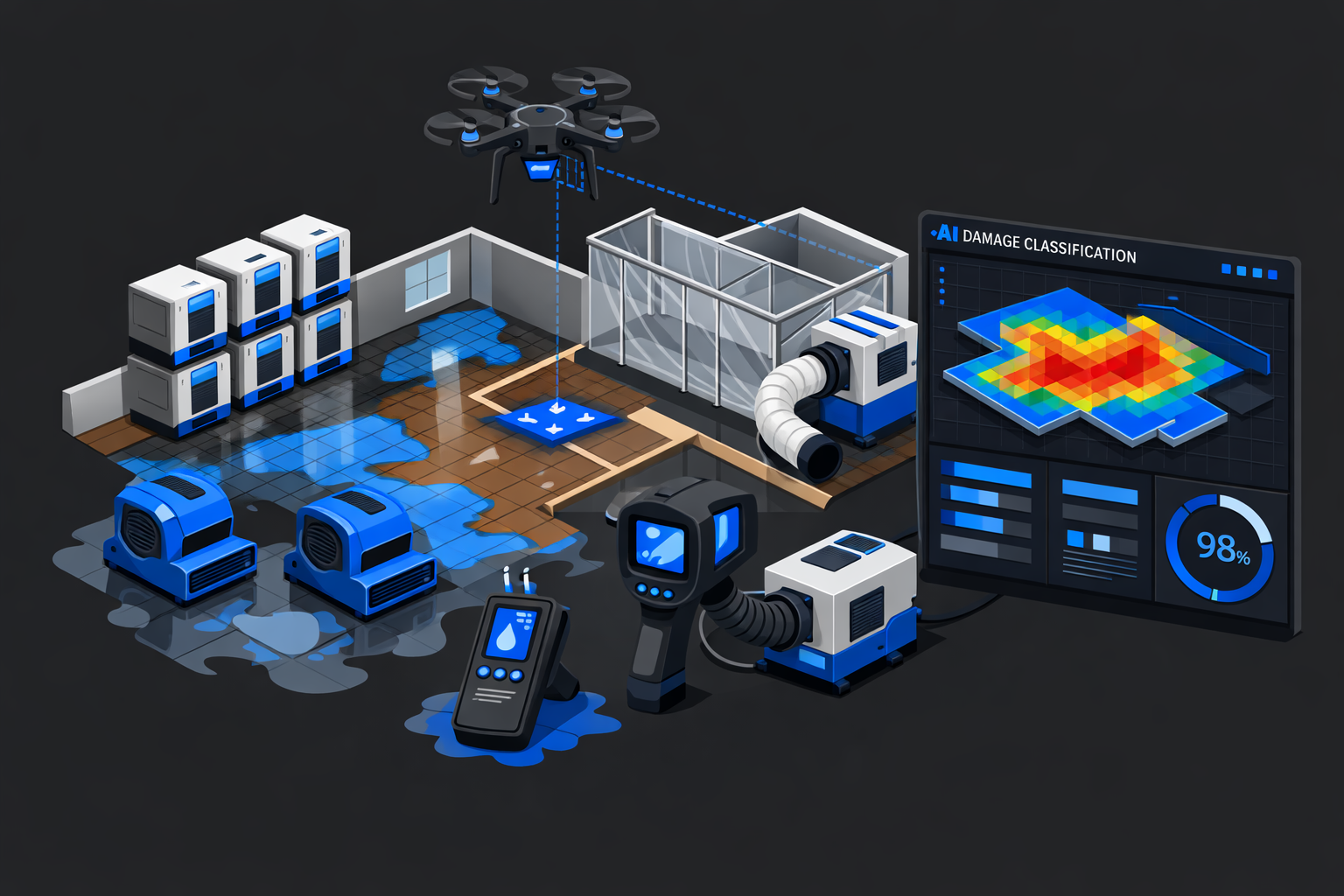
What We Build for Restoration Companies
Every AI system is designed around your project types, team structure, insurance relationships, and documentation requirements. Here is what a complete restoration AI technology program includes.
- AI damage assessment from photos and drone imagery that classifies damage type, estimates affected area, identifies materials impacted, and generates preliminary scope reports
- Automated insurance documentation that compiles photos, moisture readings, equipment logs, and labor records into Xactimate-compatible scope reports
- IoT moisture monitoring with AI analysis that tracks drying progress across all affected areas, predicts dry-out completion, and flags anomalies requiring technician intervention
- Multi-phase project management automation that coordinates extraction, drying, remediation, and reconstruction schedules across concurrent projects
- Customer communication automation that sends project updates, phase transition notifications, insurance status updates, and completion reports triggered by actual project milestones
- Compliance documentation automation that maintains IICRC standard adherence records, generates required reports, and ensures regulatory requirements are met for each project type
- AI-powered resource allocation that assigns crews, equipment, and materials across concurrent projects based on priority, certification requirements, and geographic optimization
- Drone integration for large-loss assessment providing aerial documentation of storm damage, fire damage extent, and structural conditions before crews enter the building
- Equipment tracking that monitors dehumidifier, air mover, and air scrubber placement, runtime, and performance across all active job sites
- Insurance adjuster collaboration tools that provide adjusters with real-time access to project documentation, reducing disputes and accelerating claim approval
AI Solutions for Restoration Operations
AI Damage Assessment
The initial damage assessment sets the trajectory for the entire restoration project. An accurate, thorough assessment ensures the scope report covers all affected areas, the right equipment and personnel are assigned from the start, and the insurance claim reflects the true extent of damage. An incomplete initial assessment leads to scope creep, supplemental claims, payment delays, and customer frustration.
AI damage assessment transforms this into a systematic evaluation supported by computer vision. The technician captures photos and video during the initial walkthrough. The AI analyzes the visual data to identify damage indicators that even experienced technicians sometimes miss during an emergency response.
For water damage, the AI identifies waterline marks, material discoloration, swelling in baseboards, visible moisture, and structural deflection. It classifies water category (clean, gray, or black), estimates affected square footage, and identifies impacted materials. For fire and smoke damage, the system classifies char versus smoke damage, maps the damage gradient from the point of origin, and documents structural concerns. For mold, the AI identifies visible growth, classifies likely species, and flags conditions suggesting hidden mold based on moisture patterns.
Drone integration extends assessment to dangerous or impractical areas. The AI processes drone footage to generate overhead damage maps, identify crew access points, and document pre-existing conditions for insurance purposes.
Learn more about computer vision solutions | Custom AI solutions for restoration
Automated Insurance Documentation
Insurance documentation is where restoration companies either capture their full earned revenue or leave money on the table. The documentation requirements are specific, detailed, and unforgiving. Missing a moisture reading series, failing to photograph a specific phase, or submitting an incomplete equipment log can result in claim adjustments that reduce payment by 10 to 30 percent.
AI documentation systems solve this by running in the background throughout the project, automatically organizing and compiling the data that technicians capture during normal workflow. Every photo taken on site is geotagged, timestamped, and categorized by room, damage type, and project phase. Moisture readings from Bluetooth-connected meters are logged automatically with location data and timestamps. Equipment placement and runtime data feeds from IoT sensors into the project record without manual entry.
The system generates Xactimate-compatible scope reports by combining the AI damage assessment with actual field data. Line items map to standard pricing codes. Material quantities tie to measured areas. Labor hours align with industry standards for the documented scope. The result is a scope report that reads as if a seasoned project manager spent 4 to 6 hours compiling it, generated automatically from data captured during normal production work.
For supplemental claims, the system tracks scope additions in real time. When a technician discovers hidden damage during reconstruction, the system documents it immediately with timestamped photos and generates the supplemental scope for adjuster review. A complete audit trail preserves every data point with chain-of-custody timestamps for future carrier inquiries.
Learn more about AI document processing | Workflow automation for restoration
IoT Moisture Monitoring and AI Analysis
Structural drying is the most technically demanding phase of water damage restoration. Industry standards (IICRC S500) require documenting moisture content at specific monitoring points throughout the drying process, typically every 12 to 24 hours. A mid-size residential job might have 20 to 40 monitoring points. A large commercial project can have 200 or more. Manually collecting and recording all these readings is a significant labor investment and a common source of documentation gaps.
IoT moisture sensors placed at monitoring points throughout the affected structure transmit readings automatically to the AI analysis system. The sensors measure moisture content in building materials continuously, providing a resolution of data that manual spot readings cannot match. Instead of two readings per day, the system captures readings every hour or more frequently, creating a detailed drying curve for each monitored location.
The AI layer analyzes these drying curves to predict when each area will reach target moisture content. It identifies areas drying slower than expected (hidden moisture sources, inadequate airflow, equipment needing repositioning) and calculates optimal equipment removal timing to prevent both premature removal and unnecessary extended runtime.
Project managers get a real-time dashboard with green, yellow, and red indicators across all monitoring points on every active job, enabling oversight of multiple drying projects without daily site visits. The system also generates automatic moisture mapping reports that meet carrier documentation requirements, with every reading logged by location, timestamp, and sensor ID. This documentation virtually eliminates drying-related claim disputes.
Learn more about AI data pipelines | Predictive analytics solutions
Multi-Phase Project Management
Restoration projects are inherently multi-phase, and each phase has dependencies on the previous one. You cannot begin reconstruction until drying is certified complete. You cannot begin drying until water extraction is finished. You cannot start mold remediation until containment is established. Managing these dependencies across 10 to 20 concurrent projects at different stages requires a project management system that understands restoration-specific workflows.
AI project management for restoration goes beyond standard construction scheduling tools. The system models each project as a sequence of phases with defined start conditions, required resources, duration estimates, and completion criteria. It tracks actual progress against the model in real time based on field data: moisture readings determine drying phase completion, air quality readings confirm mold remediation success, and photo documentation verifies reconstruction milestones.
Resource allocation becomes intelligent. The system adjusts reconstruction scheduling when drying completes ahead of schedule, identifies redeployable extraction equipment when emergencies arrive, and flags crew conflicts before they become problems. It coordinates with insurance adjusters, subcontractors, and material suppliers to keep phases aligned.
For large-loss projects involving multiple buildings or floors, the AI breaks work into manageable zones that progress through phases independently, significantly reducing total project duration.
Learn more about workflow automation | Business software solutions
Customer Communication During Long Projects
Restoration projects test customer patience. A homeowner dealing with water damage, fire damage, or mold is already stressed. The disruption to their daily life, the uncertainty about costs, and the unfamiliarity with the restoration process create anxiety. The companies that communicate proactively throughout the project earn trust and referrals. The companies that go silent between the initial assessment and the final walkthrough generate complaints and negative reviews.
AI communication automation sends updates triggered by actual project milestones. Drying phase start notifications explain equipment and timeline. Progress updates include estimated completion dates based on live moisture data. Phase transition notifications prepare customers for what comes next. Insurance status updates track claim submissions, adjuster assignments, and payment milestones, addressing the single biggest source of customer frustration during restoration.
The system adapts to customer preferences: text messages, email summaries, or formatted daily reports for commercial property managers. Post-project communication includes satisfaction surveys, warranty information, and check-ins during the 90-day window when post-restoration issues are most likely to surface.
Learn more about AI customer service | Chatbot development for restoration
Compliance Documentation Automation
Restoration work is regulated at federal, state, and local levels. OSHA requirements for lead paint, asbestos, and hazardous material handling. EPA regulations for mold remediation in commercial buildings. State licensing requirements for restoration contractors. IICRC standards that define best practices for water, fire, and mold restoration. Insurance carrier requirements that often exceed regulatory minimums. The documentation burden of demonstrating compliance across all of these frameworks is substantial.
AI compliance systems track requirements applicable to each project based on building type, age, location, and damage type. Pre-1978 buildings automatically trigger lead-safe documentation. Commercial mold remediation generates required EPA notifications. OSHA PPE requirements are tracked and documented per project.
The system maintains a current regulation library and applies the correct compliance framework automatically based on project location and scope. This is especially valuable for companies operating across multiple jurisdictions. When a carrier, regulator, or attorney requests documentation months later, the system produces a complete compliance record instantly. Every safety meeting, PPE log, containment verification, and air quality clearance test is organized and accessible.
Learn more about AI document processing | Custom AI solutions
What to Expect
Phase 1: Operations and Documentation Audit (Weeks 1-2)
We analyze your current project workflow from initial emergency response through final documentation submission. We review representative completed projects to assess documentation quality, identify common gaps, and measure the time your team currently spends on reporting versus production work. We evaluate your technology stack, insurance carrier relationships, and compliance requirements.
Phase 2: System Design (Weeks 2-4)
We deliver a phased implementation plan prioritized by revenue impact and operational urgency. Most restoration companies see the fastest returns from automated insurance documentation and customer communication systems. IoT moisture monitoring deploys on new projects immediately. AI damage assessment and compliance automation follow in subsequent phases. The plan includes integration specifications with your existing project management tools, Xactimate, and carrier portals.
Phase 3: Implementation (Weeks 4-14)
Systems deploy in sequence aligned with your project flow. Documentation automation integrates with your current photo capture and reporting workflow. Moisture monitoring sensors deploy on new projects as they begin, building the data foundation immediately. Customer communication automation connects to your CRM and project management system. Each phase includes training for the specific team members who interact with that system: technicians for field data capture, project managers for monitoring dashboards, and office staff for documentation submission.
Phase 4: Continuous Improvement
The AI systems improve with every completed project. Damage assessment accuracy increases as the system processes more of your market's common building types and damage scenarios. Documentation templates refine based on adjuster feedback and approval rates. Moisture prediction models improve as the system accumulates drying data for specific material types in your climate region. We review documentation quality scores, claim approval rates, and operational efficiency metrics with you monthly.
Insurance documentation improvements show impact on the first submitted claim. Moisture monitoring delivers value on the first equipped project. Full system optimization reaches peak performance at the 4 to 6 month mark.
Document Better. Get Paid Faster. Restore More.
The restoration companies that grow beyond a few crews are the ones that solve the documentation problem. Not by hiring more office staff to type reports. By building systems that generate documentation automatically while technicians focus on restoration. AI gives you insurance-ready scope reports compiled in minutes instead of hours. Moisture monitoring that runs continuously without manual readings. Project management that coordinates multi-phase work across concurrent jobs without dropping balls. Running Start Digital builds these systems specifically for restoration operations. Designed around how water damage unfolds, how insurance documentation works, and how your crews actually operate in the field.
Explore AI document processing solutions | See how we help construction companies