What We Build for Pest Control Companies
Every implementation is designed around your service model, territory size, and operational priorities. Here is what a comprehensive AI integration includes for a pest control company:
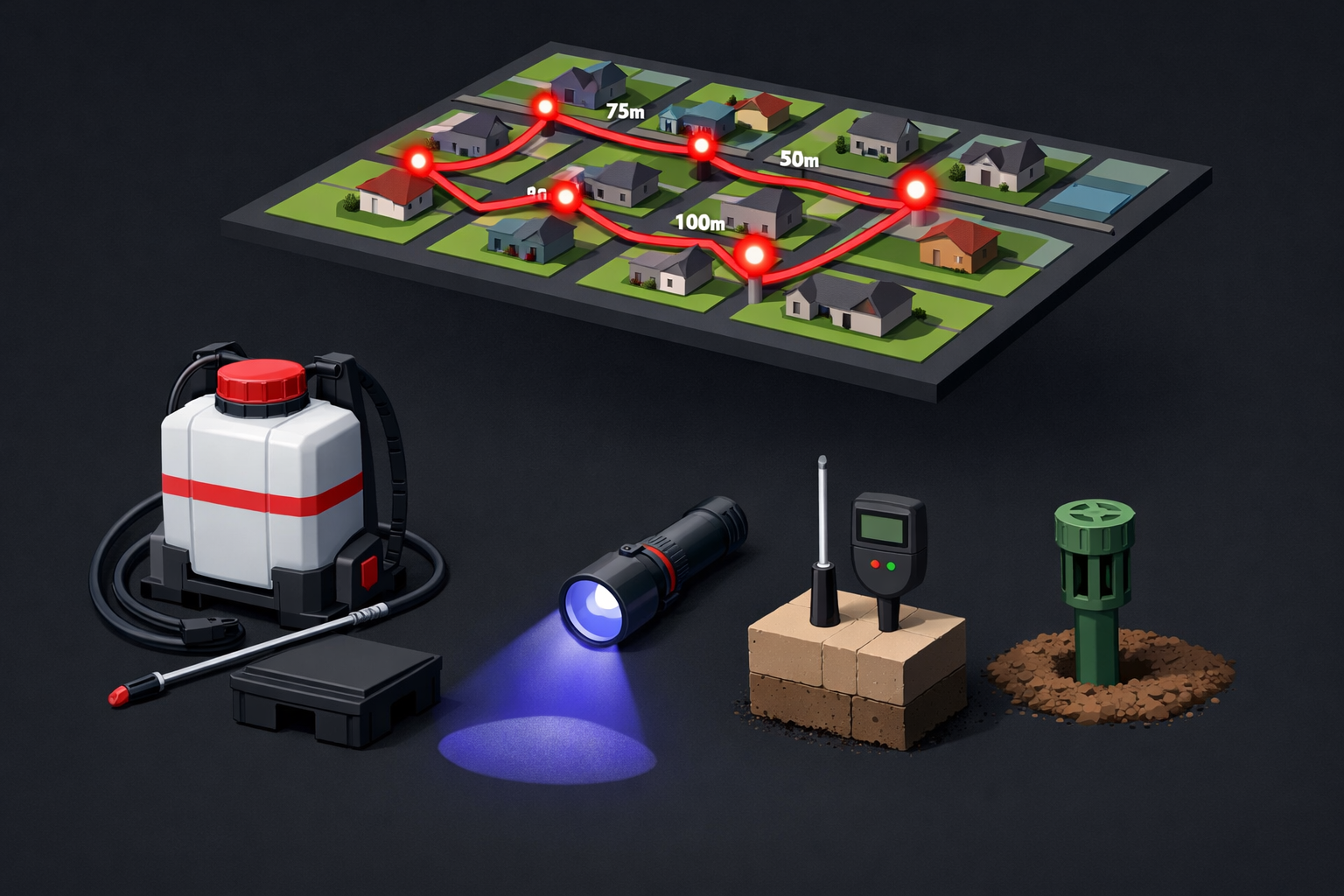
- AI route optimization engine that reduces drive time 20 to 30 percent by factoring in traffic, appointment windows, technician skills, and service requirements
- Predictive scheduling system that aligns treatment timing with weather patterns, seasonal pest data, and property-specific history
- IoT sensor integration for commercial accounts that monitors pest activity in real time and triggers service only when needed
- Automated inspection reporting with photo AI that identifies pest species, documents conditions, and generates compliance-ready reports
- Customer communication automation for service reminders, scheduling confirmations, treatment summaries, and seasonal pest alerts
- AI-powered phone answering and lead qualification that handles after-hours inquiries and schedules appointments without office staff
- Dynamic pricing engine that adjusts quotes based on property characteristics, pest type, treatment complexity, and competitive data
- Recurring service lifecycle automation managing renewal reminders, payment processing, and retention outreach
- Inventory and material forecasting that predicts chemical and equipment needs based on upcoming service schedules
- Technician performance analytics tracking completion rates, service times, callback rates, and customer satisfaction scores
- Integration with existing field service platforms like PestPac, ServSuite, FieldRoutes, and Briostack
AI Solutions for Pest Control Businesses
Route Optimization and Technician Dispatch
Route efficiency is the single largest operational lever in pest control. Your technicians spend 30 to 45 percent of their workday driving between stops. Every minute of drive time is a minute not spent servicing customers or generating revenue. Manual route planning, even by experienced dispatchers, leaves significant optimization on the table because the combinatorial complexity of routing 15 to 30 technicians across hundreds of daily stops exceeds human calculation ability.
Our AI routing systems process your full daily service schedule and generate optimized routes that account for factors no human dispatcher can juggle simultaneously. Appointment time windows. Technician certifications for specific treatment types. Equipment and material requirements that vary by service. Real-time traffic conditions. Proximity clustering that groups nearby stops. Drive time estimates that adjust for time of day. The algorithm evaluates millions of possible route combinations and selects the one that minimizes total drive time while respecting all constraints.
The impact is measurable from day one. Companies running our routing optimization consistently report 20 to 30 percent reductions in total drive miles. For a 15-truck operation averaging 200 miles per truck per day, that is 600 to 900 fewer miles driven daily. The savings compound across fuel, vehicle maintenance, insurance, and most importantly, technician productivity. Those recaptured hours become additional service stops. At an average revenue of $120 to $180 per residential stop, adding even one extra stop per technician per day generates $450,000 to $810,000 in additional annual revenue for a 15-technician company.
Routes also adapt dynamically. When a cancellation comes in, the system identifies the nearest technician with capacity and offers the slot to a waitlisted customer. When a same-day emergency request arrives, it is inserted into the route with the least disruption. Dispatchers see all of this on a real-time map dashboard and can override any routing decision with a single click.
Learn more about our scheduling and dispatch solutions | Workflow automation for service companies
Predictive Scheduling Based on Pest Activity
Calendar-based scheduling is the pest control industry's biggest hidden inefficiency. Treating every property on a fixed quarterly rotation ignores the reality that pest pressure varies dramatically by season, weather, geography, and property characteristics. Some properties need more frequent treatment during peak season and less during dormant months. Others have conditions that make them low-risk year-round. Treating every account identically wastes technician time on unnecessary visits while potentially under-serving properties that need more attention.
Our predictive scheduling system uses machine learning models trained on weather data, historical treatment records, regional pest activity reports, and property-specific variables to determine the optimal service timing for each account. The model considers temperature trends, precipitation patterns, humidity levels, proximity to water sources, property type (slab vs. crawlspace, urban vs. suburban), and past treatment efficacy data.
The practical result is a dynamic service calendar that shifts with conditions. During a wet spring with elevated mosquito and ant activity, the system schedules at-risk properties earlier and more frequently. During a dry, cold winter, it extends intervals for properties showing no activity, freeing those technician slots for new customer acquisitions or commercial work. The system does not make these decisions blindly. It presents recommendations to your scheduling team with supporting data so they can approve, adjust, or override as needed.
For commercial accounts, predictive scheduling is particularly powerful. Food service facilities, warehouses, and healthcare properties have zero tolerance for pest issues. Our system tracks activity trends at each commercial location and escalates proactively when patterns suggest emerging problems rather than waiting for the next scheduled inspection to discover an issue that has been developing for weeks.
Explore our AI marketing automation | Custom AI solutions for your business
IoT Monitoring for Commercial Accounts
Commercial pest management is evolving from scheduled inspections to continuous monitoring. IoT sensors placed at strategic locations throughout commercial facilities detect pest activity in real time and transmit data to a central dashboard. This shifts the service model from "we show up every Tuesday" to "we show up when the data tells us to." The result is better pest control with fewer unnecessary visits and faster response to emerging issues.
Our IoT integration platform connects sensor networks to your dispatch and scheduling systems. When sensors detect activity above threshold levels, the system automatically generates a service request, identifies the nearest qualified technician, and schedules an intervention. The commercial client receives a notification that activity was detected and service is being dispatched. This proactive response demonstrates a level of service quality that transforms your value proposition from commodity vendor to technology partner.
The data layer creates additional value. Over months of monitoring, the system builds a detailed activity profile for each commercial facility. It identifies seasonal patterns, correlates activity with external factors like nearby construction or weather events, and tracks the effectiveness of treatment protocols. This data supports audit compliance for food safety certifications, helps clients meet regulatory requirements, and provides documented evidence of proactive pest management that facility managers and corporate compliance teams value highly.
For pest control companies targeting commercial growth, IoT capability is a significant competitive differentiator. Most competitors are still offering the same scheduled inspection model that has not changed in decades. Offering data-driven monitoring positions your company as a technology-forward partner rather than a commodity service provider, which supports premium pricing and higher retention rates on commercial accounts.
Learn about custom AI solutions | AI data pipelines for real-time monitoring
AI Customer Service and Communication
Pest control has a communication challenge that is unique among service trades. Your customers contact you for two very different reasons. Scheduled service communication (reminders, confirmations, rescheduling) is routine and high-volume. Emergency pest sightings (found a snake in the garage, termite swarm on the patio) are urgent and emotionally charged. Both require fast, professional responses, but handling them through the same manual process overwhelms office staff and degrades service quality.
Our AI communication systems handle these differently based on context. Routine service communication is fully automated. Treatment reminders go out 48 and 24 hours before scheduled visits. Post-service summaries are generated from technician reports and sent within hours of completion. Recurring service renewal reminders trigger 30 days before contract dates. Seasonal pest awareness alerts position your company as a proactive partner. None of this requires office staff involvement.
For inbound inquiries, AI-powered phone and chat systems qualify the call, assess urgency, and route appropriately. A new lead inquiring about recurring service gets qualification questions and appointment booking. An existing customer reporting an urgent pest sighting gets immediate acknowledgment, an estimated response time, and automatic dispatch notification to the nearest available technician. An after-hours call about termite damage gets a next-morning callback scheduled with a follow-up text confirming the appointment.
The customer lifecycle automation extends to retention and reactivation. When a recurring customer misses a payment or declines renewal, the system initiates a multi-touch outreach sequence. When a one-time customer who called for a bed bug treatment 18 months ago has not purchased recurring service, the system sends a targeted offer based on their property profile and local pest conditions. These automated touchpoints generate revenue that most pest control companies leave uncaptured because they lack the systems to manage outreach at scale.
AI customer service solutions | Chatbot development for service businesses
Automated Inspection Reporting and Documentation
Documentation quality directly impacts commercial account retention, regulatory compliance, and liability protection. But asking technicians to spend 20 to 30 minutes per stop writing detailed inspection reports is neither practical nor productive. The result is usually rushed reports with minimal detail that satisfy the paper requirement but provide little actual value to the customer or the company.
AI-powered inspection tools transform this process. Technicians photograph conditions, activity evidence, and treatment areas using their mobile device. The AI system identifies pest species from photos, documents conditions in standardized language, notes compliance factors, and generates a professional report that can be delivered to the customer within hours of the visit. For commercial accounts subject to audit requirements, these reports include all required documentation fields, compliance checkboxes, and photographic evidence organized by inspection area.
The accuracy of photo-based pest identification has improved dramatically. Current AI models identify common pest species with over 90 percent accuracy from field photographs. The system flags uncertain identifications for human review rather than guessing. Over time, it learns from corrections and improves identification accuracy for your specific service region and common pest species.
Report data feeds into your analytics systems as well. Trends in inspection findings across properties, regions, and seasons become visible. You might discover that a specific neighborhood has elevated rodent activity that correlates with nearby construction, or that commercial kitchens serviced during certain months show higher activity patterns. These insights inform treatment protocols, marketing efforts, and resource allocation decisions.
Document processing and automation | Workflow automation solutions
Predictive Analytics and Business Intelligence
Pest control companies generate enormous amounts of data through daily operations. Service records, treatment histories, customer communications, financial transactions, routing data, and technician performance metrics. Most of this data sits unused in field service platforms and accounting systems. AI analytics turns that operational data into strategic intelligence.
Our analytics platforms connect to your existing systems and surface insights that drive better decisions. Customer lifetime value analysis reveals which acquisition channels produce the most profitable long-term customers. Service profitability modeling shows which service types, property types, and geographic areas generate the highest margins after accounting for travel time, material costs, and callback rates. Churn prediction identifies customers at risk of canceling based on communication patterns, payment behavior, and service satisfaction indicators.
Demand forecasting uses historical service data, weather patterns, and regional pest activity to project technician demand 30 to 90 days out. This informs hiring decisions, marketing spend, and fleet planning. Instead of being caught understaffed during spring ant season or overstaffed during winter slowdowns, you plan proactively based on data.
Technician performance analytics go beyond simple metrics like stops per day. The system evaluates callback rates by technician, average service duration versus complexity, customer satisfaction scores, upsell conversion rates, and route adherence. This data supports coaching conversations, identifies training needs, and helps you make informed decisions about technician assignments to maximize both efficiency and customer satisfaction.
What to Expect
Phase 1: Discovery and Assessment (Week 1-2)
We map your current operations in detail. How routes are planned, how scheduling works, what communication processes exist, and where the biggest time and money leaks are. We analyze your service data to identify optimization opportunities and establish baseline metrics. This assessment shapes every recommendation that follows.
Phase 2: System Design (Week 3-4)
We design the AI integration architecture specific to your operation. This includes tool selection, integration mapping, data flow documentation, and a phased deployment plan. Route optimization and scheduling are typically prioritized first because they deliver the fastest measurable ROI. You review and approve the design before development begins.
Phase 3: Build and Integration (Week 5-10)
Development proceeds in phases, starting with the highest-impact systems. Each component is tested against your actual operational data before deployment. Your team receives hands-on training as each system goes live. We integrate with your existing field service platform rather than replacing it, minimizing disruption to daily operations.
Phase 4: Launch, Optimization, and Support
After deployment, we monitor performance metrics and optimize based on real-world results. Route optimization improves as the system processes more of your geographic and traffic data. Predictive scheduling models become more accurate as they ingest more seasonal data. We provide ongoing support, quarterly reviews, and system updates to ensure your AI tools evolve with your business.
Transform Your Pest Control Operations
The pest control companies that will lead the market over the next decade are the ones investing in operational intelligence today. AI tools turn the data your business already generates into a competitive advantage that compounds over time. More efficient routes. Smarter scheduling. Better customer communication. Deeper insights. Running Start Digital builds these systems for pest control companies ready to operate at a higher level. Contact us to start your AI integration.