What We Build for Garage Door Companies
Every AI integration system is designed around your team size, service area, specializations, and existing business tools. Here is what a complete garage door AI technology program includes.
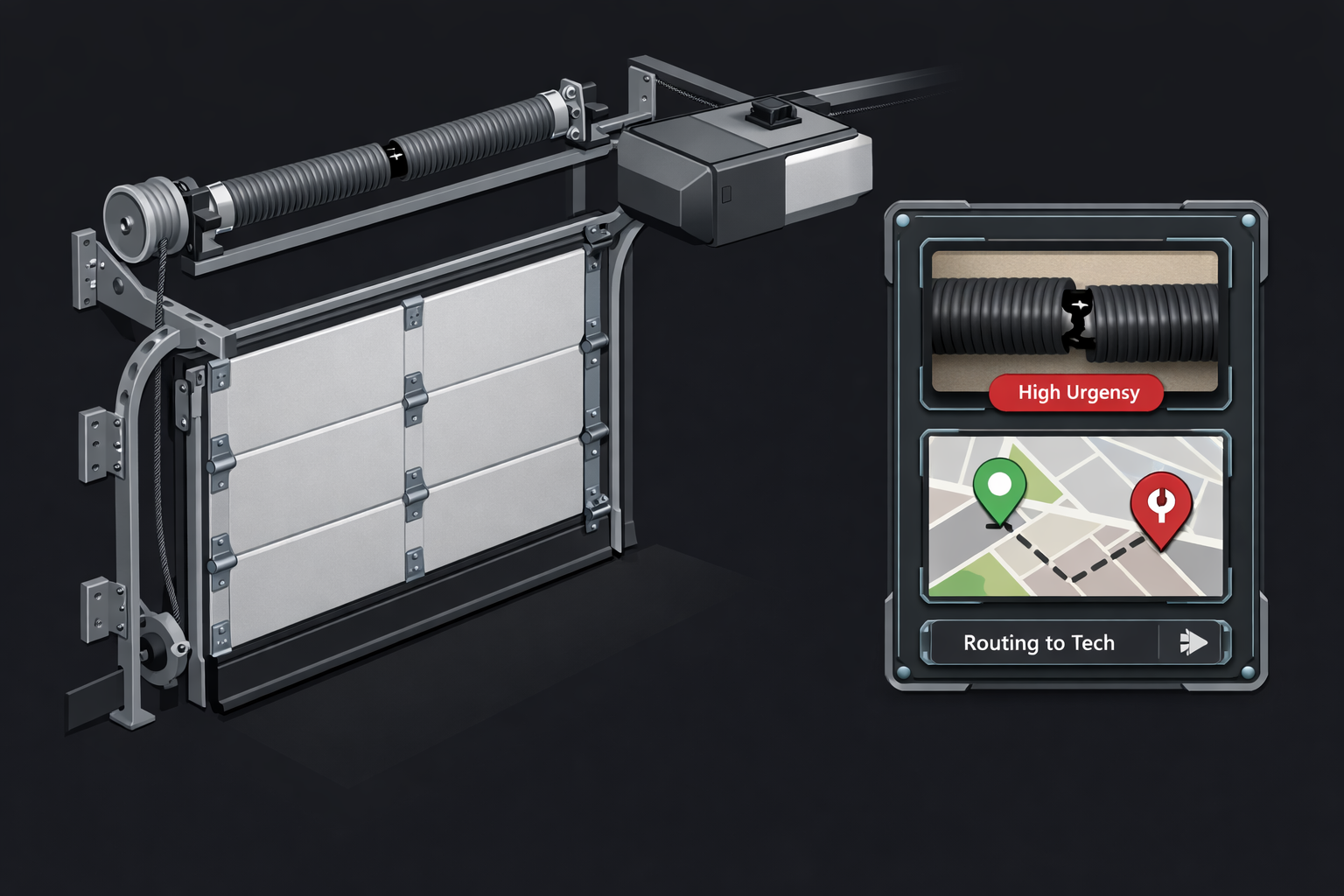
- AI-powered emergency dispatch that routes technicians based on real-time location, parts inventory on truck, skill set, and estimated drive time
- Predictive maintenance engine that analyzes door age, spring type, usage patterns, and environmental factors to forecast component failures before they happen
- Visual diagnostics AI that analyzes customer-submitted photos to triage urgency, identify likely issues, and pre-assign the correct parts and technician
- Parts inventory automation with demand forecasting that optimizes warehouse stock levels and individual truck inventories based on historical repair data and upcoming scheduled work
- Automated warranty tracking that monitors manufacturer warranty periods, service guarantee dates, and maintenance agreement renewals
- Customer communication automation including appointment confirmations, technician ETA updates, post-service follow-ups, and maintenance reminders
- Smart scheduling that balances emergency response capacity with proactive maintenance appointments to maximize daily revenue per technician
- CRM integration that connects customer history, door specifications, past repairs, and warranty status into a single accessible record
- AI-powered quoting that generates accurate repair and replacement estimates based on door specifications, component costs, and labor requirements
- Route optimization for multi-stop service days that reduces drive time and increases the number of completed jobs per technician
AI Solutions for Garage Door Operations
AI-Powered Emergency Dispatch
Emergency calls are the highest-value, most time-sensitive work in the garage door business. A broken spring call at 7 AM from a homeowner who needs to get to work is worth $350 to $500 in revenue if you can get there within the hour. Miss the window and they call your competitor. The speed and intelligence of your dispatch process directly determines how much emergency revenue you capture.
Traditional dispatch relies on human judgment under pressure. The dispatcher mentally sorts through technician availability, location, truck inventory, and urgency. This works when call volume is low. It breaks down during peak periods when multiple emergencies arrive simultaneously.
AI dispatch processes all variables in real time: every technician's GPS location, current traffic conditions, parts inventory on each truck, skill ratings by repair type, and existing scheduled appointments. The system generates an optimized dispatch recommendation within seconds. Your dispatcher confirms with a single click. Response time drops from 60 to 90 minutes to 30 to 45 minutes. First-visit completion rates increase because the right technician with the right parts shows up the first time.
The system also handles after-hours triage, evaluating whether a 10 PM call truly requires immediate response (security issue, vehicle trapped) or can wait until morning (cosmetic damage, slow opener). This prevents unnecessary overtime dispatch while ensuring genuine emergencies get immediate attention.
Learn more about AI customer service solutions | Booking and scheduling systems
Predictive Maintenance Scheduling
Predictive maintenance is the single biggest business model transformation available to garage door companies. It shifts your revenue mix from unpredictable emergency calls to scheduled, planned work with higher margins and better customer retention.
The concept is straightforward. Every garage door component has a predictable lifespan based on usage and environmental factors. A standard residential torsion spring rated for 10,000 cycles will last approximately 7 to 10 years for a household that uses the door 3 to 4 times daily. An opener motor in a hot climate degrades faster than one in a temperate region. Rollers in a coastal environment corrode faster than those in a dry inland market. With the right data points, failure timing becomes predictable within a useful window.
The AI system builds a maintenance profile for each customer based on their door specifications, installation date, repair history, usage estimates, and local climate data. It calculates estimated remaining life for each major component. When a component enters its predicted failure window, the system automatically generates a maintenance recommendation and schedules an outreach to the customer.
This proactive approach delivers multiple business benefits. First, planned maintenance visits are more profitable than emergency repairs because you schedule them efficiently during open calendar slots, reducing windshield time. Second, customer retention increases dramatically. A homeowner who receives a call saying "your spring is approaching the end of its rated life, let us replace it on your schedule before it breaks" becomes a loyal customer. They never experience the frustration of a morning breakdown. Third, you smooth your revenue curve. Instead of feast-or-famine emergency call patterns, you fill slow days with scheduled maintenance that generates consistent revenue.
The data compounds over time. As you service more doors and track more outcomes, the prediction accuracy improves. After two years of operation, the system's failure predictions become remarkably precise for the door types and climate conditions in your specific service area.
Learn more about predictive analytics | AI data pipeline solutions
Visual Diagnostics and Remote Triage
When a customer calls about a garage door problem, the first minute shapes the entire service experience. If the dispatcher identifies the likely issue and sends the right technician with the right parts, the repair goes smoothly. If they guess wrong, the customer waits another day for a second visit. Trust evaporates.
AI visual diagnostics bridges this gap. The customer sends a photo or short video through text, your website, or a customer portal. The AI analyzes the image and identifies the problem: a crooked door suggests a broken cable, a door stopping partway up indicates a spring or track issue, grinding opener sounds point to a stripped gear, and dented panels are matched against replacement specifications for that door model.
The diagnostic output goes to your dispatcher with a confidence rating and recommended parts list. High-confidence identifications allow immediate technician assignment. Lower-confidence situations generate follow-up questions for the dispatcher to clarify before dispatching.
First-visit repair completion rates increase from the industry average of 75 to 80 percent to over 90 percent. Every avoided second visit saves a truck roll, protects your reviews, and improves customer satisfaction.
Learn more about computer vision solutions | Custom AI tools for your business
Parts Inventory Automation
Parts inventory management is a hidden cost center for most garage door companies. The typical service truck carries $2,000 to $5,000 in parts inventory. A company with 6 trucks has $12,000 to $30,000 in rolling inventory that needs to be managed, replenished, and tracked. The warehouse adds another $20,000 to $50,000 in stock. Getting inventory wrong in either direction costs money.
Running out of a common spring size on a service call means a return trip to the warehouse and a second visit to the customer. That return trip costs $30 to $50 in fuel and labor, delays the repair, and frustrates the customer. Across a year, if each technician makes two unnecessary return trips per week, a 6-truck operation wastes $18,000 to $30,000 annually on avoidable logistics.
AI inventory systems track several data streams to optimize stock levels. They monitor which parts each technician uses by frequency and job type. They analyze upcoming scheduled work to predict tomorrow's likely parts needs. They factor in seasonal patterns: spring replacements spike in spring and fall when temperature fluctuations stress metal components. Commercial accounts with known door specifications allow the system to pre-stage parts for scheduled service visits.
The warehouse stocking algorithm balances carrying costs against stockout risk, considering lead times, volume pricing, and seasonal forecasts. The result: carrying costs drop 15 to 25 percent while stockout-related return trips decrease by over 60 percent. For most garage door companies, optimized inventory management pays for the entire AI system within the first year.
Learn more about workflow automation | Business software solutions
Warranty Tracking and Maintenance Agreement Management
Warranty management is administrative work that directly impacts revenue and customer retention, yet most garage door companies handle it manually with spreadsheets or basic calendar reminders. A missed warranty claim costs your customer money and damages trust. A forgotten maintenance agreement renewal means lost recurring revenue.
AI warranty management systems track every warranty automatically. When a technician installs a new door, opener, or spring, the system records the installation date, warranty period from the manufacturer, any extended warranty purchased by the customer, and your company's labor warranty terms. It creates a timeline of coverage for every component on every customer's door.
When a customer calls with an issue, the system instantly surfaces their warranty status. The dispatcher knows before the technician arrives whether the repair is covered by manufacturer warranty, your service guarantee, or is billable to the customer. This eliminates the awkward "I need to check on that and call you back" that erodes customer confidence.
For maintenance agreements, the system tracks contract dates, visits completed versus contracted, and upcoming renewals. It generates renewal outreach automatically 60 days before expiration, including a service summary and savings comparison. Renewal rates increase from the industry average of 55 to 65 percent to over 80 percent with this proactive approach.
The system also identifies upsell opportunities during warranty periods. A customer whose door is approaching the end of its manufacturer warranty is a prime candidate for an extended service plan. A customer whose spring warranty is expiring is a candidate for a preemptive spring replacement at a maintenance visit rather than waiting for a future emergency.
Learn more about AI document processing | AI customer service tools
What to Expect
Phase 1: Operations Audit (Weeks 1-2)
We analyze your current dispatch process, service call data, inventory management, warranty tracking, and customer communication workflows. We review your service call history to identify patterns in emergency timing, common repair types, parts usage, and geographic distribution of customers. We evaluate your existing software tools and identify integration points for AI systems.
Phase 2: System Architecture (Weeks 2-3)
We deliver a prioritized implementation plan based on the audit findings. Most garage door companies see the fastest ROI from dispatch optimization and parts inventory management, so these typically launch first. Predictive maintenance requires building the data foundation during early months and delivers its highest value after 6 to 12 months of operation. The plan includes technology specifications, integration requirements, training schedules, and projected returns for each component.
Phase 3: Build and Deploy (Weeks 3-10)
Systems deploy in sequence. Dispatch optimization and customer communication automation launch first because they deliver immediate value with minimal disruption to existing workflows. Parts inventory tracking integrates with your existing warehouse and truck management processes. Visual diagnostics requires initial training on your most common door types and repair scenarios. Predictive maintenance begins accumulating the data it needs to generate accurate forecasts. Each deployment phase includes team training and a supported transition period.
Phase 4: Data Accumulation and Optimization
AI systems improve with data. The dispatch optimizer learns your service area's traffic patterns and typical repair durations. The inventory system refines its predictions as it observes actual parts usage across seasons. The predictive maintenance engine becomes increasingly accurate as it tracks component failures against its predictions. We review system performance monthly and adjust configurations to maximize efficiency and revenue impact.
Dispatch and communication improvements show results within the first two weeks. Inventory optimization delivers measurable savings within 60 to 90 days. Predictive maintenance reaches full effectiveness after 6 to 12 months of data collection.
Run a Smarter Garage Door Business
Emergency response will always be the backbone of garage door service. But the companies that grow beyond a handful of trucks are the ones that add predictable, planned revenue alongside emergency work. AI gives you that capability. Predict failures before they happen. Dispatch the right technician instantly. Stock the right parts on every truck. Communicate proactively with every customer. Running Start Digital builds these systems for garage door companies that want to grow without the chaos. Designed for how your dispatchers think, how your technicians work, and how your customers expect to be served.
Explore workflow automation solutions | See how we help HVAC companies