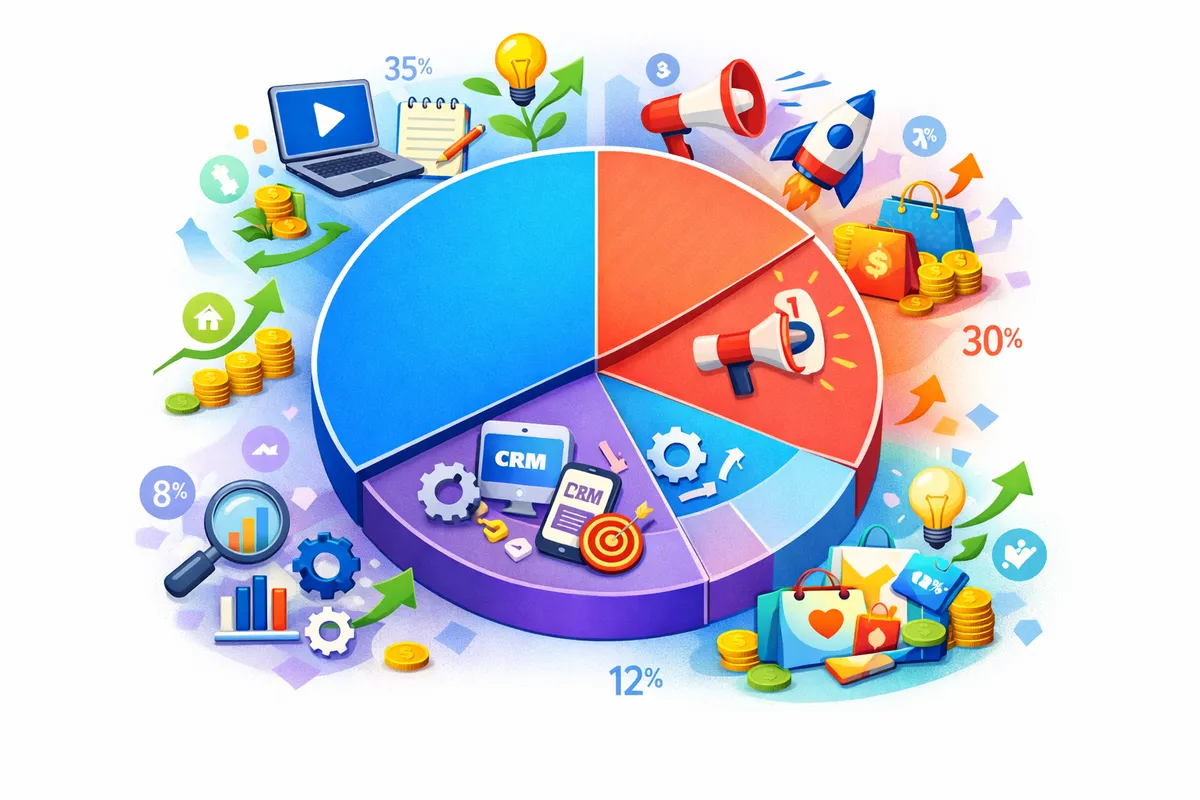
How to Allocate Your Marketing Budget
Knowing the total is only half the equation. How you distribute that budget across channels determines your return. The most common mistake is spreading budget evenly across every channel. Concentrated investment in 2 to 3 proven channels consistently outperforms scattered spending.
Content Marketing and SEO: 25% to 40% of Budget
This allocation funds blog posts, landing pages, website copy, pillar content, and search engine optimization. Content is the foundation of long-term customer acquisition because you own these assets permanently. A blog post that ranks on Google continues generating leads for years without additional investment.
What this buys at different budget levels:
- At $500/month: 2 blog posts/month + basic on-page SEO
- At $1,500/month: 4 blog posts/month + technical SEO audit + keyword targeting
- At $3,000/month: 8 blog posts/month + comprehensive SEO services + link building
- At $5,000/month: Full content marketing program with pillar content, topic clusters, and strategic SEO
Content and SEO are the highest-priority allocation for businesses with a 12-month or longer time horizon. The compound return is unmatched: a business investing $2,000/month in content for 18 months builds an asset library that generates leads at $15 to $40 each, compared to $80 to $200 per lead through paid advertising.
Paid Advertising: 20% to 35% of Budget
Paid advertising on Google, Facebook, Instagram, LinkedIn, or TikTok delivers immediate visibility and fast customer acquisition. It is the fastest way to test messaging, identify high-intent keywords, and generate leads while organic channels build.
What this buys at different budget levels:
- At $500/month: One platform (Google Ads or Facebook), testing phase, 50-100 clicks/month
- At $1,500/month: One to two platforms, enough data for meaningful optimization, 200-400 clicks/month
- At $3,000/month: Multi-platform campaigns with retargeting, A/B testing, landing page optimization
- At $5,000+/month: Full PPC advertising management with aggressive scaling on proven channels
The minimum viable ad spend depends on your industry. Google Ads in competitive markets (legal, insurance, home services) require $2,000 to $3,000/month to generate enough data for optimization. Less competitive markets can produce meaningful results at $500 to $1,000/month.
A critical rule: never spend more on ads than you spend on conversion optimization. Driving 1,000 visitors to a website that converts at 1% produces 10 leads. Improving that site to 3% conversion produces 30 leads from the same traffic. Conversion optimization multiplies the return on every advertising dollar.
Email Marketing: 10% to 20% of Budget
Email marketing investment covers your email platform (Mailchimp, ConvertKit, Klaviyo), list-building tools, and content creation for sequences and campaigns. This channel delivers the highest average ROI ($36 return per $1 spent) and should be part of every small business marketing budget regardless of size.
What this buys at different budget levels:
- At $200/month: Email platform + one automated sequence (welcome series or post-purchase)
- At $500/month: Platform + 3 to 4 automated sequences + monthly newsletter
- At $1,000/month: Full email marketing program with segmentation, A/B testing, and campaign management
- At $2,000+/month: Advanced automation with behavioral triggers, personalization, and lifecycle marketing
Even at the lowest budget level, email marketing pays for itself quickly. A local service business sending one monthly email to a 500-person list generates 3 to 8 bookings per send at typical conversion rates. At an average service value of $200, that is $600 to $1,600 from a $200 investment.
Brand and Website: 10% to 20% of Budget
This allocation covers website design and maintenance, logo and brand identity, photography, and graphic design. Unlike recurring channel investments, brand spending is often front-loaded: you invest heavily in year one and maintain in subsequent years.
Year-one priorities:
- Professional website design ($3,000 to $15,000 depending on complexity)
- Brand identity (logo, color palette, typography): $1,000 to $5,000
- Professional photography: $500 to $2,000
- Site speed optimization: $500 to $2,000
Ongoing maintenance:
- Website hosting and updates: $100 to $300/month
- Design support for marketing materials: $200 to $500/month
Cheap branding hurts more than most businesses realize. A $200 logo signals "budget operation" to every prospect who visits your website. Professional brand presentation does not require luxury-level investment, but it does require intentional design that communicates competence and trustworthiness.
Tools, Analytics, and CRM: 5% to 15% of Budget
The infrastructure that makes your marketing measurable and manageable. Without these tools, you are guessing about results and manually executing tasks that should be automated.
Essential tools by budget level:
- $100/month: Google Analytics (free) + basic email platform + social scheduling tool
- $300/month: CRM (HubSpot free tier or Pipedrive) + email platform + analytics + scheduling
- $700/month: Full CRM + marketing automation + analytics suite + project management
- $1,500+/month: Enterprise CRM + AI marketing automation + CRM and martech consulting
The right tools save time that more than justifies their cost. A CRM that prevents one lost deal per month (because a follow-up reminder fires automatically) pays for itself many times over. Marketing automation that sends personalized emails based on customer behavior generates revenue without manual effort.
Social Media: 5% to 15% of Budget
Social media investment covers content creation, scheduling tools, community management, and potentially social media marketing management. The allocation depends heavily on whether social media is a primary customer acquisition channel for your business type.
- B2C businesses with visual products: 15% (social is a primary channel)
- B2B professional services: 5% to 10% (LinkedIn only, focused on thought leadership)
- Local service businesses: 5% (minimal, focused on review generation and community engagement)
Budget Allocation by Business Type
Different business models have different channel economics. Here are specific allocation frameworks for common small business types.
Service Businesses (Consulting, Agencies, Freelancers)
| Channel | % of Budget | Why |
|---|---|---|
| Content/SEO | 35% | Thought leadership drives trust and inbound leads |
| Email marketing | 20% | Nurtures long sales cycles, maintains relationships |
| Paid ads (LinkedIn/Google) | 20% | Targets high-intent searches and specific job titles |
| Brand/website | 15% | Professional presentation is essential for credibility |
| Tools | 10% | CRM and automation support relationship management |
E-Commerce (Physical or Digital Products)
| Channel | % of Budget | Why |
|---|---|---|
| Paid ads (Meta/Google Shopping) | 35% | Direct-response advertising drives product sales |
| Email marketing | 25% | Repeat purchases and cart recovery are highest ROI |
| Content/SEO | 20% | Product and category pages drive organic traffic |
| Social media | 10% | Visual platforms showcase products |
| Tools | 10% | Analytics and automation optimize performance |
Local Services (Plumbing, HVAC, Cleaning, Landscaping)
| Channel | % of Budget | Why |
|---|---|---|
| Local SEO/Google Ads | 35% | High-intent local searches drive emergency and planned service calls |
| Reputation management | 20% | Reviews directly impact local search rankings and conversion |
| Content/website | 20% | Service pages and blog posts capture local search traffic |
| Email marketing | 15% | Seasonal reminders and maintenance programs drive repeat business |
| Tools | 10% | Scheduling, CRM, and review management |
SaaS (Software as a Service)
| Channel | % of Budget | Why |
|---|---|---|
| Content/SEO | 35% | Long sales cycles require educational content at every stage |
| Paid ads (Google/LinkedIn) | 25% | Targets specific search intent and decision-maker titles |
| Email marketing | 15% | Trial nurturing, onboarding, and expansion revenue |
| Product/brand | 15% | Free trial experience and brand perception drive conversion |
| Tools | 10% | Product analytics, marketing automation, attribution |
Budget by Growth Stage
Your marketing budget should evolve as your business grows. What works at $100K revenue is wrong at $1M.
Pre-Revenue / Pre-Product-Market Fit
Total budget: $0 to $500/month. Do not invest in marketing until you have confirmed that people will pay for your product or service. Spend your time (not money) on customer discovery interviews, landing page tests, and direct outreach. The only marketing investment justified at this stage is a basic website ($1,000 to $3,000 one-time) that explains what you offer.
Startup Phase ($50K to $200K Revenue)
Total budget: $500 to $1,500/month. Focus on one primary acquisition channel. If you are a local business, invest in local SEO and Google Business Profile optimization. If you are B2B, invest in content and LinkedIn. If you are e-commerce, invest in one paid ad platform. Do not split attention. Prove one channel works before adding a second.
At this stage, founder time is your primary marketing investment. Writing blog posts, responding to reviews, emailing prospects, and posting on social media costs time but not cash. The monetary budget supplements your time investment with tools, professional help for your website, and a small ad spend for testing.
Growth Phase ($200K to $1M Revenue)
Total budget: $1,500 to $8,000/month (7% to 10% of revenue). You have validated at least one acquisition channel. Now invest in scaling it while testing a second. Hire your first marketing help, either a part-time contractor or an agency for your primary channel.
This is the stage where tracking becomes critical. You must know your customer acquisition cost by channel, your customer lifetime value, and your payback period. These numbers determine whether increasing marketing spend will accelerate growth or accelerate losses.
Scale Phase ($1M to $5M Revenue)
Total budget: $5,000 to $25,000/month (5% to 10% of revenue). Multiple channels are working. Your marketing team (in-house or agency) executes playbooks. Your focus shifts from finding what works to optimizing what works and building systems that scale.
At this stage, lead generation systems, marketing automation, and predictive analytics become viable investments that improve efficiency. The goal is not to spend more per lead but to generate more leads at the same or lower cost.
Mature Phase ($5M+ Revenue)
Total budget: $25,000 to $50,000+/month (5% to 8% of revenue). Efficiency matters more than experimentation. Optimize unit economics across all channels. Invest in brand building that supports premium pricing. Explore new markets or segments with controlled test budgets.
Common Budgeting Mistakes That Waste Money
Spreading budget too thin. $1,000/month split across 5 channels means $200/month per channel. That is not enough to generate meaningful results on any single platform. Concentrate your budget on 2 channels maximum until each is producing proven returns.
Cutting marketing during slow periods. Marketing is not an expense you reduce when times are tight. It is the investment that prevents slow periods. Businesses that maintain marketing spend during downturns consistently outperform competitors who cut. The competitor who stops advertising gives you their market share.
Expecting immediate ROI from every channel. Paid ads can show returns in weeks. SEO takes 4 to 8 months. Content marketing takes 6 to 12 months. Brand building compounds over years. Each channel has a different timeline, and evaluating all channels on a 30-day ROI window leads to underinvestment in the channels that deliver the best long-term returns.
Ignoring existing customers. Acquiring a new customer costs 5 to 7 times more than retaining an existing one. Yet most budgets allocate 80% or more to acquisition and almost nothing to retention. Email marketing to your current customer base, loyalty programs, and referral incentives are among the highest-ROI marketing investments available.
Not tracking results by channel. If you cannot attribute revenue to specific marketing activities, you cannot make informed budget decisions. Every marketing dollar should be traceable to a lead, a sale, or at minimum a measurable engagement metric. Without attribution, you are allocating budget based on gut feeling.
Building a Budget You Can Actually Execute
Start with a number you can commit to for 6 months without anxiety. Marketing requires consistency to produce results. A $1,000/month budget maintained for 6 months produces dramatically better results than a $3,000/month budget maintained for 2 months.
Allocate 70% to your primary channel, 20% to a secondary channel, and 10% to tools and measurement. After 3 months, review the data. If your primary channel is working, increase its allocation. If it is underperforming, adjust the strategy before abandoning the channel.
Track three numbers every month: total marketing spend, new customers acquired, and cost per customer. These three metrics tell you whether your marketing investment is productive. Everything else, impressions, clicks, followers, shares, is supporting data, not the scorecard.
Frequently Asked Questions
Is 5% of revenue really enough for marketing?
For mature businesses with strong word-of-mouth, established market position, and steady demand, 5% maintains your presence and supports modest growth. For businesses actively trying to grow, 7% to 10% is more realistic. For businesses launching new products, entering new markets, or competing against well-funded competitors, 12% to 15% may be necessary in the first 12 to 18 months. The right percentage depends on your growth goals, competitive landscape, and the efficiency of your marketing channels.
Should I invest in marketing before I have product-market fit?
No. Marketing amplifies your product. If the product does not solve a real problem for a willing buyer, marketing just accelerates the rate at which people discover it does not work for them. Validate your product through direct customer conversations, small-scale testing, and manual sales before investing in marketing infrastructure. Once you have 10 to 20 paying customers acquired through non-scalable methods, you have enough signal to start investing in scalable marketing.
How do I justify marketing spend to partners or investors?
Present marketing as a customer acquisition investment with measurable returns. "We spend $X per month on marketing. This generates Y leads per month. Z of those leads convert to customers worth $W each. Our return on marketing investment is A:1." If you cannot present this data, implement tracking first. Investors and partners respond to unit economics (CAC, LTV, payback period), not vanity metrics.
What is the first thing I should spend money on?
Your website. Before any recurring marketing spend, invest in a website that clearly communicates your value proposition, loads fast, and makes it easy for visitors to take action. Every other marketing channel drives traffic to your website. If the website does not convert, every marketing dollar is partially wasted. A professional, conversion-focused website is the foundation that makes all other marketing investments more effective.
How quickly should I increase my marketing budget as revenue grows?
Increase marketing spend in proportion to proven results, not in proportion to revenue. If your marketing is generating a 3:1 return (every $1 produces $3 in revenue), increase the budget by 20% to 30% quarterly as long as the return ratio holds. If returns start declining (usually due to market saturation or audience exhaustion), hold steady and optimize before increasing further. Never increase budget faster than your ability to track and attribute results.
Should I hire a marketing person or outsource to an agency?
At marketing budgets below $5,000/month, outsource to specialized freelancers or a small agency. A $5,000/month in-house hire (roughly $60,000/year salary) is a generalist who knows a little about everything but is not expert in anything. That same $5,000 split between an SEO specialist, a content writer, and a PPC manager gets you expert execution on three channels. Above $8,000 to $10,000/month in marketing spend, an in-house marketing manager who coordinates external specialists and owns strategy becomes cost-effective.