AI Tools That Are Working Right Now
AI Site Assessment from Satellite Imagery
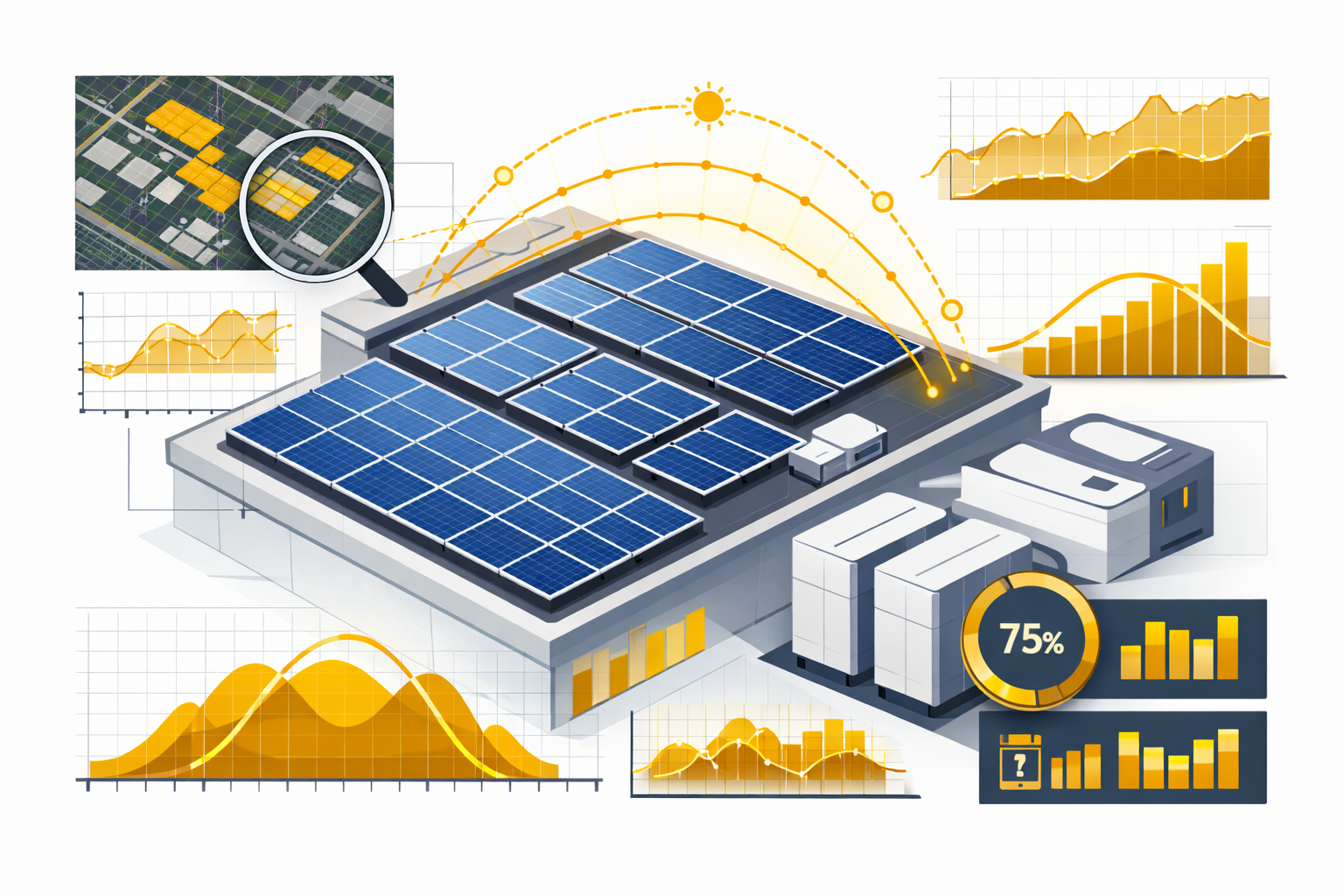
The biggest time sink in residential solar sales is the site visit. AI-powered satellite assessment eliminates the need for an initial visit on most projects. Computer vision models analyze high-resolution satellite and aerial imagery to identify roof dimensions, orientation, pitch angle, and available mounting area. These systems can evaluate a property in under 60 seconds and produce a preliminary design that would have taken a designer 45 minutes.
The accuracy has reached the point where many companies skip the pre-sale site visit entirely and only send a crew for final verification before installation. This alone can cut customer acquisition costs by 30 to 40 percent. See how computer vision works for trade businesses.
Automated Shading Analysis
Shading is the single biggest variable in solar system performance, and manual shading analysis is both time-consuming and prone to error. AI shading tools use a combination of satellite imagery, LiDAR data, and 3D modeling to map shade patterns across every hour of every day throughout the year.
The AI accounts for trees, neighboring structures, chimneys, and other obstructions that would require hours of on-site measurement with traditional tools. It also factors in tree growth projections and seasonal sun path changes. The result is a shading report that is more accurate than what a technician can produce with a Solar Pathfinder and more consistent across your entire sales team.
System Sizing Optimization
Traditional system sizing follows a conservative formula. Calculate the customer's energy usage, apply a production ratio, and size the system to offset a target percentage. AI sizing tools go further by analyzing granular utility rate structures, time-of-use patterns, net metering policies, battery storage economics, and the customer's actual load profile.
The AI can model dozens of system configurations in seconds. It evaluates different panel counts, string configurations, inverter options, and battery combinations to find the design that maximizes the customer's financial return. Not just the one that offsets their bill, but the one that generates the best ROI given their specific rate structure and consumption patterns.
This matters because a system that is optimally sized and configured can deliver 10 to 15 percent better economics than a standard design. That difference often makes the sale.
AI-Generated Energy Production Estimates
Customers make buying decisions based on energy production estimates. If your estimates are wrong, you either lose the sale or lose the customer's trust after installation. AI production models combine site-specific data (shading, orientation, tilt, local weather patterns) with equipment performance curves and degradation rates to generate estimates that are consistently within 3 to 5 percent of actual production.
These models improve over time by comparing predictions against actual monitored output across your installed fleet. The more systems you install and monitor, the more accurate your future estimates become. This creates a competitive advantage that compounds.
Permit Document Automation
Permitting is the hidden cost center in solar installation. The average residential permit package requires structural calculations, electrical diagrams, site plans, equipment specifications, and compliance documentation. Many companies employ dedicated staff just to handle permit applications.
AI document processing tools can generate complete permit packages from your system design in minutes rather than hours. They pull equipment specifications, apply local code requirements, generate single-line diagrams, and format everything to match the specific requirements of each jurisdiction. When a jurisdiction changes its requirements, the AI updates its templates automatically. Explore our document processing automation services.
Predictive Maintenance for Installed Systems
Every installed system is a recurring revenue opportunity and a potential liability. AI monitoring platforms analyze inverter data, module-level production, and weather conditions to identify performance degradation before it becomes a customer complaint.
The AI detects patterns that indicate specific failure modes. A gradual production decline in one string might indicate a cracked cell. Sudden intermittent drops could signal a loose connection. Production that does not recover after cloud events might point to an inverter fault. The system flags these issues and prioritizes them by severity and financial impact.
For companies managing hundreds or thousands of systems, this is the difference between reactive service calls and proactive maintenance schedules that reduce truck rolls and improve customer satisfaction.
AI-Powered Lead Qualification Scoring
Not every lead is worth a site visit. AI lead scoring models analyze incoming leads against dozens of variables to predict which ones will convert. Roof age, home value, energy costs, geographic location, credit indicators, engagement patterns with your website and communications.
The model learns from your historical data. It knows which lead sources produce buyers, which property characteristics correlate with good solar sites, and which behavioral signals indicate purchase intent. Sales teams that implement AI lead scoring typically see conversion rates improve by 20 to 35 percent because they focus their time on leads that are most likely to close. Learn how AI customer service tools can improve your lead response.
What Custom AI Integration Looks Like
Off-the-shelf solar software handles the basics. Aurora, Helioscope, and similar platforms include some AI features. But custom AI integration connects these tools to your specific business processes in ways that generic software cannot.
A custom integration might connect your CRM lead data to your design tool and your permitting workflow. When a qualified lead comes in, the AI automatically generates a preliminary design, estimates production, creates a proposal, and queues the permit package. Your sales rep reviews and personalizes the proposal rather than building it from scratch.
Another example. Connecting your monitoring platform to your service scheduling system so that when the AI detects a performance anomaly, it automatically creates a service ticket, assigns a crew based on location and availability, and notifies the customer. No manual triage required.
The goal is not to replace your team's expertise. It is to eliminate the manual handoffs and data entry that slow everything down. See our full workflow automation capabilities.
Running Start Digital builds these integrations for solar companies by connecting the tools you already use with custom AI logic that matches your specific sales process, design standards, and service protocols.
Results You Can Expect
Solar companies implementing AI across their operations are seeing measurable improvements at every stage of the business.
Sales efficiency. AI site assessment and lead scoring reduce customer acquisition cost by 25 to 40 percent. Sales teams handle more leads with fewer site visits and produce more accurate proposals in less time.
Design throughput. Automated shading analysis and system sizing increase design capacity by 3 to 5x per designer. A team of two designers can handle the volume that previously required six.
Permitting speed. AI document generation cuts permit preparation time from 4 to 8 hours per project to under 30 minutes. This accelerates your entire project timeline and reduces overhead labor costs.
Installation quality. Better system designs mean fewer change orders in the field. AI-optimized string configurations and equipment matching reduce installation time and improve long-term performance.
Maintenance revenue. Predictive monitoring enables proactive service contracts that generate recurring revenue while reducing emergency service calls by 40 to 60 percent.
Customer trust. Production estimates within 3 to 5 percent of actual output build referral-worthy relationships. Customers who see their system performing as promised become your best marketing channel.
The solar companies that adopt AI tools now will have a significant operational advantage over those that wait. The data advantages compound over time, and the efficiency gains create margin that can be reinvested in growth. Explore booking and scheduling automation for your service teams.
Frequently Asked Questions
How much does AI integration cost for a solar company?
The investment depends on scope. Basic AI tools like satellite-based site assessment are available as SaaS subscriptions starting around $200 to $500 per month. Custom integrations that connect your CRM, design tools, permitting workflow, and monitoring systems range from $5,000 to $25,000 depending on complexity. Most companies see positive ROI within 2 to 4 months from reduced labor costs and faster close rates alone.
Can AI really replace a manual site visit?
For initial assessment and proposal generation, yes. AI satellite analysis is accurate enough that many companies now skip the pre-sale site visit entirely. A verification visit before installation is still standard practice, but eliminating the initial assessment visit saves 1 to 2 hours per lead and removes a major scheduling bottleneck from the sales process.
How accurate are AI energy production estimates?
Modern AI production models are consistently within 3 to 5 percent of actual output when provided with accurate site data. This is comparable to or better than manual estimates from experienced solar designers. The models improve as they incorporate real-world performance data from your installed systems.
Does AI work with our existing solar design software?
Most AI tools integrate with popular solar design platforms like Aurora Solar, Helioscope, and OpenSolar through APIs. Custom integrations can connect additional business systems like your CRM, accounting software, and project management tools. The goal is to enhance your current workflow rather than replace it.
What data do we need to get started with AI monitoring?
If you have inverter-level monitoring on your installed systems, you already have the core data needed for AI-powered predictive maintenance. Module-level monitoring from optimizers or microinverters provides even better diagnostic capability. The AI works with data from all major inverter brands including Enphase, SolarEdge, SMA, and others. See our predictive analytics services.
How long does it take to implement AI tools for a solar business?
Basic SaaS tools can be set up in a few days. A full custom integration connecting your sales pipeline, design workflow, permitting process, and monitoring system typically takes 4 to 8 weeks depending on the complexity of your existing systems and the number of integrations required. Running Start Digital handles the implementation so your team stays focused on installations.