What We Build for Pool and Spa Companies
Every AI system is designed around your service area, account mix (residential vs. commercial), team size, and growth plans. Here is what a complete pool service AI technology program includes.
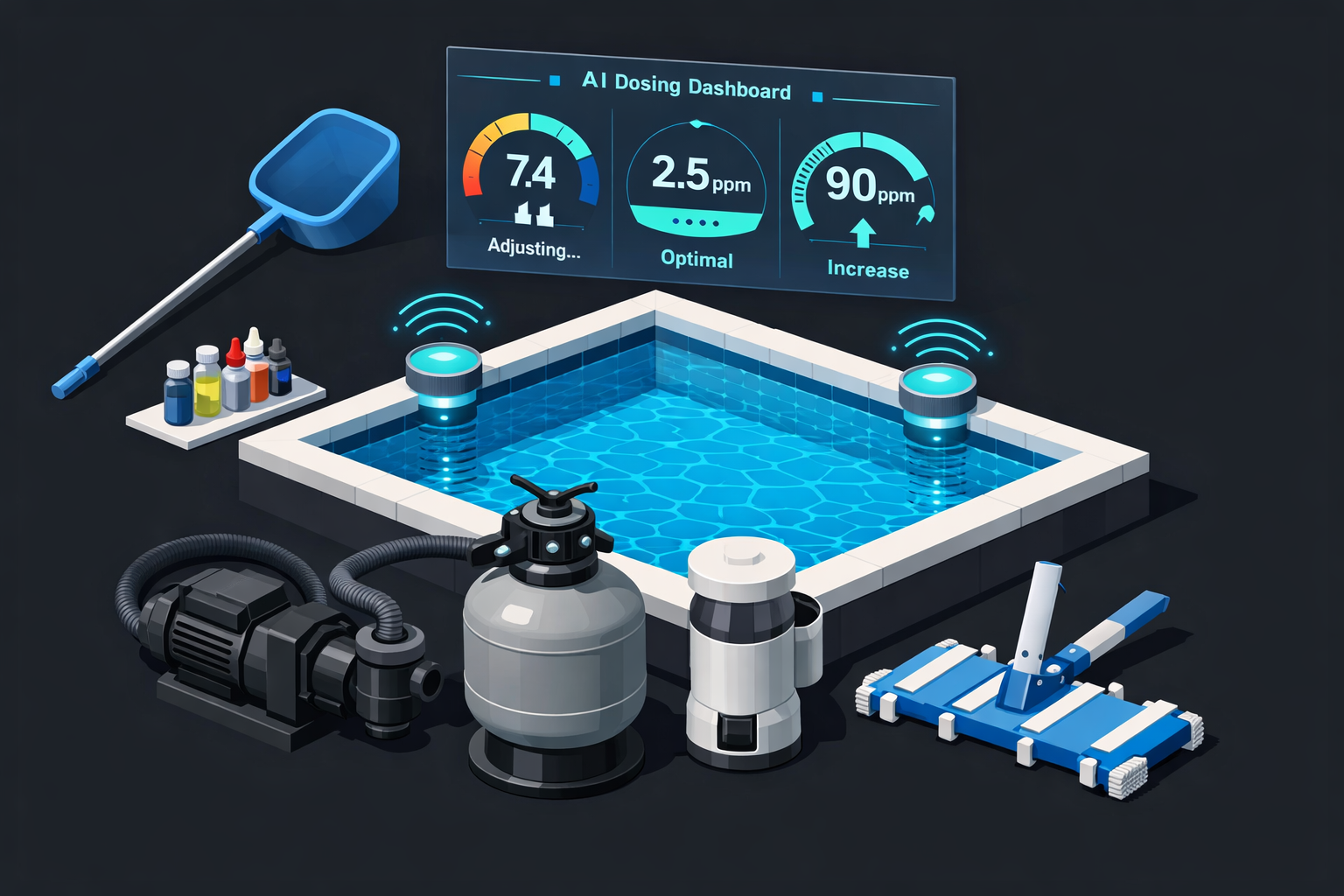
- AI water chemistry analysis that generates precise chemical dosing recommendations based on test results, pool volume, surface type, and environmental factors
- IoT pool monitoring systems with remote sensors tracking water chemistry, temperature, pump operation, and filter pressure between service visits
- Route optimization that plans the most efficient daily service routes, accounting for drive time, service duration, chemical resupply needs, and priority scheduling for problem pools
- Predictive maintenance for pumps, filters, heaters, salt cells, and automation systems based on runtime data, age, and performance trends
- Automated customer reporting that delivers professional service summaries after every visit including test results, chemicals applied, equipment status, and recommendations
- Seasonal scheduling automation for pool openings, closings, and weekly service that distributes workload optimally across your technician team
- Chemical inventory management that tracks usage by route and pool, predicts resupply needs, and optimizes purchasing to reduce waste and cost
- Commercial compliance tracking that monitors health code requirements, documents regulatory inspections, and maintains chemical handling records
- Equipment lifecycle tracking that records installation dates, maintenance history, and warranty status for every piece of equipment on every customer's pool
- Customer communication automation including service confirmations, seasonal reminders, equipment recommendations, and billing notifications
AI Solutions for Pool and Spa Operations
AI Water Chemistry Analysis
Water chemistry is the technical core of pool service. Getting it right means crystal clear water, healthy swimmers, and protected equipment. Getting it wrong means algae, cloudy water, skin irritation, corroded heaters, stained surfaces, and unhappy customers. The challenge is that correct treatment depends on understanding the relationships between multiple chemical parameters that interact with each other.
pH affects chlorine efficacy. Alkalinity buffers pH. Calcium hardness protects surfaces. Cyanuric acid stabilizes chlorine against UV breakdown. An experienced technician develops intuition for these relationships over years. An AI system applies the full chemistry model to every pool on every visit, delivering precise treatment recommendations in seconds.
The technician tests water and enters results into the mobile app (or results sync from a connected digital tester). The AI analyzes the complete chemical profile against pool-specific parameters: volume, surface type, equipment, historical trends, and weather conditions. The output is a specific dosing recommendation: exact chemical quantities, adjusted for all interacting parameters. This precision prevents both undertreating and overtreating, saves chemicals, and ensures consistent quality across your entire route.
The system also identifies emerging problems before they become visible. Rising phosphate trends signal developing algae risk. Declining salt cell output suggests scaling. Persistent high pH despite acid additions may indicate a CO2 or surface buffering issue. These pattern recognitions enable proactive treatment that prevents callbacks.
Learn more about AI data pipelines | Custom AI solutions for pool businesses
IoT Remote Pool Monitoring
Weekly service visits leave six days between each check on a pool's condition. A lot can go wrong in six days. A pump failure goes undetected until the water turns green. A chemical imbalance from a heavy use weekend develops into a full algae bloom. A heater malfunction in a spa creates a safety hazard. By the time the technician arrives for the regular visit, what should have been a 30-minute service call has become a 2-hour recovery requiring extra chemicals, equipment troubleshooting, and a disappointed customer.
IoT monitoring systems close this visibility gap. Connected sensors installed at the pool monitor key parameters continuously: free chlorine or ORP (oxidation-reduction potential), pH, water temperature, pump run status, filter pressure, and flow rate. The data transmits to the AI monitoring platform every 15 to 60 minutes depending on the sensor configuration.
The AI layer analyzes incoming data against established baselines for each pool. When free chlorine drops below the target range, the system alerts the assigned technician. When filter pressure rises above normal operating range indicating a need for cleaning, the system logs the alert and schedules the maintenance task. When the pump stops running during its scheduled cycle, indicating a potential failure, the system generates an immediate notification.
Remote monitoring transforms the service model. It prevents emergencies by catching problems early. It enables premium service tiers at $50 to $100 per month above standard weekly rates. It makes every service visit more efficient because the technician arrives knowing exactly what the pool needs.
Commercial accounts benefit most. Health codes require compliant chemical parameters at all times. IoT monitoring ensures compliance issues are addressed immediately, protecting both the facility operator and your reputation.
Learn more about predictive analytics | AI customer service solutions
Route Optimization
Route efficiency is the fundamental economics of pool service. A technician who services 14 pools in 8 hours is more profitable than one who services 11 pools in the same time, assuming equal service quality. The difference usually comes down to drive time between stops. A technician spending 45 minutes per day driving between pools loses nearly 100 hours per year to windshield time. Reduce that to 25 minutes per day and you gain the equivalent of 12 additional service days per year per technician.
AI route optimization considers variables that manual route planning cannot efficiently process. It accounts for real-time traffic patterns by time of day, not just distance. It factors in service duration estimates based on each pool's typical needs. It considers chemical resupply requirements. If a technician's truck will run out of liquid chlorine after the eighth pool, the route includes a stop at the supply warehouse positioned to minimize backtracking. It prioritizes problem pools that need more attention while ensuring routine accounts stay on schedule.
The system handles daily route changes dynamically. Cancellations, additions, and emergency calls trigger automatic recalculation to minimize disruption.
Seasonal transitions create the most dramatic value. During opening season, every customer wants their pool opened within two weeks. Openings take 45 to 90 minutes versus 20 to 30 for weekly service, fundamentally changing route capacity. The AI clusters geographic zones, sequences tasks efficiently, and accounts for the longer service duration. The same logic applies to closing season.
For growing companies, route optimization models the impact of adding new accounts: how many routes are affected, whether a new technician is needed, and marginal cost per account. This prevents growing faster than operational capacity allows.
Learn more about workflow automation | Booking and scheduling systems
Predictive Equipment Maintenance
Pool equipment fails in predictable patterns. Variable speed pumps have motor bearing lifespans that correlate with runtime hours and ambient temperature. Sand filters lose effectiveness as media compresses over 3 to 5 years of use. Salt chlorine generators develop calcium scale buildup that reduces output based on water chemistry and cell age. Heaters experience heat exchanger degradation related to water chemistry balance and usage patterns. Natural gas heaters in coastal environments corrode faster than those in dry inland climates.
AI predictive maintenance tracks equipment performance to forecast failures. For IoT-connected equipment, data collection is automatic: pump amperage, filter pressure trends, heater differentials, and salt cell output. For other equipment, technician observations during visits feed the model.
The system builds degradation curves for each piece of equipment. Rising pump amperage indicates bearing wear. Declining salt cell output triggers cleaning or replacement recommendations based on whether the pattern matches scaling or end-of-life decline. The system estimates remaining useful life and recommends proactive scheduling.
Predictive maintenance creates two revenue opportunities. It generates proactive equipment sales at premium margins. And it prevents the relationship damage when equipment fails unexpectedly. A customer who receives a recommendation to replace their heater before summer sees you as a trusted advisor, not the company that let their equipment break.
The system also tracks warranty periods and flags coverage status before repairs are quoted, ensuring customers receive entitled coverage.
Learn more about predictive analytics | Business software solutions
Automated Customer Reporting
Service transparency builds customer trust and justifies premium pricing. Pool owners want to know what happened during their service visit, what the water chemistry looks like, and whether any issues need attention. Delivering this information consistently across every customer on every visit is impractical with manual processes. A technician servicing 15 pools per day cannot write detailed reports for each one. But an AI system that compiles the data the technician already captures into a professional report can.
The system generates service summaries after every visit: color-coded chemistry results, chemicals applied with explanations, equipment observations, photos, and proactive recommendations. Reports deliver automatically by email or customer portal within hours of the visit.
For commercial accounts, reports create a continuous compliance record for health department inspections. The system also identifies upsell opportunities naturally. When data shows high phosphate trends or equipment nearing end of life, the report includes objective, data-backed recommendations that customers receive far more positively than a sales pitch.
Learn more about AI customer service | Chatbot development for pool businesses
What to Expect
Phase 1: Operations Assessment (Weeks 1-2)
We analyze your current service operations: route structure, chemistry management practices, equipment tracking methods, customer communication processes, and technology stack. We review your account data to understand the mix of residential and commercial accounts, geographic distribution, seasonal workload patterns, and revenue per route. We identify the specific operational bottlenecks where AI integration delivers the highest return.
Phase 2: System Design (Weeks 2-4)
We deliver a prioritized implementation plan. Route optimization and automated reporting typically launch first because they deliver immediate value with minimal workflow disruption. AI chemistry analysis integrates during a training period where technicians use the tool alongside their existing methods to build confidence. IoT monitoring deploys incrementally, starting with premium accounts and problem pools. The plan includes technology specifications, integration points with your existing pool service software, and training schedules for each team role.
Phase 3: Implementation (Weeks 4-12)
Systems deploy in phases timed to your seasonal calendar. Route optimization launches before opening season when scheduling complexity is highest. Chemistry analysis rolls out during the weekly service season when technicians can practice with the tool daily. IoT monitoring sensors install on new and renovated pools first, then expand to existing accounts on a priority basis. Customer reporting launches as soon as chemistry analysis is active, since the reports draw directly from the test result data. Each phase includes hands-on training and a supported adoption period.
Phase 4: Scaling and Seasonal Optimization
The AI systems reach peak performance after one full seasonal cycle. Route optimization learns your market's traffic patterns across all seasons. Chemistry analysis accumulates pool-specific data that improves dosing recommendations. Predictive maintenance models build equipment performance baselines. We review system performance after each seasonal transition and adjust configurations for the upcoming season. The optimization is continuous: each year's data makes the next year's operations more efficient.
Route optimization shows measurable drive time reduction within the first week. Chemistry analysis delivers consistent dosing improvements within the first month. Predictive maintenance reaches reliable forecasting after 6 to 12 months of equipment monitoring data.
Build a Scalable Pool Service Operation
The pool companies that grow from 200 accounts to 800 accounts without losing service quality are the ones that invest in operational intelligence. Consistent chemistry. Efficient routes. Proactive equipment maintenance. Professional customer communication. These are not things that scale with manual processes. They scale with AI systems designed specifically for how pool service operates. Running Start Digital builds these systems for pool and spa companies that want to grow their route density and their reputation at the same time. Built around the chemistry, the seasonality, and the route economics that define your business.
Explore workflow automation solutions | See how we help landscaping companies