What We Build for Moving Companies
Every engagement is scoped to your operation. Local residential, long-distance, commercial, specialty items, or full-service. Here is what a comprehensive AI integration looks like:
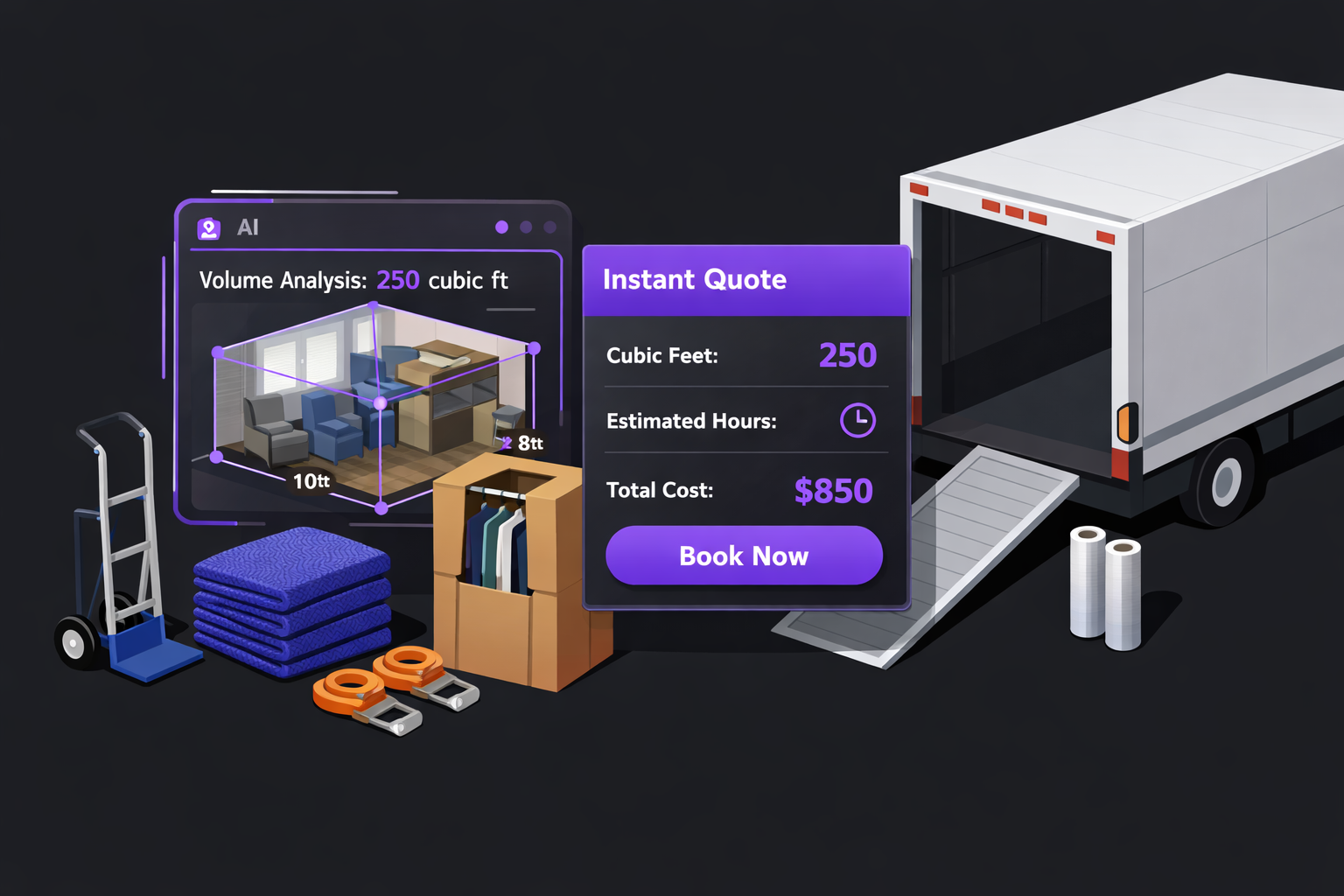
- AI visual estimating system that generates detailed inventory lists and cost estimates from customer smartphone photos
- Logistics optimization for truck routing, crew allocation, and multi-stop move planning
- CRM automation managing the full lead-to-booking sales cycle with intelligent follow-up sequences
- Inventory tracking system with item-level documentation, condition recording, and chain of custody
- Automated damage documentation with timestamped photo evidence at pickup and delivery
- Dynamic pricing models that adjust for seasonality, demand, distance, complexity, and competitive positioning
- Customer communication automation for booking confirmations, pre-move instructions, day-of updates, and post-move follow-up
- AI-powered phone and chat systems that handle inquiries and capture leads 24/7
- Crew performance analytics tracking move times, customer satisfaction, damage rates, and efficiency
- Storage facility management with inventory tracking and automated client communication for items in storage
- Financial analytics showing profitability by move type, distance category, lead source, and season
- Integration with existing platforms like MoveitPro, Granot, SmartMoving, Supermove, and others
AI Solutions for Moving Companies
AI-Powered Visual Estimating
Estimating is the single biggest bottleneck in the moving business sales funnel. Every lead needs an estimate. Every estimate requires assessing the customer's belongings, calculating volume, pricing labor and transportation, and presenting a quote. Traditional in-home estimates are thorough but slow and expensive. A company handling 30 estimate requests per week needs multiple full-time estimators just to keep up, and each no-sale visit is sunk cost.
Our AI visual estimating system fundamentally changes this equation. The customer receives a link to a guided photo capture process. They photograph each room following simple prompts: living room from two angles, bedroom from the doorway, kitchen including cabinets, garage overview. The AI system analyzes these photos to identify and catalog items. It recognizes furniture types (sofa, dining table, bookshelf), estimates dimensions, flags specialty items requiring special handling, and calculates total cubic footage with detailed item counts.
The system accounts for items that are not visible in photos as well. A guided questionnaire asks about closet contents, items in drawers, seasonal items in storage, and garage or shed contents that may not have been photographed. The AI combines photo analysis with questionnaire responses to build a comprehensive inventory estimate.
Your sales team receives a detailed estimate package: itemized inventory list, total cubic footage calculation, recommended truck size, estimated crew requirements, and a preliminary price range based on your rate structure. The sales rep reviews the estimate, makes judgment-based adjustments (the customer mentioned their grandmother's china collection needs extra packing, the third-floor walkup will slow the crew), and presents a final quote. The entire process takes 20 to 30 minutes of human time compared to 2 to 3 hours for a traditional in-home estimate.
For long-distance moves where in-home estimates are geographically impractical, AI visual estimating is transformative. You can accurately estimate and book moves across the country without sending anyone to the origin location. This dramatically expands your addressable market and eliminates the geographic limitations that constrain growth for long-distance movers.
The system also tracks accuracy over time. As completed moves are reconciled against AI estimates, the model learns which item types it tends to over- or under-estimate and self-corrects. After processing 100 to 200 completed moves, the AI typically achieves accuracy within 5 to 8 percent of actual volume, rivaling experienced human estimators.
Custom AI solutions for your business | Business software for moving companies
Logistics Optimization and Crew Dispatch
Moving logistics involve a set of constraints that standard routing software cannot handle. A 26-foot truck has different access limitations than a cargo van. A 4-person crew on a large residential move has a fundamentally different time profile than a 2-person crew on an apartment move. Multi-stop moves with a storage facility in between require sequencing that accounts for storage facility hours, dock availability, and load configuration. Long-distance moves require DOT compliance, driver hour tracking, and fuel stop optimization.
Our logistics AI handles all of these variables. For each move on the schedule, the system calculates optimal crew size based on estimated volume and property characteristics (stairs, elevator access, walk distance, parking conditions). It selects the right truck from your fleet based on load size and access requirements. It generates time estimates for loading, transit, and unloading based on your historical performance data for similar moves. And it builds the daily schedule across your entire fleet to maximize utilization and minimize deadhead miles.
Multi-day scheduling across your full fleet is where the logistics AI creates the most value. A moving company running 8 trucks needs to balance local moves that complete in a single day with long-distance moves that take multiple days. Trucks returning from long-distance moves need backhaul loads or return routes that pick up new moves along the way. Commercial moves scheduled for weekends need crews that are not already committed to Saturday residential jobs. The AI evaluates all of these constraints simultaneously and builds schedules that human dispatchers simply cannot optimize at the same level of complexity.
Dynamic rescheduling handles the inevitable disruptions. A crew running two hours behind on a morning load triggers automatic notifications to the afternoon move customer with an updated arrival window. A truck breakdown routes the affected moves to alternative vehicles with capacity. A same-day booking request is evaluated against current fleet positions and crew availability to determine whether it can be accommodated without disrupting committed jobs.
Scheduling and dispatch solutions | Workflow automation for movers
CRM Automation for the Moving Sales Cycle
The moving industry has one of the most complex sales cycles in home services. The average customer contacts 4 to 8 moving companies, waits for estimates, compares pricing and reviews, and takes 1 to 4 weeks to make a decision. During that window, the company that maintains the best communication wins more often than the company with the lowest price. But managing consistent follow-up across 50 to 100 active leads at any given time overwhelms office staff who are also handling bookings, dispatch, and customer service for active moves.
Our CRM automation system manages the entire lead lifecycle without dropping a single touchpoint. When a new inquiry comes in, whether by phone, web form, or email, the system captures details, sends an immediate acknowledgment, and initiates the estimate process. After the estimate is delivered, automated follow-up sequences begin. The cadence and messaging adapt based on the lead's behavior: whether they opened the estimate email, whether they visited your website again, whether they requested a revised quote, and how much time has passed since last contact.
The system handles objection-based follow-up as well. A lead who says "your price is too high" receives different follow-up than one who says "we haven't decided on our moving date yet." The automation sequences are built around the common objections and decision factors in the moving purchase decision: price comparison, timing uncertainty, anxiety about damage, and trust concerns. Each sequence provides relevant information (insurance coverage details, customer testimonials, packing guides) timed to address the specific hesitation.
Post-booking communication is equally automated. Confirmation details, pre-move preparation checklists, packing timelines, day-of-move logistics, and payment reminders all go out at the right time without office staff writing individual emails. On moving day, real-time updates keep the customer informed about crew arrival time, progress, and estimated completion.
Post-move follow-up closes the loop. Satisfaction surveys, review requests, referral incentives, and thank-you messages are triggered automatically based on move completion. For customers who are moving locally and might need services again (or who have friends and family who will), the system maintains long-term nurture sequences that keep your company top of mind for referrals.
AI marketing automation for your business | AI customer service solutions
Inventory Tracking and Damage Documentation
Damage claims are the moving industry's most persistent financial and reputational liability. The average damage claim costs $200 to $1,500 in direct compensation, but the reputational cost of a negative review citing damaged belongings is far higher. Most damage disputes come down to one question: was the item damaged during the move, or was it already damaged? Without documentation, this becomes an unwinnable argument.
Our inventory tracking system creates a digital chain of custody for every item. At pickup, the crew photographs and catalogs items using their mobile device. The AI system identifies item types, records condition from photos, and notes any pre-existing damage. The customer confirms the inventory digitally. At delivery, the process repeats: items are checked against the pickup inventory, condition is re-documented, and the customer signs off on receipt.
When a damage claim occurs, you have timestamped photographic evidence from both ends of the move. This documentation resolves disputes faster, reduces fraudulent claims, and provides evidence for insurance purposes. It also identifies patterns. If a specific crew or truck has elevated damage rates, the data reveals it before the pattern becomes a financial problem.
For high-value and specialty items, the system provides enhanced tracking. Antiques, artwork, electronics, and fragile items receive individual condition documentation with multiple angles. The customer receives a detailed condition report for these items as part of the move documentation. This level of professionalism reinforces the trust that customers need when handing over their most valued possessions.
Commercial moves benefit from inventory tracking at the organizational level. Office furniture, IT equipment, and document boxes are tracked with location tags so that delivery at the destination follows the floor plan. The system generates unpacking guides organized by room and department, reducing the time the client's team spends directing movers and getting back to productive work.
AI document processing | Custom AI solutions
Dynamic Pricing and Revenue Optimization
Moving companies face a pricing challenge that is unique among service businesses. Every job is different, demand varies dramatically by season and day of week, and customers are price-sensitive but also willing to pay premiums for trust and convenience. A flat rate card cannot capture this complexity. Pricing that is too simple leaves money on the table during peak season and loses bids during slow periods.
Our dynamic pricing engine generates optimized quotes based on multiple factors. Job characteristics: volume, distance, access conditions, specialty items, packing requirements. Market conditions: seasonal demand patterns, local competitive pricing, day-of-week demand. Customer profile: lead source, move timeline, expressed budget sensitivity. Historical performance: actual costs for similar moves in your database.
The system implements tiered pricing strategies. Premium pricing during peak moving season (May through September) when demand exceeds supply. Competitive pricing during off-peak months to maintain crew utilization. Mid-week discounts that incentivize customers to choose lower-demand days, smoothing your weekly workload. Last-minute booking surcharges that compensate for schedule disruption. Each pricing lever is configurable and transparent to your sales team.
Revenue optimization goes beyond individual job pricing. The system analyzes your overall book of business to identify revenue opportunities. Backhaul matching pairs long-distance moves in opposite directions to eliminate empty return trips. Storage upsell identification flags customers who might benefit from temporary storage during their transition. Packing service attachment rates are optimized by testing different offer presentations and timing.
Predictive analytics | Business software for moving companies
Predictive Analytics and Business Intelligence
Moving companies make strategic decisions about fleet size, crew staffing, marketing spend, and geographic expansion. These decisions should be driven by data, but most moving companies rely on gut instinct and last year's revenue numbers. AI analytics transforms your operational data into strategic intelligence.
Our analytics platform connects to your CRM, dispatch system, financial records, and operational databases. The dashboards surface the insights that drive better decisions. Lead conversion rates by source, showing which marketing channels produce customers who actually book. Job profitability by move type, distance, and season, revealing where your best margins are. Crew productivity analysis comparing revenue generated per labor hour across different team configurations. Customer lifetime value for repeat movers and referral networks.
Demand forecasting is critical for a seasonal business like moving. Our models analyze historical booking patterns, local real estate transaction data, college enrollment cycles, military transfer schedules, and corporate relocation trends to project demand 30 to 90 days out. This forecast drives staffing decisions (when to hire seasonal crews and when to scale back), marketing spend allocation (increase digital advertising 6 weeks before peak season, not during it), and fleet planning (when to add rental trucks to supplement your fleet).
Competitive intelligence tracks your market position. The system monitors competitor pricing, review scores, and service offerings across your market area. You see where you are priced above or below market, where your review scores compare favorably, and where competitive gaps create opportunities for differentiation.
Predictive analytics solutions | AI data pipeline development
What to Expect
Phase 1: Discovery and Assessment (Week 1-2)
We examine your entire operation from lead intake through post-move follow-up. How estimates are built, how moves are scheduled and dispatched, how crews are allocated, how customers are communicated with, and where the biggest operational pain points are. We analyze your data to identify optimization opportunities and set baseline performance metrics.
Phase 2: System Design (Week 3-4)
Based on discovery findings, we design your AI integration architecture. Tool selection, integration mapping, data flows, and a phased deployment plan are all documented and reviewed with your team. For most moving companies, visual estimating and CRM automation deliver the fastest ROI and are prioritized for early deployment.
Phase 3: Build and Integration (Week 5-12)
Moving company implementations tend to be slightly longer than other trades because of the logistics optimization complexity. Development proceeds in phases: estimating and CRM first, followed by logistics optimization and inventory tracking. Each system is tested with your real move data before going live. Your team receives hands-on training as each component launches.
Phase 4: Launch, Optimization, and Support
Post-deployment optimization is particularly important for moving companies because the AI models improve significantly with data volume. Visual estimating accuracy increases with every completed move that is reconciled against the AI estimate. Route optimization improves as the system processes more of your geographic and timing data. We provide ongoing support, performance reviews, and system updates throughout the engagement.
Move Your Business Forward with AI
The moving companies that will lead the market are the ones that pair excellent service with intelligent operations. AI gives you the ability to estimate faster, schedule smarter, communicate better, protect against damage claims, and make data-driven decisions about growth. Running Start Digital builds these systems for moving companies ready to compete at the highest level. Contact us to start your AI integration.