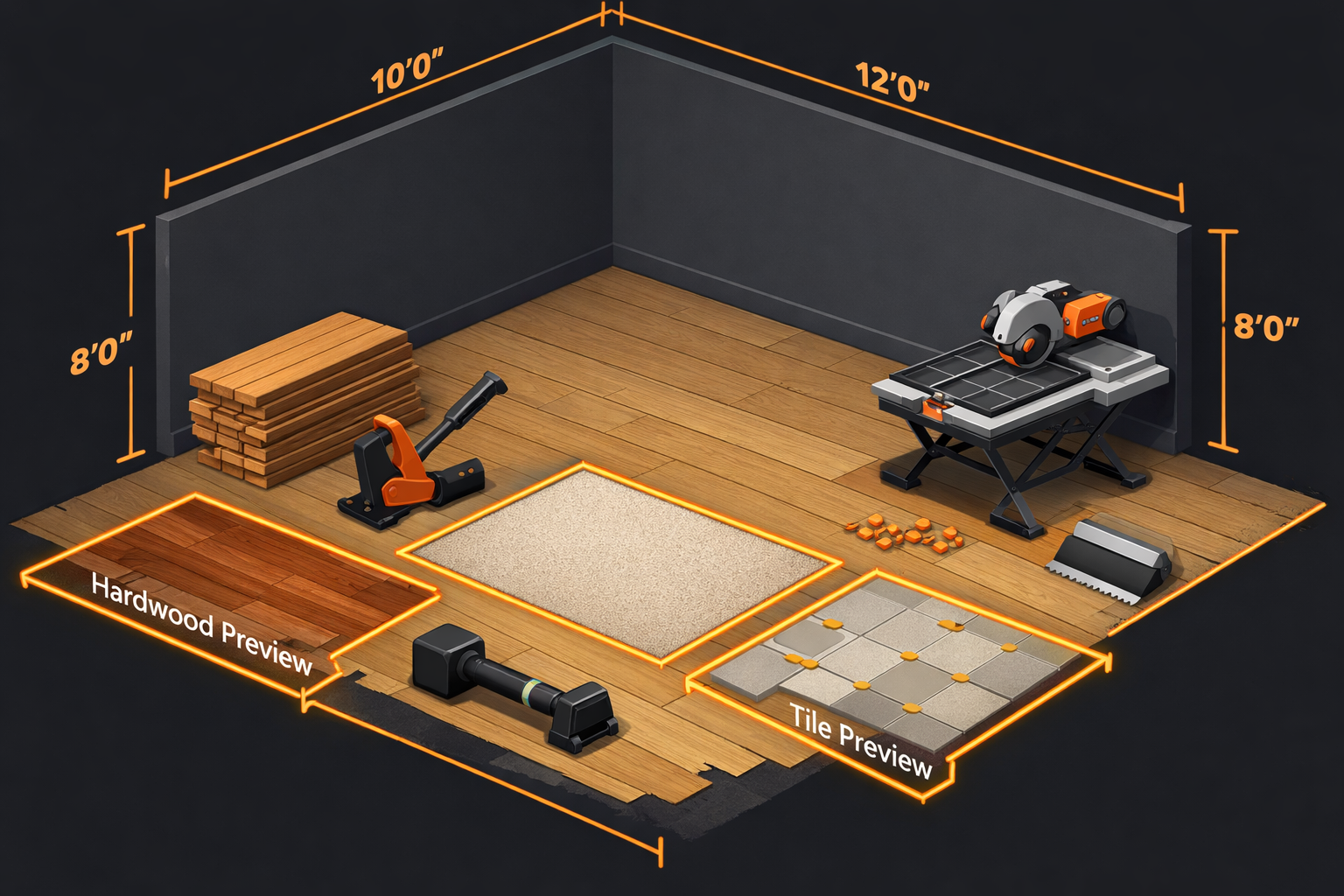
What We Build for Flooring Companies
Every AI integration system is designed around your specific product mix, team size, service area, and operational workflow. Here is what a complete flooring AI technology program includes.
- Computer vision measurement systems that calculate room dimensions and square footage from smartphone photos, reducing the need for in-person measurement visits on straightforward projects
- AR visualization tools that let customers preview flooring options in their actual rooms through a smartphone or tablet camera, increasing close rates and average project values
- Automated quoting engines that combine AI-measured dimensions with real-time material pricing, labor rates, and waste factors to generate accurate estimates in minutes instead of hours
- Inventory management systems with demand prediction that forecast material needs based on historical sales patterns, seasonal trends, and current pipeline
- AI-powered cutting optimization that calculates the most efficient material usage for each room layout, reducing waste percentages and saving thousands annually
- Project scheduling systems that match installer skill sets to product types, optimize daily route planning, and account for material delivery timing
- Customer communication automation that sends project updates, installation day preparation instructions, and post-installation care guides without manual effort
- CRM integration connecting estimates, approvals, scheduling, and invoicing into a single workflow
- Visual project documentation using AI to organize before-and-after photos, warranty records, and material specifications for each completed job
- Supplier integration that automates purchase orders based on confirmed projects and optimizes ordering quantities across multiple active jobs
AI Solutions for Flooring Operations
Computer Vision Measurement
The traditional flooring measurement process requires sending an estimator to every home, often scheduling the visit 3 to 5 days after the customer's initial inquiry. That delay costs jobs. Customers who wait too long for an estimate often get competing bids or lose motivation. Computer vision measurement systems change this dynamic fundamentally.
The technology works through a simple process. The customer takes photos of each room with their smartphone. The AI system analyzes the images to identify room boundaries, doorways, closets, and architectural features. It calculates total square footage with accuracy rates that consistently reach 95 to 98 percent for standard room layouts. For complex spaces with irregular angles, bay windows, or built-in features, the system flags those areas for manual verification while still providing an accurate baseline measurement.
This capability transforms your sales process. You provide preliminary estimates within hours instead of days. Speed wins deals: the first company to deliver a professional estimate captures the job 60 to 70 percent of the time. Your estimators spend their time on product consultation and design advice rather than basic measurement. You qualify leads remotely before committing to an in-person visit. And the system builds a measurement database that improves over time as you complete more projects.
Learn more about computer vision solutions | Custom AI solutions for your business
AR Room Visualization
Augmented reality visualization is the single most powerful sales tool available to flooring companies today. When a homeowner can point their phone at their living room floor and see exactly how a medium-tone engineered oak or a gray herringbone luxury vinyl will look in their actual space, the buying decision accelerates dramatically.
We implement AR visualization systems that integrate with your product catalog. Customers browse your available flooring options on your website or in your showroom, select the products they are considering, and preview them in real time through their device camera. The visualization accounts for room lighting, furniture placement, and spatial perspective to deliver a realistic representation of the finished installation.
The business impact is measurable across several metrics. Close rates typically increase by 15 to 25 percent when customers can visualize products in their own homes. Average project values rise because customers feel more confident selecting premium products when they can see the result rather than imagining it from a small sample tile. Return and cancellation rates drop because there are fewer surprises when the installation is complete. The customer already knows what it will look like.
AR visualization also reduces sample waste and showroom overhead. Instead of cutting samples for every customer to take home, the AR tool serves as a virtual sample room where customers compare 20 options in minutes.
Learn more about custom AI solutions | Explore our business software services
Automated Quoting and Estimation
Manual quoting is one of the biggest time sinks in a flooring business. The typical process involves measuring the space, looking up current material pricing, calculating waste factors for the specific product and installation pattern, estimating labor hours based on the product type and room complexity, adding disposal fees for old flooring removal, and formatting everything into a professional proposal. For a multi-room residential project, this process can take 1 to 3 hours of an estimator's time.
AI-powered quoting systems automate 80 to 90 percent of this work. The system pulls room measurements from the computer vision tool or from manually entered dimensions. It applies the correct waste factor based on the product type, pattern, and room layout. It calculates material quantities at current pricing from your supplier agreements. It estimates labor hours using historical data from similar completed projects. It generates a formatted proposal with product images, pricing breakdowns, and terms.
The estimator reviews the output, makes adjustments, and sends the proposal. A process that took 2 hours now takes 15 minutes. Across 10 to 15 estimates per week, that is 15 to 25 hours recovered for selling and managing active projects. The system also tracks win rates by product category and price point, identifying patterns that transform pricing from guesswork into strategic advantage.
Learn more about workflow automation | AI marketing automation tools
Inventory Management and Demand Prediction
Inventory management in flooring is a balancing act with real financial consequences on both sides. Understocking means emergency orders at premium shipping rates, delayed installations, and unhappy customers. Overstocking ties up cash in material that may sit in your warehouse for months, risking damage, discontinued product lines, and storage costs.
AI-powered inventory systems solve this by analyzing multiple data streams simultaneously. Historical sales data reveals which products move in which seasons. Your current pipeline of quoted and approved projects shows near-term demand. Regional housing market indicators predict whether renovation activity will increase or decrease. Manufacturer lead times and pricing trends inform optimal order timing.
The system generates automated reorder recommendations when stock for active products drops below calculated safety thresholds. It flags slow-moving inventory that should be promoted or discounted before it becomes dead stock. It identifies demand trends early enough to secure favorable pricing on bulk orders before seasonal price increases.
For flooring companies carrying $100,000 to $500,000 in inventory, optimizing stock levels by even 10 to 15 percent frees significant working capital. Reducing emergency orders, which typically carry 20 to 40 percent premium shipping charges, adds direct margin improvement. And eliminating stockouts that delay installations protects your reputation and customer relationships.
Learn more about AI data pipelines | Predictive analytics for business
Waste Reduction Through AI Cutting Optimization
Every flooring installer understands the frustration of cutting waste. Standard practice adds 10 to 15 percent to material orders to account for cuts, patterns, and errors. That buffer is expensive. On a $4,000 material order, the waste buffer costs $400 to $600. Multiply that across 200 jobs per year and waste represents $80,000 to $120,000 in material costs that produce no revenue.
AI cutting optimization reduces waste by calculating the most efficient layout for each room before installation begins. The system accounts for room geometry, doorway transitions, pattern repeats, plank stagger requirements, and seam placement rules. It generates a cutting plan that minimizes offcuts and maximizes the use of partial pieces across rooms.
For patterned products like herringbone, chevron, or diagonal installations, the waste reduction is even more significant. These patterns traditionally generate 15 to 20 percent waste due to angle cuts. AI-optimized cutting plans reduce this to 8 to 12 percent by calculating how offcuts from one area can be used in another.
The system also tracks actual waste versus predicted waste for every completed job, continuously refining its calculations. Over time, it learns the real-world waste patterns for your most common products and room configurations, making each subsequent estimate more precise.
Learn more about custom AI solutions | Workflow automation services
Smart Scheduling and Project Management
Flooring installation scheduling is more complex than most service trades because product type determines installer requirements. Hardwood installation requires different skills and tools than tile work. Carpet stretching is a different discipline than vinyl plank floating floor installation. Commercial projects have different crew requirements than residential. An effective scheduling system must match the right installers to each job type while minimizing travel time and accounting for material delivery timing.
AI scheduling systems optimize across all these variables simultaneously. They assign jobs based on installer certifications and skill ratings for each product category. They plan daily routes to minimize drive time between job sites. They sequence multi-day projects to avoid gaps between phases. They coordinate with material delivery schedules to ensure product arrives at the job site on the correct day, not sitting in a customer's garage for three days before installation begins.
The productivity gains are substantial. Optimized routing saves 20 to 40 minutes of drive time per installer per day. Better job-skill matching reduces rework rates. Coordinated material delivery eliminates the wasted trips that occur when an installer arrives at a site and the materials are not there. For a 6-person installation crew, these efficiencies add up to the equivalent of one additional full-time installer's production without hiring anyone.
Customer communication automation ties into the scheduling system. Customers receive automated notifications when their installation is scheduled, the day before the crew arrives, and when the crew is en route. Post-installation follow-up triggers automatically to confirm satisfaction, request reviews, and share care instructions for their new flooring.
Learn more about booking and scheduling systems | AI customer service tools
What to Expect
Phase 1: Assessment (Weeks 1-2)
We audit your current operations end to end. Estimation process, quoting workflow, inventory management, scheduling methods, customer communication, and technology stack. We analyze your job data to understand product mix, average project values, waste percentages, and installer productivity metrics. We identify the specific bottlenecks where AI integration delivers the highest ROI for your business.
Phase 2: System Design (Weeks 2-4)
We deliver a detailed integration plan prioritized by impact and implementation complexity. Quick wins like automated quoting and customer communication workflows often launch first. Larger systems like computer vision measurement and AR visualization follow on a defined timeline. The plan includes technology selection, integration requirements with your existing tools, team training needs, and projected ROI for each component.
Phase 3: Implementation (Weeks 4-12)
Systems deploy in phases so your team can adopt each tool before the next one launches. Computer vision measurement requires initial calibration against your market's common home layouts. Quoting automation needs your pricing structures, waste factors, and proposal templates configured. Inventory systems need historical data ingestion and supplier feed connections. Each phase includes hands-on training for the team members who will use the tools daily.
Phase 4: Optimization and Scaling
Once live, every system generates performance data that drives continuous improvement. Measurement accuracy rates improve as the system processes more of your market's room configurations. Quoting win rates inform pricing adjustments. Inventory predictions refine as the system accumulates seasonal demand patterns. We monitor system performance, review metrics with you monthly, and adjust configurations to maximize the return on your technology investment.
Initial productivity gains are visible within the first month. Full system optimization typically reaches peak performance at the 3 to 4 month mark as AI models accumulate enough of your operational data to deliver their best recommendations.
Build a Smarter Flooring Business
The flooring companies that will dominate their markets over the next five years are the ones investing in operational intelligence right now. Faster estimates, more accurate measurements, lower material waste, and optimized scheduling are not marginal improvements. They are the difference between a company that grows profitably and one that stays stuck trading hours for dollars. Running Start Digital builds these systems specifically for flooring operations. Designed around how your estimators sell, how your installers work, and how your business actually makes money.
Explore AI customer service solutions | See how we help other trades