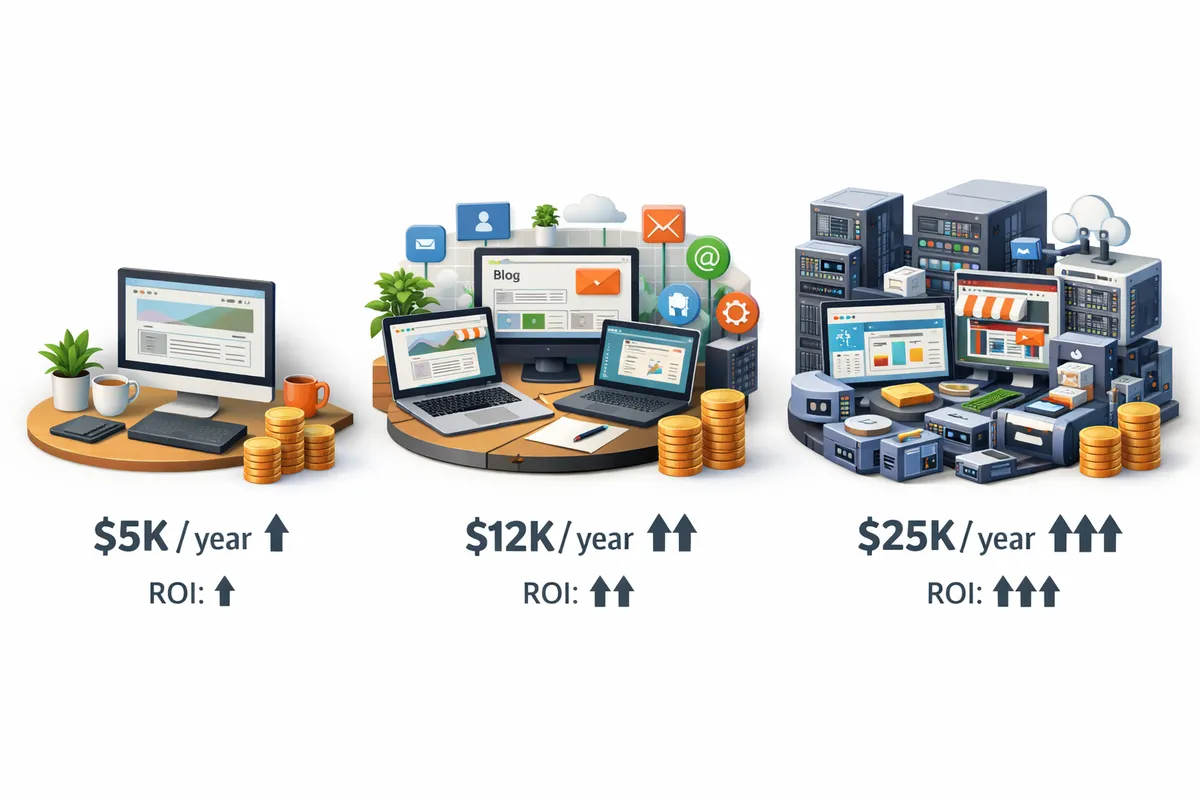
Ongoing Costs Most People Forget
Your website costs money every month after launch. These recurring costs are not optional. They are the cost of keeping your digital presence functional, secure, and effective. Budget for these from day one.
Hosting: $20 to $200/month for standard business sites. $100 to $1,000/month for high-traffic sites or complex web applications. The difference between $20 shared hosting and $100 managed hosting is reliability and speed. Shared hosting means your site shares server resources with hundreds of other sites. When one of them gets a traffic spike or security breach, your performance suffers. Managed hosting at our web hosting and maintenance service level provides dedicated resources, automatic scaling, and proactive monitoring.
Domain registration: $15 to $50/year for standard domains. Premium domains (short, common words) can cost $500 to $50,000. Budget $15/year for a standard .com domain and move on.
SSL certificate: Free to $300/year. Let's Encrypt provides free SSL certificates that work perfectly for most sites. Extended validation certificates ($100 to $300/year) display your company name in the browser address bar, which matters for e-commerce sites where trust signals influence purchase decisions.
Maintenance and updates: $100 to $1,000/month for security patches, CMS updates, plugin compatibility, bug fixes, and performance monitoring. WordPress sites need more frequent maintenance than custom-built sites because of plugin ecosystem complexity. Neglecting maintenance for 6 months typically results in security vulnerabilities, broken functionality, or both.
SEO and marketing: $500 to $5,000/month if you want your site to generate leads rather than just exist. SEO services build organic visibility over time. PPC advertising drives immediate traffic. Content marketing establishes authority. Most businesses underinvest here and wonder why their $15,000 website does not generate business.
Content creation: $500 to $3,000/month for blog posts, case studies, page updates, and resource creation. Fresh content drives SEO performance and gives visitors reasons to return. A site that has not been updated in 6 months signals to both Google and visitors that the business may not be active.
Analytics and tools: $0 to $300/month for Google Analytics (free), heatmap tools ($30 to $100/month), A/B testing platforms ($50 to $200/month), and conversion optimization tools. These are investments in understanding what works and improving it.
What Drives Cost Up
Custom design costs 3 to 5 times more than template-based design. The investment is justified when your brand needs to stand out in a competitive market or when conversion optimization requires layouts tested for your specific audience.
Complex functionality like booking systems, user accounts, payment processing, member areas, or interactive tools adds $2,000 to $20,000 per feature depending on complexity. An appointment booking system with calendar sync, automated reminders, and payment collection is $5,000 to $12,000 as a standalone feature.
Content volume matters. 50 pages cost more than 10. But the relationship is not linear. Pages 1 through 10 establish the design system, templates, and workflows. Pages 11 through 50 use those established patterns at lower per-page cost. Budget $200 to $500 per additional page for content-heavy sites.
Third-party integrations with CRMs, payment processors, ERPs, or APIs add $1,000 to $10,000 per integration depending on API quality and data complexity. CRM integration is among the most common and most valuable integrations for service businesses.
Regulatory compliance including HIPAA, ADA accessibility (WCAG 2.1), PCI-DSS for payment handling, or GDPR adds 15 to 30% to development costs. The investment is not optional if your business operates in regulated industries.
What Drives Cost Down
Clear requirements reduce back-and-forth and revision cycles. Projects where the client provides detailed requirements, approved content, and timely feedback cost 20 to 30% less than projects with vague scopes and extended decision timelines.
Existing content saves significant writing time and cost. If you already have well-written copy, professional photography, and organized brand assets, those components do not need to be created from scratch.
Phased delivery lets you launch faster and spread investment over time. Launch with your core 5 to 7 pages, then add features and content in subsequent phases. You start generating value from your site immediately while continuing to build.
Template-based design starting points cost 40 to 60% less than fully custom design. Platforms like Webflow, Squarespace, or WordPress with premium themes provide professional starting points that a designer customizes to your brand.
Smaller scope always costs less. The most effective way to reduce website cost is to launch with fewer features and add based on actual user behavior rather than assumed needs.
How to Evaluate a Website Proposal
Not all proposals are created equal. Here is what to look for when comparing quotes.
Line-item detail. A quote that says "Website: $12,000" tells you nothing. A quote that breaks down design, development, content, SEO, hosting, and support hours gives you the transparency to make informed decisions.
Scope definition. How many pages? Which features? What integrations? What content is included? The more precisely the scope is defined, the less likely you are to encounter change orders and budget overruns.
Revision rounds. How many design revisions are included? What happens if you need more? Unlimited revisions sounds generous but often means the agency expects you to accept their first draft. Two to three defined revision rounds with clear feedback processes is the standard that works.
Post-launch support. What happens after the site goes live? 30 to 90 days of bug-fix support should be standard. Ongoing maintenance should be quoted separately with clear deliverables.
Ownership. Do you own the code, design files, and content? Can you take them to another provider? Agencies that hold your work hostage through proprietary platforms or restrictive contracts create long-term risk for your business.
Frequently Asked Questions
Why is the price range so wide for websites?
Because "website" describes everything from a 5-page business card site to a complex SaaS platform. A five-page site for a local plumber and a 200-page e-commerce platform with custom product configuration are both "websites" but share almost nothing in terms of development complexity. The key is matching your budget to your actual requirements, not paying for features you will not use or skipping capabilities you genuinely need.
Should I build my website on WordPress or custom code?
WordPress works well for content-focused sites, blogs, and standard business websites with up to 50 pages. Its plugin ecosystem covers most common functionality. Custom code is better for web applications, complex e-commerce with unique business logic, sites requiring high performance under heavy traffic, and applications where site speed optimization is critical for user experience. We recommend the right platform based on your specific requirements rather than defaulting to one approach.
Can I start small and add features later?
Yes. This is often the smartest approach and the one we recommend most frequently. Launch with your core pages and essential functionality. Monitor user behavior through analytics. Add features based on what actual visitors need rather than what you assume they want. A phased approach reduces upfront cost, reduces risk of building unused features, and gets your site generating value faster.
How do I know if a quote is fair?
Compare 3 to 5 proposals for the same scope. Ensure each proposal addresses identical deliverables so you are comparing equivalent offerings. Be wary of quotes significantly below market rate. A $3,000 quote for a project that three other agencies quoted at $10,000 to $15,000 usually means corners will be cut, inexperienced developers will do the work, or hidden costs will appear mid-project. Be equally wary of premium pricing without premium justification.
What is the ROI of investing more in my website?
A well-built website generates leads, reduces customer service costs, supports your marketing investment, and builds credibility with prospects. For service businesses, one new client from your website can pay for the entire project. For e-commerce, a 1% improvement in conversion rate on 10,000 monthly visitors at $75 average order value adds $7,500/month in revenue. For businesses investing in lead generation, the website is the conversion point where ad spend turns into actual revenue.
How often should I redesign my website?
Most business websites benefit from a full redesign every 3 to 5 years and content refreshes every 6 to 12 months. Technology, design trends, and user expectations evolve. A site built in 2022 may still function in 2026 but likely has outdated design patterns, performance issues, and missed opportunities for mobile optimization. Regular maintenance extends the useful life of your site between redesigns.