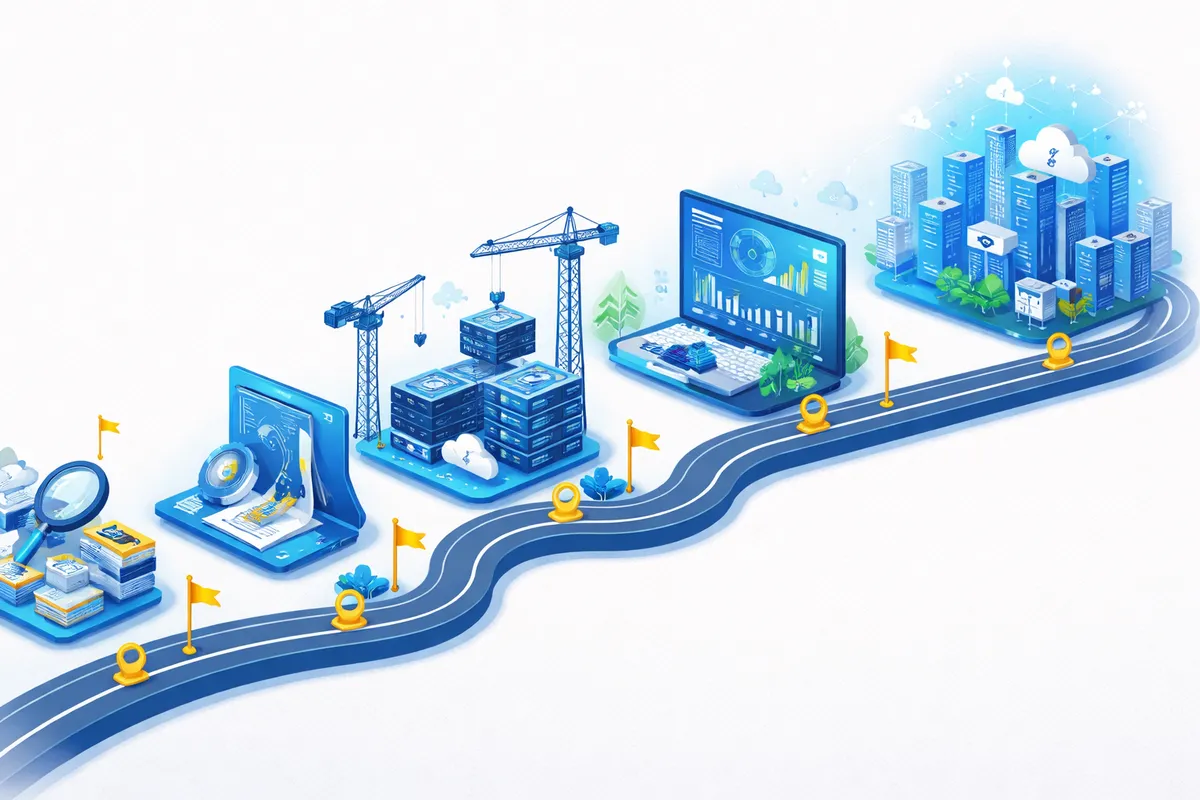
Phase 2: Prioritization and Planning (Weeks 5 to 8)
You cannot transform everything at once. Prioritization determines success. Businesses that try to tackle 10 initiatives simultaneously finish zero.
Score Each Initiative
Rate every potential initiative on three dimensions using a simple 1 to 5 scale:
1. Business Impact. How much revenue, cost savings, or customer satisfaction will this create? A project saving $50,000/year scores higher than one saving $5,000. 2. Feasibility. How complex is the implementation? Do you have the data, team, and infrastructure? A CRM migration scores lower on feasibility than setting up automated email responses. 3. Time to Value. How quickly will you see results? A project delivering value in 30 days scores higher than one that takes 6 months.
Multiply the three scores for a composite priority number. Sort from highest to lowest. The top 3 to 5 initiatives become your roadmap.
Create the Phased Roadmap
Organize initiatives into three waves:
Wave A (0 to 3 months): Quick wins. These build momentum, prove value to stakeholders, and generate confidence. Examples: setting up booking and scheduling automation, implementing a chatbot for common customer questions, or automating invoice generation.
Wave B (3 to 6 months): Medium-complexity projects. These deliver significant impact and often build on Wave A foundations. Examples: CRM migration with marketing automation, website redesign with self-service portal, or implementing workflow automation for your core business processes.
Wave C (6 to 12 months): Large-scale transformations. These require the data infrastructure, team capabilities, and organizational buy-in developed in earlier waves. Examples: predictive analytics for demand forecasting, custom AI solutions for industry-specific workflows, or complete digital sales channel implementation.
Each wave must deliver measurable results. Never plan 12 months of work before showing any value.
Secure Budget and Resources
Present your phased roadmap with ROI projections for each wave. Budget for four categories: technology (software licenses, platform costs), implementation (external partners, integration work), training (staff upskilling, change management), and contingency (15 to 20% buffer for scope adjustments).
Typical investment ranges for small to mid-size businesses: - Wave A quick wins: $10,000 to $25,000 - Wave B medium projects: $25,000 to $75,000 - Wave C large transformations: $50,000 to $200,000
Underfunding transformation is worse than not starting. A half-implemented CRM that nobody uses costs money and produces zero return.
Phase 3: Foundation Building (Months 2 to 4)
Before building new systems, fix your foundation. Every transformation project we have seen stall did so because of data problems, team readiness gaps, or poor technology choices made without proper evaluation.
Data Infrastructure
Your transformation runs on data. If your customer data lives in spreadsheets, your sales pipeline is tracked on sticky notes, and your financial data requires manual exports from three different systems, no amount of new software will fix the underlying problem.
Clean your data. Deduplicate customer records. Standardize naming conventions. Fill in missing fields. A CRM with 10,000 records where 40% have incomplete contact information is a liability, not an asset.
Consolidate systems. If customer information lives in 5 different tools, consolidate into one source of truth. This is often the single highest-impact transformation initiative because it unlocks everything that follows.
Build integrations. Tools that share data automatically eliminate manual entry, reduce errors, and enable the automated workflows you will build in later phases. Our business software services help businesses select and integrate the right platforms.
Team Readiness
Technology transformation fails when teams are not prepared. Identify skill gaps early and build a training plan that runs parallel to implementation, not after it.
Common gaps we see: basic data literacy (understanding reports and dashboards), CRM adoption (actually using the tool instead of reverting to spreadsheets), digital communication (chat, video, collaborative documents), and process documentation (writing down how things work so automation is possible).
Allocate 10 to 15% of your transformation budget to training. This investment has the highest return of any transformation spend because technology only works when people use it.
Technology Selection
Choose platforms and tools based on your specific requirements, not vendor marketing or what your competitor uses. Key evaluation criteria:
- Integration capability. Does this tool connect to your existing systems? API availability is non-negotiable.
- Scalability. Will this tool handle 3x your current volume without breaking or requiring replacement?
- Total cost of ownership. License fees, implementation costs, training costs, and ongoing maintenance over 3 years.
- Vendor stability. Will this company exist in 5 years? Check funding, revenue growth, and customer base.
- Data portability. Can you export your data if you need to switch? Avoid vendor lock-in.
Phase 4: Implementation (Months 3 to 12)
Execute your roadmap in waves. Each wave follows the same pattern: build, test with real users, deploy to a pilot group, gather feedback, iterate, then roll out broadly.
Build and Test
For every initiative, define acceptance criteria before building. "The CRM is set up" is not an acceptance criterion. "Sales team can create new contacts, log activities, view pipeline stages, and generate weekly reports" is. Specific criteria prevent scope creep and ensure the implementation actually solves the problem it was designed to solve.
Test with real data and real workflows. Staging environments with fake data miss the edge cases that real data reveals: duplicate records, unexpected data formats, integrations that work in testing but fail with production volume.
Measure Results Against Business Case
Track the metrics you defined in your business case from Phase 1. Is the initiative delivering the projected value? If yes, move to the next wave with confidence. If not, understand why and adjust before scaling.
Common reasons initiatives underperform: adoption is lower than expected (training issue), data quality is worse than assessed (go back and clean it), or the process was more complex than mapped (re-scope the solution).
Manage Change Deliberately
Technology changes are straightforward. People changes are not. Every transformation initiative needs a change management plan that includes:
- Communication: Why are we making this change? What problem does it solve? What does it mean for each role?
- Training: Hands-on training sessions, not just documentation. Scheduled 2 to 3 weeks before go-live and repeated 30 days after.
- Support: A point person who answers questions and troubleshoots for the first 60 days.
- Feedback loop: A way for users to report problems and suggest improvements without bureaucracy.
Celebrate wins publicly. When the new system saves 10 hours of manual work in its first week, make sure the team knows. Visible wins build momentum for the next wave.
Phase 5: Optimization and Scale (Ongoing)
Digital transformation is not a project with an end date. It is an ongoing capability that your organization develops over time.
Continuous Improvement
Review and optimize implemented systems quarterly. Technology improves. Business needs evolve. Customer expectations shift. Your digital infrastructure should evolve with them. Schedule quarterly reviews to identify: what is working well, what needs adjustment, what new opportunities have emerged, and what should be retired.
Expand Scope
Each successful initiative creates the foundation for the next one. A well-implemented CRM enables marketing automation. Marketing automation enables lead generation at scale. Lead generation at scale enables predictive analytics about customer behavior. Transformation compounds.
Build Internal Capability
The goal is to reduce dependence on external partners over time. Train your team to manage and extend the systems built during transformation. Hire specialists as your needs justify it. Build the internal capability to drive transformation independently. External partners should accelerate your journey, not become a permanent dependency.
Common Pitfalls and How to Avoid Them
Starting with technology. "We need AI" is not a transformation strategy. "We need to reduce customer response time from 24 hours to 2 hours" is. Technology is the tool, not the goal. Always start with the business problem.
Boiling the ocean. Attempting to transform 15 processes simultaneously transforms zero. Pick 3 to 5 high-impact initiatives and execute them well. Success breeds success.
Ignoring change management. A $100,000 CRM that your sales team refuses to use is a $100,000 loss. Budget time and resources for training, communication, and ongoing support. People adoption is the bottleneck, not technology implementation.
No executive sponsor. Transformation requires leadership commitment. Without an executive champion, initiatives lose funding and priority when competing demands arise. The sponsor does not need to manage the project. They need to remove organizational obstacles and maintain strategic priority.
Not measuring results. If you cannot measure the impact, you cannot justify continued investment. Define metrics before implementation, track them consistently, and report to stakeholders monthly.
Perfectionism. Waiting for the perfect solution means waiting forever. Launch at 80% and iterate based on real usage data. A functional system in use beats a perfect system still in development.
Frequently Asked Questions
How long does digital transformation take?
Meaningful results start within 3 to 6 months with the quick wins approach. Comprehensive transformation across an organization typically takes 18 to 36 months. The key is delivering value in phases rather than waiting for a big-bang launch. Most businesses we work with see ROI from their first wave of initiatives within 90 days.
How much does digital transformation cost for a small business?
Small businesses (under 50 employees) can start meaningful transformation with $15,000 to $50,000 for the first wave of quick wins. Complete multi-phase transformation across all core processes typically ranges from $75,000 to $250,000 over 12 to 18 months. The ROI should exceed the investment within the first year for well-planned initiatives.
Do we need to hire a digital transformation consultancy?
Not necessarily. If your team includes people with technology strategy experience, you can drive transformation internally. Most businesses benefit from external expertise for assessment, roadmapping, and the first wave of implementation. After that, internal teams take over ongoing optimization. Our approach is to build your internal capability alongside the transformation itself.
What is the biggest risk in digital transformation?
Organizational resistance. Technology implementation is rarely the bottleneck. People who are uncomfortable with change, unclear about their new role, or unconvinced of the value will undermine even the best technology. Address this proactively with clear communication, thorough training, and visible executive support.
How do we maintain momentum during a long transformation?
Deliver quick wins early and celebrate them. Communicate progress regularly with specific numbers: "The new scheduling system saved 12 hours of phone calls last week." Show measurable results to leadership and the broader team. Each visible success builds support for the next phase. If momentum stalls, go back to your impact scoring and pick the next highest-impact initiative that can be completed quickly.
Should we build custom solutions or buy off-the-shelf software?
Buy first, customize second, build custom only when necessary. Off-the-shelf tools like HubSpot, Salesforce, or industry-specific platforms solve 80% of most business needs at a fraction of the cost and timeline of custom development. Build custom only when your competitive advantage depends on unique functionality that no existing tool provides. Our custom AI solutions and business software services help businesses make this build-versus-buy decision based on their specific requirements.