What We Build for Fencing Companies
AI-Powered Measurement and Site Assessment
The foundation of every fencing estimate is accurate measurement. Our AI measurement system uses satellite imagery, drone photography where available, and computer vision to produce detailed site assessments without a truck roll.
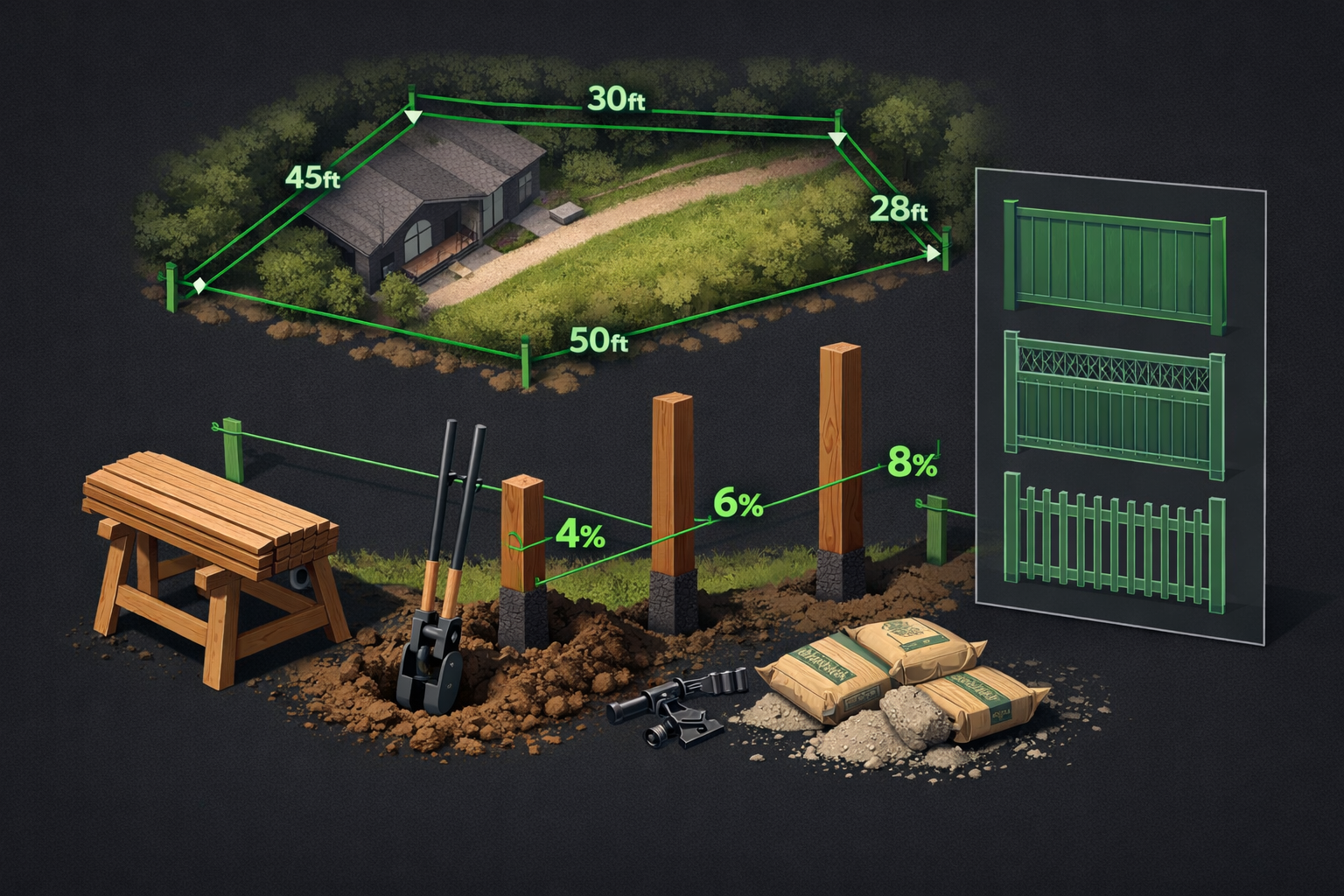
The system calculates total linear footage along the proposed fence line using property boundary data and customer-indicated placement. It identifies grade changes along the fence path, flagging sections that require stepped panels, racked installations, or retaining solutions. Trees, structures, utility boxes, and other obstacles within the fence corridor are detected and marked. The output is a preliminary site map with measurements, obstacle annotations, and terrain notes that your estimator can review in minutes.
This is not a replacement for human judgment. Your estimator still visits the site to verify measurements, check soil conditions, and assess access for equipment. But they arrive with 80% of the work already done. The visit becomes confirmation rather than discovery. Response time to the customer drops from three to five days to same-day or next-day, which is the single biggest factor in winning residential fence jobs.
Accuracy matters here. Our measurement systems achieve 95% to 98% accuracy on linear footage calculations from satellite imagery, with grade estimation within six inches over standard residential lot distances. Drone imagery pushes accuracy even higher. For most residential estimates, the AI measurement is accurate enough to quote from directly, with the verification visit serving as a quality check rather than a necessity.
Learn more about our computer vision solutions
Automated Estimating Engine
Raw measurements mean nothing without the math that turns them into a profitable quote. Our estimating engine takes the AI site assessment and produces a complete, itemized estimate in minutes.
The system connects to your supplier pricing databases and updates material costs automatically. When your fence supply distributor changes the price on cedar pickets or vinyl panels, your estimates reflect the new pricing without manual updates. Post counts are calculated based on material specifications, terrain data, and local code requirements. Concrete volumes account for post diameter, depth requirements (which vary by frost line), and soil type. Gate hardware, caps, rails, and fasteners are itemized based on the fence configuration.
Labor calculations use your company's historical data. The system learns how long your crews take to install different fence types in different conditions. A 150-foot cedar privacy fence on level ground with good access gets a different labor estimate than the same fence on a slope with narrow side-yard access. As you complete more projects and log actual hours, the labor model becomes increasingly precise for your specific operation.
The estimate output is customer-facing and professional. Material specifications, quantities, labor scope, timeline, and total investment are presented clearly. Optional upgrades like premium hardware, decorative post caps, or stain/seal packages are included as add-on line items. Customers see exactly what they are getting and what it costs. No surprises, no ambiguity.
Learn more about our custom AI solutions
Weather-Dependent Project Scheduling
Fencing installation is outdoor work that depends heavily on weather conditions. Post holes cannot be dug in frozen ground without specialized equipment. Concrete should not be poured in extreme cold or heavy rain. Staining and sealing require specific temperature and humidity windows. And crew productivity drops significantly in extreme heat or precipitation.
Our scheduling system integrates with weather forecast APIs to optimize your installation calendar. When you book a job, the system identifies the best installation window based on a 14-day forecast, crew availability, equipment needs, and material lead times. If weather conditions are projected to be unfavorable during a scheduled installation, the system flags the conflict and suggests alternative dates before your crew shows up to a muddy, frozen, or rain-soaked jobsite.
For fencing companies running three to five crews, this optimization prevents the cascade of rescheduling that eats productivity. One rained-out job does not just cost you that day. It pushes the next job, which pushes the next, and within a week your schedule is a mess that takes days to untangle. Weather-aware scheduling builds buffer into the right places and reroutes crews proactively rather than reactively.
The system also tracks seasonal patterns in your market. If your area has a consistent three-week period in spring where ground conditions make post-hole digging difficult, the system learns that pattern and schedules accordingly. Long-term scheduling becomes more realistic because it accounts for the conditions your crews actually face rather than assuming every week is a perfect installation week.
Learn more about our scheduling solutions
AR Fence Visualization
The number one objection on residential fence estimates is uncertainty about how the finished product will look. Customers struggle to visualize a six-foot cedar privacy fence versus a four-foot ornamental aluminum fence on their property. They cannot picture how different colors, styles, and heights will change the appearance of their yard. This uncertainty causes decision paralysis, delayed approvals, and lost jobs to competitors who showed up with better visual tools.
Augmented reality visualization lets your estimator or the customer themselves point a phone or tablet at their property and see the proposed fence overlaid on the real environment. Different styles can be swapped in seconds. Cedar privacy, vinyl, chain link with privacy slats, ornamental aluminum, composite. Heights adjust in real time. Customers see exactly how the fence meets their house, wraps around corners, and integrates with existing landscaping.
This is not a novelty feature. It is a closing tool. Fencing companies using AR visualization report 20% to 35% improvement in estimate-to-sale conversion rates. The customer who can see the finished product is a customer who is ready to commit. The visual eliminates the gap between imagination and reality that causes hesitation.
We build AR visualization that works with your specific product catalog. Your materials, your colors, your styles. When the customer picks the fence they want to see, it looks like the fence you actually install, not a generic 3D model that bears little resemblance to the finished product.
Customer Communication Automation
Fencing projects have a predictable communication pattern. The customer requests an estimate. They wait for the site visit. They receive the quote. They take time to decide. They approve and wait for scheduling. They want updates during installation. They need follow-up after completion.
At every stage, the customer has the same question: what happens next and when? Your office staff spends hours each day answering calls and emails that ask "when is my estimate appointment?" and "when does installation start?" and "is my fence done yet?"
AI-powered communication automation handles the predictable interactions so your team handles only the exceptions. Automated appointment confirmations with estimated arrival windows go out after booking. Pre-visit preparation instructions tell the customer to mark their desired fence line and secure pets. Post-estimate follow-ups deliver the quote with material specifications and visual references. Decision-stage nurture provides helpful information about material options and maintenance requirements without being pushy.
During installation, automated updates notify the customer when the crew is en route, when post-setting is complete, when panels are going up, and when the job is finished. Post-completion messages deliver care instructions, warranty information, and a review request. The customer feels informed at every step without your office making a single phone call for routine updates.
Learn more about our AI customer service solutions
Permit Document Automation
Building permits for fences vary by jurisdiction, but the documentation requirements follow predictable patterns. Our permit automation system maintains a database of requirements by municipality and generates submission-ready packages from your project data.
When an estimate converts to a sold job, the system identifies the local jurisdiction, pulls the correct permit application forms, and populates them with project details. Plot plans are generated from the site assessment data showing fence placement, setbacks from property lines, and gate locations. Material specifications and height documentation are attached. For jurisdictions requiring HOA approval, the system generates the HOA submission package with the same project details formatted to the association's requirements.
Your office staff reviews the completed package, makes any necessary adjustments, and submits. Instead of building each permit application from scratch, they verify and send. For fencing companies that operate across multiple jurisdictions with different requirements, this standardization prevents the errors that cause permit rejections and delays.
What to Expect
Phase 1: Assessment (Weeks 1-2)
We map your current estimating workflow from first customer contact through completed installation. We document every step, every handoff, every bottleneck. We analyze your estimate accuracy by comparing quoted versus actual costs on your last 20 to 30 completed projects. We identify where time is lost, where errors occur, and where automation delivers the highest return. We review your scheduling patterns, permit processes, and customer communication touchpoints.
Phase 2: System Design (Weeks 3-4)
Based on the assessment, we design your AI integration stack. This includes the measurement system configured for your service area, the estimating engine loaded with your materials, pricing, and labor data, scheduling optimization configured for your crew structure, and communication workflows mapped to your customer journey. We present the plan with projected time savings, accuracy improvements, and ROI estimates. You review, adjust, and approve before we build.
Phase 3: Build and Integration (Weeks 5-10)
We build and integrate each system component, starting with measurement and estimating because they deliver the fastest ROI. Your team is trained on each tool as it goes live. We import your historical project data to calibrate the estimating models. Scheduling and communication systems are configured and tested with real scenarios from your recent projects. Integration with your existing CRM, accounting software, and supplier systems ensures data flows without manual re-entry.
Phase 4: Optimization and Scaling
After 30 days of live operation, we analyze performance data and refine each system. Estimating accuracy is compared against actual project costs and the model is adjusted. Scheduling efficiency is measured by crew utilization and rescheduling frequency. Customer communication effectiveness is evaluated by response rates and satisfaction feedback. Monthly optimization continues as your data grows and the systems become increasingly precise for your specific operation.
Industry Connections
Fencing contractors frequently work alongside other trades on residential and commercial projects. Landscaping companies often coordinate with fencing contractors on property improvement projects where fence installation and landscape design happen in sequence. General contractors and home builders subcontract fencing work on new construction where AI coordination between trades eliminates scheduling conflicts. Electrical contractors collaborate on powered gate installations, security lighting along fence lines, and electric fence systems for agricultural applications.
Stop Measuring Twice. Start Building Faster.
Every hour your estimator spends measuring a property that does not convert is an hour you cannot get back. Every estimate that misses a grade change or undercounts posts is money out of your pocket. Every permit application built from scratch is time your office staff could spend on work that grows the business.
AI integration for fencing companies is not about replacing your team. It is about removing the repetitive, error-prone, time-consuming tasks that prevent your team from doing their best work. Faster estimates. More accurate quotes. Smarter scheduling. Better customer communication. And a permit process that does not bury your office in paperwork.
Schedule a consultation and let us show you exactly how AI tools can streamline your fencing operation from first measurement to final walkthrough.