The Real Problem AI Solves for Trade Businesses
Trade businesses do not have a demand problem. They have a capture problem.
The phone rings while you are on a ladder. A lead fills out a contact form at 9 PM and expects a response by morning. A five-star review opportunity passes because nobody sent the follow-up text. A Google Ads campaign burns budget on keywords that attract tire-kickers instead of buyers.
The gap between demand and revenue is not talent. It is operations. Most trade businesses are running their marketing and customer communication on the same system they used in 2015: a cell phone, a pad of paper, and whatever they can remember to do between jobs.
AI closes that gap. Not by replacing the work. By handling everything around the work that the owner never has time for.
The Numbers Behind the Gap
Consider this scenario. An HVAC company gets 40 inbound calls per week during peak season. The owner and two office staff answer about 28 of those calls. Twelve go to voicemail. Of the twelve that go to voicemail, maybe four leave a message. Of those four, maybe two get called back the same day.
That is ten lost opportunities per week. At an average ticket of $350, that is $3,500 in weekly revenue walking out the door. Over a 16-week peak season, that is $56,000 in lost revenue. Not because the company cannot do the work. Because nobody answered the phone.
An AI answering service does not take breaks, does not eat lunch, and does not go home at 5 PM. It answers every call, qualifies the lead, books the appointment, and sends the confirmation. The cost is a fraction of a single part-time receptionist.
This is not futuristic. This is happening right now across every trade vertical.
AI Answering Services: Your 24/7 Front Desk
The most immediate, highest-ROI AI tool for any trade business is an AI-powered answering service. The technology has matured dramatically. Modern AI voice agents sound natural, handle complex conversations, and integrate directly with your scheduling software.
How It Works
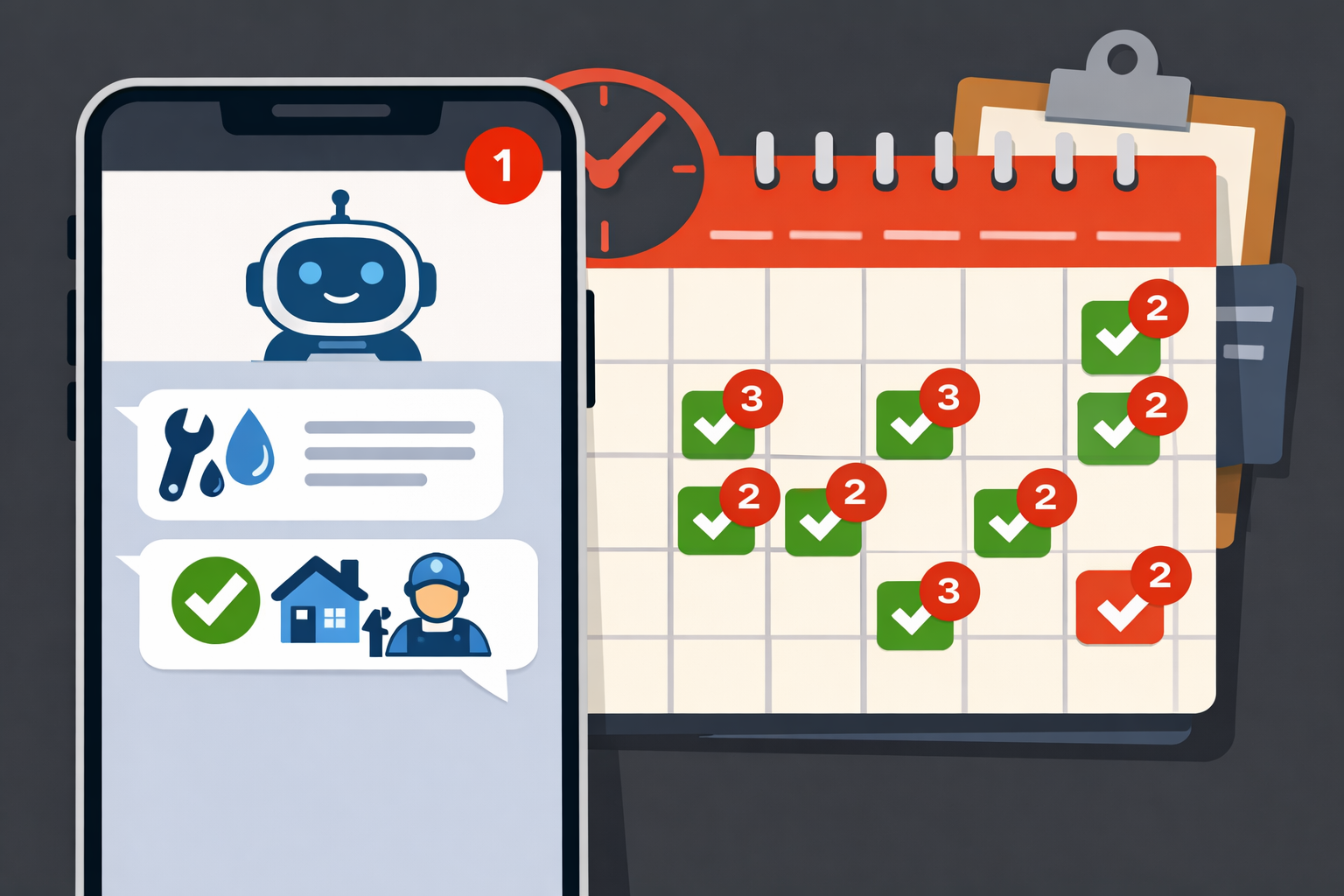
When a customer calls your business line, the AI agent picks up. It greets the caller by your company name. It asks qualifying questions: What is the issue? What is the address? Is this an emergency? It checks your calendar for availability, books the appointment, and sends the customer a confirmation text with the technician's name and arrival window.
If the call requires a human (a complex commercial bid, an insurance question, a complaint), the AI routes it to the right person with a full summary of the conversation so far.
What Changes for Your Business
The shift is profound. Your close rate on inbound leads increases because every call gets answered. Your customer satisfaction increases because response time drops from hours to seconds. Your office staff stops spending 60% of their day on routine scheduling calls and starts handling the work that actually requires a human brain.
For plumbing companies running emergency service, this is transformational. A burst pipe at midnight does not wait until morning. The homeowner calls three companies. The first one that answers and books the job wins. With an AI answering service, you are always the first one that answers.
AI Scheduling and Dispatch Optimization
Beyond answering the phone, AI is reshaping how trade businesses schedule and route their crews. This matters because inefficient scheduling is one of the biggest hidden costs in any service business.
Route Optimization
Traditional scheduling works like this: the dispatcher looks at the board, eyeballs the geography, and tries to minimize drive time. Maybe they get it right. Maybe a technician drives 45 minutes between two jobs that could have been grouped with another tech's afternoon.
AI scheduling tools analyze every variable simultaneously. Drive time, technician skill set, job duration estimates, parts availability, customer time preferences, traffic patterns. They produce optimized routes that reduce windshield time by 15 to 30 percent for most companies.
For a general contracting operation running six trucks, a 20% reduction in drive time translates to roughly one additional job per truck per day. Over a month, that is 120 additional billable hours. The math speaks for itself.
Dynamic Rescheduling
Jobs run long. Customers cancel. Emergencies come in. Static schedules break by 10 AM on most days. AI scheduling tools handle this dynamically. When a job runs over, the system automatically adjusts the rest of the day's schedule, notifies affected customers, and fills any gaps with jobs from the waitlist.
This kind of real-time optimization was previously only available to companies large enough to employ full-time dispatchers with sophisticated software. AI has made it accessible to five-truck operations.
AI Review Management: Building Your Reputation on Autopilot
Online reviews are the single most influential factor in a homeowner's decision to call one company over another. You know this. Every trade business owner knows this. The problem is that generating reviews consistently requires a system, and most trade businesses do not have one.
The Review Generation Loop
AI-powered review management works as a closed loop. After a job is marked complete in your system, the AI waits a predetermined period (usually 2 to 4 hours, long enough for the customer to evaluate the work, short enough that the experience is fresh). Then it sends a personalized text message thanking the customer and asking for a review. It includes a direct link to your Google Business Profile.
If the customer clicks but does not complete the review, a gentle follow-up goes out 48 hours later. If the customer leaves a review, the AI generates a personalized response and queues it for your approval or posts it automatically.
Handling Negative Reviews
This is where AI review management earns its keep. When a negative review comes in, the system alerts you immediately with a suggested response that is professional, empathetic, and specific to the complaint. Speed matters here. A business that responds to a negative review within two hours signals to every future customer reading that review that you take service seriously.
For roofing companies especially, where project values are high and the sales cycle involves significant trust building, a strong review profile with consistent owner responses is the difference between winning and losing bids.
AI-Powered PPC: Smarter Ad Spend for Trades
Pay-per-click advertising on Google is the fastest path to booked jobs for most trade businesses. It is also the fastest way to waste money if it is not managed properly. AI has fundamentally changed how PPC campaigns are built and optimized.
How AI Changes PPC for Trades
Traditional PPC management is reactive. A human reviews performance data weekly or monthly, adjusts bids, pauses underperforming keywords, and writes new ad copy. The cycle is slow. By the time you react to a trend, you have already lost budget to it.
AI-powered PPC management operates in real time. The system adjusts bids hour by hour based on conversion probability. It factors in time of day, day of week, weather (critical for HVAC and roofing), competitor activity, and historical conversion data by zip code.
Practical Example
A plumbing company running Google Ads for "emergency plumber" keywords traditionally sets a daily budget and lets Google distribute it throughout the day. The problem: most emergency plumbing searches happen between 6 PM and 6 AM. A flat daily budget means you run out of money at 3 PM and miss the highest-intent searches of the day.
AI bid management recognizes this pattern. It reduces bids during low-conversion daytime hours and increases them during the evening and night when conversion rates spike. Same daily budget. Dramatically more booked jobs.
The Geo-Targeting Advantage
For trade businesses, geography is everything. A lead 45 minutes away is worth less than a lead 10 minutes away because of drive time economics. AI-powered PPC tools analyze your historical data to identify which zip codes produce the highest-value jobs with the best close rates. They then concentrate budget in those areas and pull back from zones where your cost per acquisition is too high.
This level of geographic intelligence used to require a dedicated marketing analyst. Now it runs automatically inside the campaign management platform.
AI Content Generation for Trades
Content marketing for trade businesses has a specific challenge. The people who know the trade (you) do not have time to write blog posts. The people who write blog posts (generic content agencies) do not know the trade. The result is either no content at all or content so generic it does not rank or convert.
AI content generation solves this by meeting in the middle. You provide the expertise. AI handles the production.
How Trade Content Generation Works
The process looks like this. You spend 10 minutes recording a voice memo about a topic you know cold. Why tankless water heaters fail in hard-water areas. How to tell if your electrical panel needs upgrading. What homeowners should check on their roof after a hailstorm.
AI transcribes that voice memo, structures it into a search-optimized article, adds relevant headers and internal links, and produces a draft that sounds like you wrote it. Because in a real sense, you did. The expertise is yours. The AI just handled the formatting and optimization.
The SEO Compound Effect
One article is a blog post. Fifty articles is a search engine optimization moat. When your website has authoritative, detailed content about every common problem in your trade, you start ranking for hundreds of long-tail keywords. "Water heater making knocking noise." "How much does a 200-amp panel upgrade cost." "Best time to replace HVAC system."
Each of those articles becomes a lead generation asset that works 24/7 without additional ad spend. For electricians especially, where the range of services is broad (residential, commercial, industrial, data center, EV charger installation), a deep content library creates a compounding SEO advantage that is extremely difficult for competitors to replicate.
Content Across Channels
A single well-produced article does not have to live only on your blog. AI tools can repurpose that article into social media posts, email newsletter content, Google Business Profile updates, and even scripts for short video content. One piece of expertise becomes ten touchpoints across every channel where your customers spend time.
AI Email and SMS Follow-Up Sequences
The fortune in trade businesses is in the follow-up. Most trade companies do one job and never contact that customer again until the customer calls with another problem. That is leaving money and referrals on the table.
Automated Customer Lifecycle
AI-powered email and SMS marketing creates an automated customer lifecycle. After a job is complete, the customer enters a sequence. They receive a thank-you message with care tips related to their specific service. Thirty days later, they get a seasonal maintenance reminder. Six months later, a check-in. Twelve months later, an annual service offer.
This is not spam. This is service. A homeowner who got their furnace repaired in October appreciates a reminder in April to schedule AC maintenance. They do not have to remember. You do not have to remember. The system handles it.
Reactivation Campaigns
For customers who have not booked in 18 months or more, AI can identify patterns and generate personalized reactivation messages. "It has been two years since we serviced your water heater. Hard water buildup can reduce efficiency by 30% over that period. Want us to take a look?" Specific, helpful, and rooted in genuine expertise. Not a generic "we miss you" email.
AI Marketing Automation: Tying It All Together
The real power of AI for trade businesses is not any single tool. It is the integration of all these tools into one cohesive marketing automation system. The phone gets answered. The appointment gets booked. The confirmation gets sent. The job gets completed. The review gets requested. The follow-up sequence begins. The reactivation campaign fires when the customer goes dormant.
Every step happens automatically. Every step is tracked. Every step feeds data back into the system so it gets smarter over time.
This is what separates a trade business doing $500K per year from one doing $2M. Not more trucks. Not more technicians. Better systems that capture and convert more of the demand that already exists.
Common Mistakes When Adopting AI Tools
Mistake 1: Trying to Automate Everything at Once
Start with the highest-impact, lowest-complexity tool. For most trade businesses, that is an AI answering service. Get that working. Let it stabilize. Then layer on review management. Then PPC optimization. Then content. Building incrementally means each tool has time to prove its ROI before you invest in the next one.
Mistake 2: Choosing Tools That Do Not Integrate
An AI answering service that cannot talk to your scheduling software is just a fancy voicemail. A review management tool that does not connect to your CRM is creating data silos. Before you buy any tool, ask one question: does it integrate with what I already use? If the answer is no, keep looking.
Mistake 3: Removing the Human Entirely
AI handles the routine. Humans handle the exceptions. A customer calling to complain about a botched install should talk to a person, not a chatbot. A commercial client requesting a $200K bid should get a personal call, not an automated email. The best AI implementations know exactly where the handoff point is between machine and human.
Mistake 4: Ignoring the Data
Every AI tool generates data. Call volume patterns. Conversion rates by source. Review sentiment trends. Customer lifetime value by service type. This data is a strategic asset. Trade businesses that review their AI performance data monthly and adjust accordingly outperform those that set it and forget it.
Mistake 5: Waiting for It to Be Perfect
The trade businesses winning with AI in 2026 did not wait until every tool was flawless. They started early, iterated, and built institutional knowledge about what works for their specific market and customer base. The best time to start was last year. The second best time is now.
The Trades Are Not Being Replaced. They Are Being Amplified.
Here is the core truth that every trade business owner needs to internalize. AI is not a threat to your livelihood. It is the most powerful leverage tool your industry has ever seen. For the first time, a five-person HVAC company can have the marketing sophistication of a 50-person operation. A solo electrician can have a 24/7 customer service operation. A three-truck plumbing company can run optimized PPC campaigns that rival what the biggest players in their market are doing.
The skilled trades are experiencing the largest labor shortage in modern history. Demand is through the roof. The businesses that capture that demand efficiently will dominate their markets for the next decade. AI tools are not a luxury for trade businesses in 2026. They are the infrastructure of growth.
Your hands do the work. Let AI handle everything else.
Related Guides
AI-Resistant Careers: Why the Trades Are the Opportunity of a Generation
Skilled trades are among the most AI-resistant careers in the economy. Here's why the labor shortage, wage growth, and data center boom make this the decade for trade businesses.
Content Systems That Scale: From First Post to Content Machine
One post is a start. A content system is an asset. Build a repeatable content operation that compounds without depending on any single creator.
Distribution Strategy: How Your Product Shapes Your Channels
The right marketing channel is a function of your product and customer. Learn how to match what you sell to how you reach people.