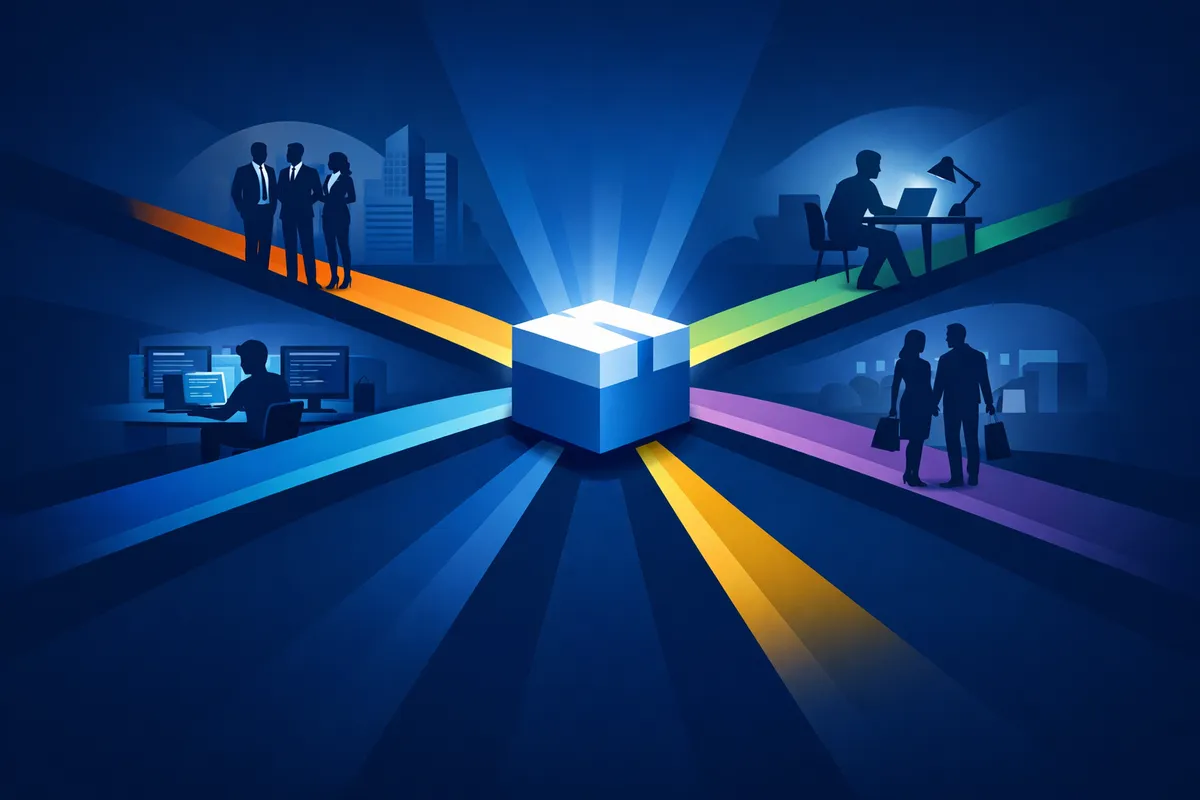
The Six Delivery Models and What They Tell You
Every product fits into one of six delivery models. Your delivery model dictates the type of customer you can serve and the channel that will reach them.
1. No-Touch
A product so simple and self-evident that a customer can discover it, understand it, and buy it without talking to a human. Stripe is the classic example. Someone discovered Stripe because they were looking for how to accept payments on their website. They read the documentation. They integrated the API. They started using it. No sales call. No support required.
Channels that work: Inbound search, community, word-of-mouth, SEO, content marketing.
What to obsess over: Build something so obviously correct that when people find it, they just use it. Your documentation is your sales team.
2. Light-Touch
Products that require minimal training or onboarding but not zero. A project management tool like Linear is light-touch. You can figure out the basics in an hour. You don't need a salesperson to explain what a task is. But you might need a quick onboarding call to understand workflow differences.
Channels that work: Product-led growth, community, trusted networks, free trials.
What to obsess over: Excellent onboarding. Easy to test with a small team and expand. The channel is still mostly inbound.
3. Assisted-Sale
A product that a customer can evaluate through self-service but where a salesperson significantly speeds up the decision. Notion is assisted-sale. A solo founder can discover Notion, sign up free, and build something in an afternoon. But an enterprise buyer probably wants to talk to someone about security, integrations, and training.
Channels that work: Inbound interest, customer word-of-mouth, outbound sales to qualified prospects.
What to obsess over: Customer marketing that creates inbound demand. Then hire salespeople to accelerate conversations that are already happening.
4. Full-Service
Products that require significant human time to implement. A management consulting firm is full-service. You hire them. They send people to your company. They work with your team over months. You're buying their time and expertise.
Channels that work: Outbound sales, trusted relationships, speaking, writing, referrals.
What to obsess over: Real relationships, not digital marketing. Speaking at conferences. Publishing thought leadership. Building a network of people who trust your expertise.
5. Marketplace
A product connecting two groups of people. A job board connects employers and candidates. Uber connects riders and drivers. Your revenue comes from the transaction, and you must acquire both sides simultaneously.
Channels that work: Network effects, SEO, targeted paid acquisition for the constrained side.
What to obsess over: Which side is harder to acquire? That's where all your marketing energy goes first.
6. Platform
A product that other companies build on top of. Stripe is a platform. Twilio is a platform. Your customer is not the end user. It's the developer or company building something that others use.
Channels that work: Developer communities, documentation, SDKs, word-of-mouth among builders, Hacker News, GitHub, developer conferences.
What to obsess over: Great docs. Active SDKs. Showing up where developers hang out. Be in community with builders, not selling to them directly.
Why Most Founders Pick the Wrong Channel
This happens for two reasons, usually at the same time.
Reason 1: Founder Taste
You like Twitter. You're good at Twitter. You think in tweets. So you build a Twitter distribution strategy regardless of what you're selling.
This is backwards. Your product determines the channel. Your preference is irrelevant.
A full-service consulting product cannot succeed on Twitter. Twitter is where ideas spread. Consulting buys are determined by trust earned over time through relationships. You could be the best Twitter account in the world and still generate zero revenue because nobody buys consulting from a Twitter thread.
Reason 2: Generic Playbooks
Digital marketers and growth hackers are generalists. They know how to run ads on Facebook, build email sequences, optimize landing pages. So they apply the same playbook to every product regardless of whether the playbook matches the product. This is cargo cult marketing.
A founder with a deeply technical API product doesn't need an email sequence that nurtures prospects through a sales funnel. They need excellent documentation and a community where developers can ask questions and solve problems together. Completely different channels requiring completely different skills.
The fix: Start with the product, not the channel. Ask yourself: how does this product actually get sold? Can someone discover it themselves? Do they need handholding? Are they buying for themselves or recommending it to someone else?
From that answer, everything else follows.
Channel Economics: What Different Channels Actually Cost
Different channels have different unit economics. Understanding these economics tells you which channels can sustain your business model and which ones can't.
| Channel | Typical CAC | Conversion Speed | Best For |
|---|---|---|---|
| SEO/Content | $50-200 | 6-18 months | Products with $1,000+ annual value |
| Social/Community | $10-50 | 3-12 months | Products with engaged niche audiences |
| Outbound Sales | $2,000-10,000 | 1-6 months | Enterprise deals $20,000+ ACV |
| Paid Ads (LinkedIn) | $200-500 | 1-3 months | B2B SaaS with $1,500+ LTV |
| Paid Ads (Google) | $100-300 | Immediate-3 months | High-intent search products |
| Partnerships | $0-500 | 3-6 months | Products that complement existing workflows |
The math matters. A self-serve product with a $10 monthly subscription cannot support a $500 CAC. A $100k enterprise deal can support a $10k CAC for outbound sales.
The best founders understand these economics early. They calculate what customer acquisition cost their business model can support on the back of a napkin. Then they pick channels where they can hit that CAC target. Then they go deep.
The Single Channel Discipline: Going Deep Before Going Wide
This is the hardest part for most founders. Resisting the urge to be everywhere.
You can have a strategy for multiple channels eventually. But at the beginning, you pick one. You go deeper on that one channel than any competitor has ever gone. You become the expert in using that channel for your specific use case.
What deep commitment looks like:
- You post less but what you post is more thoughtful
- You target fewer people but with precision
- You run fewer ads but test more variations of each
- You send fewer emails but they're more relevant
The founder who tries to win on four channels simultaneously at 25% intensity will always lose to the founder who goes 100% intensity on one channel. Not because the second founder is working harder. Because the second founder is building systems that compound.
An email campaign refined over 12 weeks gets better every iteration. By month three, you're opening at 40% instead of 20%. By month six, you're at 60%. By month twelve, the system is a finely tuned engine. But you only get there with consistency and focus for a whole year.
A Twitter strategy worked on for three months, dropped, picked back up, then ignored. You never build momentum. You never develop the voice that gets engagement. You start over every time you come back to it.
The single channel discipline means you commit. For the next 12 months, you're building one channel. Everything else is secondary. You do the bare minimum on other channels to not miss opportunities. But your focus, energy, and experimentation goes to the one channel where you can win.
Adding a Second Channel
You add a second channel only when two conditions are met:
1. Saturation. You've reached the people on your first channel who wanted to hear from you. Your email list opens reliably. Your social following engages with every post. Your inbound search strategy generates leads at maximum capacity.
2. Repeatable system. You've documented the process. The content calendar is planned for three months. The email sequence is automated. You're not spending 20 hours a week on it anymore. You check in, refine, but it runs without daily attention.
Only then do you add a second channel. And the process is the same. Go 100% intensity for 12 weeks. Find what works. Build to saturation or to a repeatable system. Then consider a third.
Most founders never do this. They add channels before saturating the first. They never build repeatable systems. They're always in experimentation mode on three channels instead of in execution mode on one channel.
Distribution Moats: How the Channel Becomes the Advantage
The companies that are hardest to compete against are not the ones with the best product. They're the ones who have a moat in distribution. They own a channel in a way that's hard to replicate.
How distribution moats form early:
- You become known as the person or company who owns a specific channel for a specific use case
- You become the person people ask about LinkedIn personal branding
- You become the newsletter people forward to others
- You become the conference where everyone in your industry wants to speak
These moats take time to build. But they're incredibly valuable because they become self-reinforcing. The more known you are on a channel, the more people come to you, the more you understand that channel, the harder you are to compete against.
The founders who build these moats played the long game. They picked a channel. They built on it for years. They didn't jump to the next shiny thing. By year three or four, the channel itself became an unfair advantage.
Product-Channel Fit in Practice
Notion: Community-Led Assisted Sale
Notion is an assisted-sale product. People try it for free. They build something simple. They talk about it. Their friends try it. Some buy the paid version. Distribution is dominated by community, word-of-mouth, and inbound interest. They also have a sales team, but that team mostly lands customers who came inbound and need hand-holding on implementation.
Notion did not build a massive outbound sales motion calling random companies. They didn't build a massive paid ads strategy. They built in community. They showed up where their customers were. They let the product speak for itself.
HubSpot: Inbound Content Engine
HubSpot's entire business is built on the idea that they should create content bringing potential customers to them. They write guides about sales, marketing, and customer service. They optimize for search. When someone is trying to solve a problem, HubSpot's content shows up. Some become customers.
HubSpot's distribution is inbound search and content. They also have sales. But sales accelerates conversations that are already happening. Not cold calling and prospecting.
Twilio: Developer-First Platform
Twilio understood that the channel to reach developers is documentation, SDKs, and community. They built all three obsessively. They sponsored developer conferences. Their documentation is legendary in the industry.
Twilio did not try to run banner ads or email campaigns. Those channels would not reach developers. They went where developers actually are. They became the standard in their space.
Each company matched their product to their channel. They didn't apply a generic marketing playbook. They asked: how does this product actually get sold? Who needs to hear about it? Where are they already spending time? Then they built distribution in that place.
Your Distribution Decision
Your channel is not optional. It's determined by your product. Your job is to recognize what your product is, accept what that means for distribution, and go deep on the channels that are actually going to work.
This requires honesty about your product. It's easy to imagine your product is no-touch when it's actually assisted-sale. It's easy to imagine you can succeed on the channel you prefer instead of the channel your product demands. It's easy to try to do everything and spread yourself too thin.
The hard thing is to pick one channel and commit.
If you're not sure which channel is right for your product, or if your product doesn't fit neatly into one model, that's exactly what we should talk through. Contact us to discuss your distribution strategy and find the channel that actually works for what you've built.
Related Guides
AI-Resistant Careers: Why the Trades Are the Opportunity of a Generation
Skilled trades are among the most AI-resistant careers in the economy. Here's why the labor shortage, wage growth, and data center boom make this the decade for trade businesses.
Content Systems That Scale: From First Post to Content Machine
One post is a start. A content system is an asset. Build a repeatable content operation that compounds without depending on any single creator.
Your First 90 Days of Startup Marketing
The first 90 days of marketing make or break your launch. Get the week-by-week playbook for channels, messaging, and early traction.