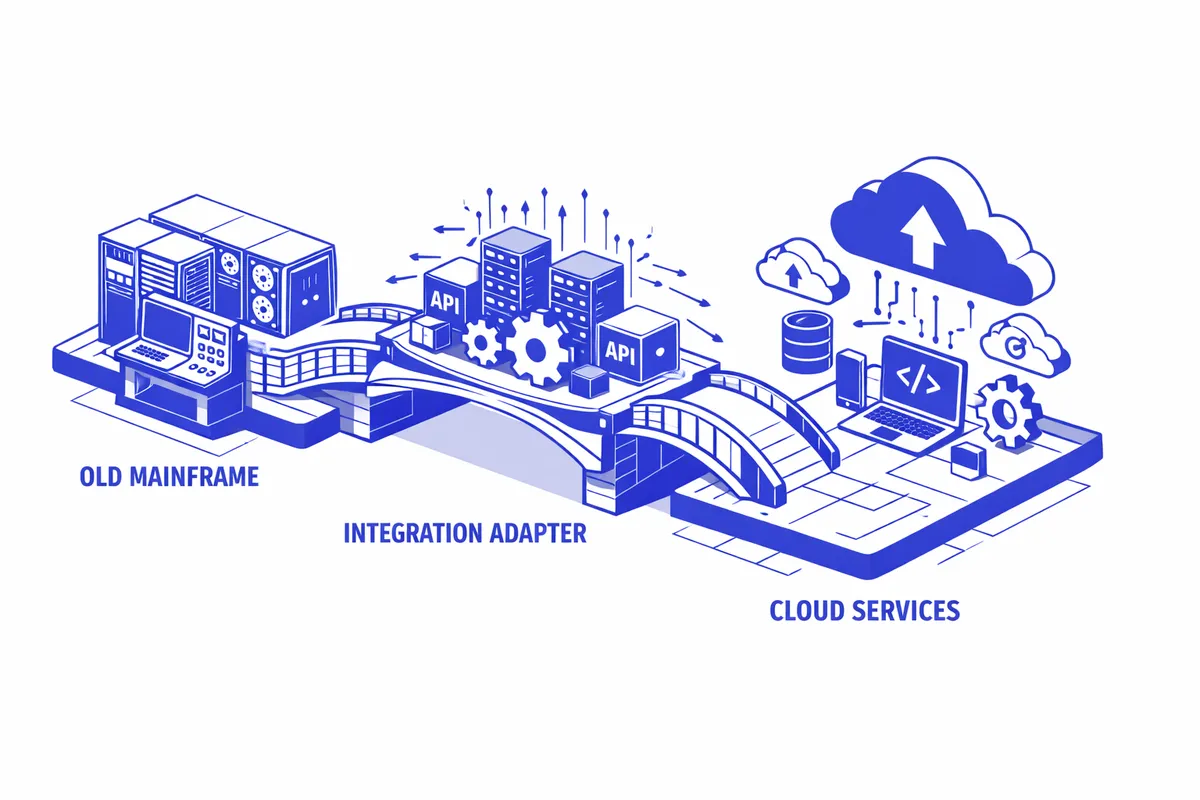
Our Legacy System Integration Services in Detroit
- Legacy system discovery, documentation, and capabilities assessment
- Integration architecture design and approach selection
- Automotive EDI integration: ANSI X12, Odette, and VDA standards
- Middleware and integration layer development
- API wrapper creation for systems without native API capabilities
- Database-level integration for direct data access
- File-based and batch integration for production systems
- Screen scraping and robotic process automation for UI-only systems
- HL7 v2 and FHIR integration for Detroit healthcare organizations
- MiHIN connectivity for Michigan health information exchange
- Data mapping and transformation between legacy and modern formats
- Data migration from legacy to modern systems with validation
- Reconciliation monitoring and data consistency management
- Modern web and mobile interface development layered on top of legacy data
- Compliance logging and audit trail design for regulated industries
- Incremental modernization roadmap development
Industries We Serve in Detroit
Automotive OEMs, Tier Suppliers, and Dealer Networks: Detroit's automotive legacy integration environment is unique in its depth and specificity. Ford in Dearborn, General Motors in Warren and Renaissance Center, and Stellantis each have proprietary ERP ecosystems, quality management platforms, and supply chain communication requirements that their supplier networks must integrate with. EDI standards, OEM-specific portal integrations, and production scheduling system connectivity are standard components of our automotive legacy integration work.
Manufacturing and Industrial: The broader manufacturing base across Wayne, Oakland, and Macomb counties, including the Automation Alley technology corridor, manages production and quality systems with deep customization that makes replacement risky and integration the right answer. Connecting these systems to modern analytics platforms, IoT infrastructure, and customer portals extends their operational value.
Healthcare and Hospital Systems: Henry Ford Health System, the Detroit Medical Center, Beaumont Health, and McLaren Health Care collectively manage one of the most complex clinical legacy integration environments in Michigan. HL7 message handling, FHIR API development, MiHIN connectivity, and HIPAA-compliant architecture are standard components of our healthcare legacy integration work in Detroit.
Medical Device and Pharmaceutical: Detroit-area medical device manufacturers and pharmaceutical distributors manage regulatory and quality systems that require integration with modern track-and-trace, serialization, and compliance platforms. The FDA's product traceability requirements make this integration work regulatory-critical.
Financial Services and Banking: Detroit's financial services community, from community banks across the metro to the financial operations of major Detroit employers, runs core banking and financial management systems that need integration with modern CRM, analytics, and digital banking platforms.
Defense and Aerospace: Michigan's defense and aerospace contractors, many located in southeast Michigan, operate under FAR and DFARS requirements that govern how their systems handle controlled unclassified information. Legacy integration architectures for defense contractors must account for these requirements from the start.
What to Expect
Step 1: Legacy System Discovery. We begin by documenting the legacy system's actual behavior: data structures, existing integration points, communication capabilities, and performance characteristics. For automotive systems, this includes identifying the specific EDI transaction sets, OEM portal protocols, and production data formats the system uses. For undocumented systems, this discovery builds the understanding necessary to design reliable integration.
Step 2: Integration Architecture Design. Based on discovery, we design the integration approach. For automotive EDI, this involves selecting between direct EDI translation, EDI VANs, and modern API-based supply chain platforms depending on your OEM customers' current requirements. For healthcare systems, this involves HL7 or FHIR translation layer design. We design error handling and reconciliation frameworks that maintain data consistency under production conditions.
Step 3: Development and Testing. We build the integration layer and test it using production-representative data and transaction volumes. For automotive integrations, testing includes certification testing with OEM customers. For healthcare integrations, testing includes compliance scenario coverage. We test reconciliation logic and error handling before any live data flows through the integration.
Step 4: Deployment and Monitoring. We deploy with monitoring that alerts on errors, data inconsistencies, or performance degradation. Detroit's automotive legacy integrations require monitoring that can detect missing EDI transactions before they become delivery failures. We remain engaged post-launch to address issues as they arise.