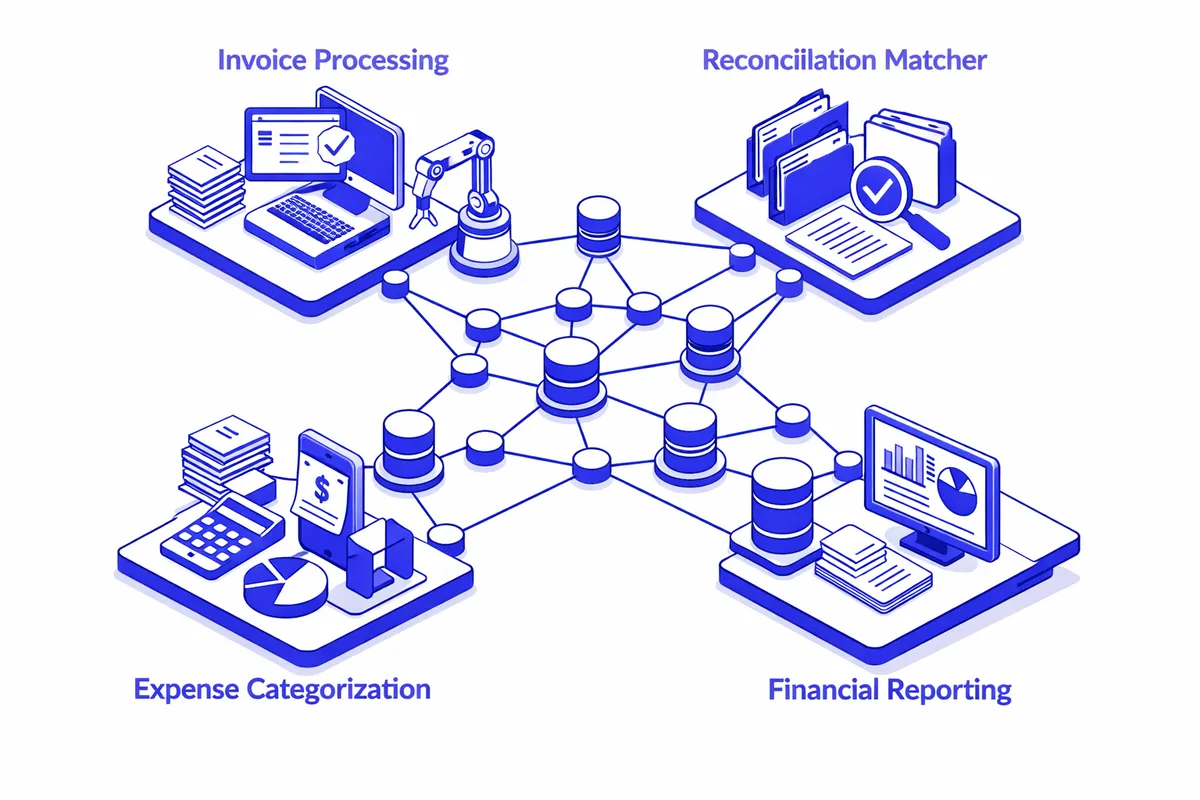
Our Accounting Automation Work in Detroit
- Three-way purchase order matching automation for Metro Detroit automotive suppliers and manufacturers, eliminating manual comparison of POs, receiving records, and invoices for high-volume supplier payment operations
- Automated bank reconciliation for Detroit businesses managing multiple bank accounts and high transaction volumes, with intelligent matching that handles partial payments and currency differences
- Cost accounting automation for Detroit manufacturers tracking production costs, labor allocations, and overhead by job, product line, and plant across multi-facility operations
- Insurance claim reconciliation automation for Detroit healthcare organizations managing multi-payer billing across the Wayne, Oakland, and Macomb county health systems
- Expense report automation for Detroit businesses with field employees and significant travel spending, replacing paper receipts with mobile capture and automatic cost center allocation
- Multi-entity accounting consolidation for Metro Detroit holding companies, automotive group parent companies, and corporate structures spanning multiple operating entities
- Michigan Business Tax and sales and use tax automation for compliance accuracy, including the manufacturing exemptions that reduce Michigan sales tax liability on qualifying purchases
- QuickBooks, Sage, SAP, and Microsoft Dynamics integration connecting accounting software to the ERP and operations systems common in the Detroit automotive and manufacturing market
- Legacy system migration support for Detroit manufacturers moving from aging on-premises accounting software to cloud-based platforms with automation capability
- Automated financial close packages for Detroit companies with investor oversight requirements or bank reporting obligations
Industries We Serve in Detroit
Automotive. Ford, GM, Stellantis, and the hundreds of Tier 1 and Tier 2 suppliers that form the backbone of the Metro Detroit economy need automated purchase order matching, supplier payment processing, warranty cost tracking, and multi-plant cost consolidation. The volume and complexity of automotive accounting at any level of the supply chain demands automation. Suppliers that process payments faster and more accurately build better supplier relationships with their OEM customers and avoid the costly late payment penalties that manual processes accumulate.
Manufacturing. Detroit's broader manufacturing base, from precision metal fabrication in Sterling Heights to plastics and polymers in suburban Macomb County, needs automated cost accounting, inventory valuation, accounts payable management, and production variance reporting. Real-time cost visibility enables better pricing decisions and faster response to material cost changes. Automation makes that visibility possible without requiring a dedicated cost accountant to manually compile reports.
Healthcare. Henry Ford Health System, Detroit Medical Center, McLaren Health Care, and the network of clinics, community health centers, and specialty practices across Wayne, Oakland, and Macomb counties need automated insurance claim reconciliation and accounts receivable management. The complexity of multi-payer billing in healthcare, combined with the volume of transactions at major health systems, makes manual reconciliation both inefficient and error-prone. Automation recovers revenue that manual processes miss and shortens the revenue cycle.
Real Estate and Development. Detroit's downtown and neighborhood development activity is creating large real estate portfolios that need automated property accounting and owner reporting. Developers managing multiple projects across downtown, Midtown, and Detroit's revitalizing neighborhoods need consolidated financial visibility that manual processes cannot efficiently provide.
Technology. Companies at TechTown, the Michigan Central innovation hub, and Detroit's growing tech sector need automated accounting that keeps pace with growth without proportional back-office headcount. Revenue recognition for subscription and usage-based products, automated customer invoicing, and real-time financial dashboards are the automation priorities for most Detroit tech companies.
Professional Services. Detroit's law firms, accounting firms, and consulting companies need automated billing tied to time tracking, expense management with mobile capture, and client-level profitability reporting. Firms that know which clients and matters are actually profitable make better business development decisions.
Logistics. Michigan's freight and distribution companies, including those operating at Detroit Metropolitan Wayne County Airport and the Ambassador Bridge corridor, need automated invoice processing and reconciliation for high-volume carrier and shipper transactions. Freight audit automation that validates carrier charges against contracted rates before payment catches overcharges automatically.
Nonprofits. Detroit's active nonprofit and community development sector, from neighborhood organizations to major cultural institutions, needs fund accounting automation that tracks grant restrictions, produces funder reporting, and meets IRS requirements for Form 990 preparation. Grant tracking automation ensures that restricted funds are spent in compliance with grant terms and that reporting to funders is accurate and timely.
What to Expect
Discovery. We start by understanding your current financial processes, software environment, and the specific bottlenecks your finance team experiences. For manufacturers and automotive suppliers, this includes mapping the PO-to-payment cycle and identifying where delays and errors occur. For healthcare organizations, we review the claim-to-payment cycle and reconciliation process. We do not recommend automation until we understand the specifics of your situation.
Strategy. We deliver a prioritized automation roadmap that identifies the highest-ROI workflows and sequences them for implementation. For Detroit manufacturers, this often means starting with three-way matching for high-volume AP, then building to cost accounting and consolidation. We give you specific time savings and cost estimates before any work begins.
Implementation. We configure and connect automation within your existing accounting environment, including integration with the SAP, Oracle, Plex, or other ERP systems common in the Detroit market. We test with real transaction data from your environment before go-live and provide hands-on training for your finance and accounting teams.
Ongoing Support. Detroit's business environment changes. New entities are formed, new software is acquired, tax requirements shift. We offer ongoing support arrangements that keep your automation current and address new automation opportunities as your business evolves.
Detroit Precision Applied to Your Financial Operations
Your operations run on precision. Your accounting should too. Running Start Digital builds automation that brings the same rigor to financial processes that Detroit manufacturing applies to the shop floor. Contact us to discuss your accounting automation needs.