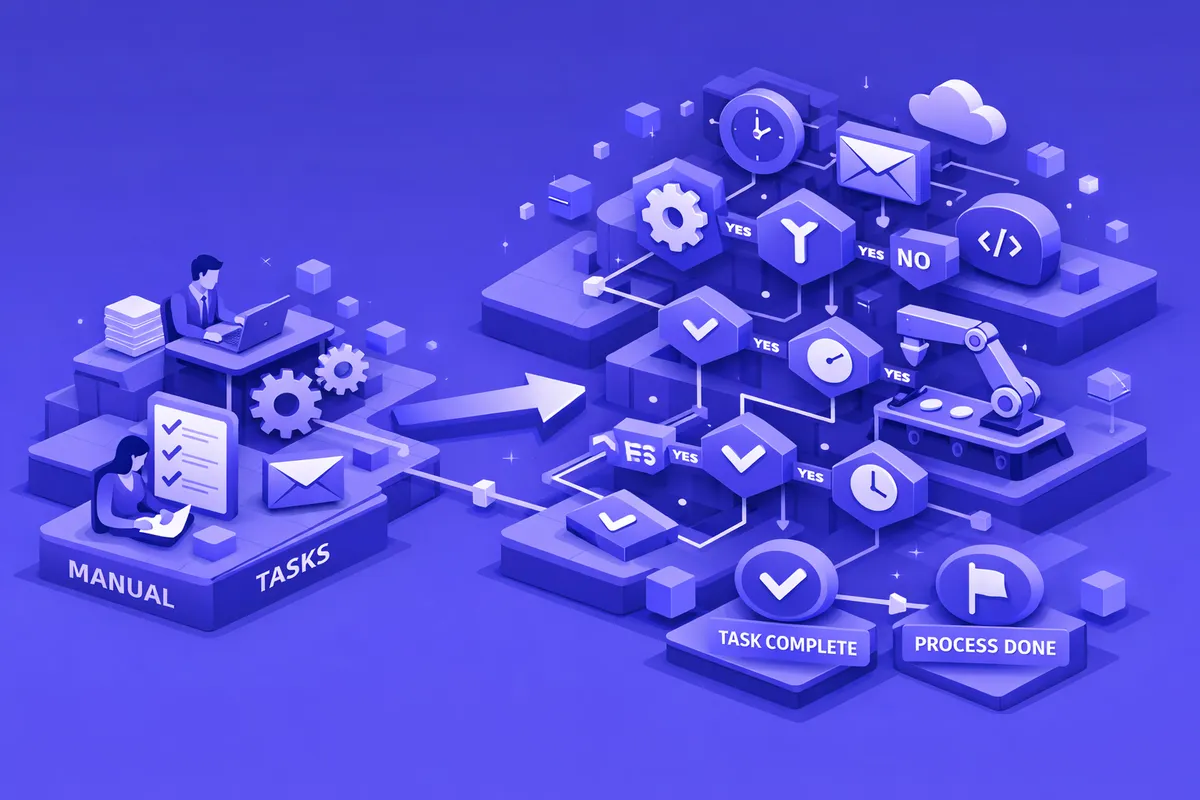
Our Business Process Automation Services in Detroit
- Process mapping and automation opportunity assessment across departments
- Automation strategy with prioritized roadmap and documented ROI projections
- Workflow design and digital process implementation
- Robotic process automation (RPA) for legacy manufacturing ERP and MES systems
- Automotive supplier EDI and OEM portal integration automation
- System integration automating data flow between operational platforms
- Document processing, generation, and routing automation
- Quality documentation and compliance workflow automation
- Approval and escalation workflow automation with configurable rules
- Healthcare-specific automation: patient intake, insurance verification, prior authorization, and billing
- Customer and supplier communication automation
- Exception handling workflows with intelligent routing to human review
- Process monitoring dashboards and alerting
- Testing, documentation, and staff training
Industries We Serve in Detroit
Automotive Manufacturing and Tier 1 Suppliers (Dearborn, Warren, Auburn Hills). Detroit's automotive supply chain is one of the most process-intensive business ecosystems in the world. Purchase order processing, quality control documentation, supplier performance reporting, tooling change requests, and production planning communication are each individually complex and collectively exhausting to manage manually. We build automations that connect supplier systems to OEM portals, route quality documents through approval workflows, and generate production reports automatically. The result is fewer manual data entry errors, faster processing times, and supply chain staff focused on relationship and exception management rather than routine data handling.
Industrial Manufacturing and Metalworking. Metro Detroit's industrial sector extends well beyond automotive. Machine shops, metalworking companies, plastics manufacturers, and industrial service providers throughout Wayne, Oakland, and Macomb counties share common process automation needs: quoting, order acknowledgment, purchase order processing, and shipping notification. We automate these workflows to reduce cycle time and eliminate the manual errors that cost money and customer goodwill.
Healthcare Systems (Henry Ford, Corewell, Detroit Medical Center). Detroit's major health systems and the independent practices in their networks process enormous administrative volume daily. Prior authorization requests, insurance eligibility checks, appointment reminders, referral routing, and billing reconciliation are each labor-intensive when manual. Automated together, they dramatically reduce administrative overhead while improving accuracy. We design every healthcare automation with HIPAA compliance as a built-in requirement, not an afterthought.
Technology Startups and SaaS Companies (TechTown, Corktown). Detroit's growing technology sector, anchored by TechTown Detroit and the Corktown innovation district, includes companies that use automation as a core operational strategy from their earliest days. We help these companies automate customer onboarding, subscription management, support ticket routing, and reporting so they can scale without administrative headcount growing proportionally.
Financial Services and Banking. Detroit's banking and credit union community serves one of the most financially complex metro areas in the Midwest. Loan origination document collection, compliance reporting, customer onboarding, and audit documentation are all processes that automation handles more reliably than manual execution. We build financial automations that meet Michigan regulatory requirements and federal compliance standards.
Professional Services and Consulting. Law firms, accounting practices, and management consulting firms throughout Downtown and Midtown manage document-intensive workflows at every client engagement. Proposal generation, billing, and compliance filings are all automatable. We build workflows that reduce administrative burden so professional staff focus on billable work.
What to Expect
Discovery. We spend two weeks mapping your current processes: every step, every handoff, every system touchpoint, and every error. We interview the people doing the work, not just leadership, because the actual process usually differs from the documented one. This phase produces a quantified picture of automation opportunity with time and error data attached to each candidate.
Strategy. We present a prioritized roadmap with explicit ROI projections. You choose which processes to automate first based on your priorities. We design the complete automation architecture before any build begins so integration complexity and cost are fully visible before you commit.
Implementation. We build automations in phases, starting with the highest-priority process. Each automation goes live before the next begins. Detroit clients typically have a production automation running within six weeks of kickoff. We test against real production data and run a structured acceptance period before each automation is fully live.
Results. We establish baseline metrics before deployment and track them after. We report time saved, error rate changes, and staff capacity released to higher-value work. Ongoing support includes monitoring, issue response, and updates as your processes and systems evolve.