Your Cart (0)

Your cart is empty

Atlanta

Legacy System Integration in Atlanta

Professional legacy system integration services for Atlanta businesses. Strategy, execution, and results.

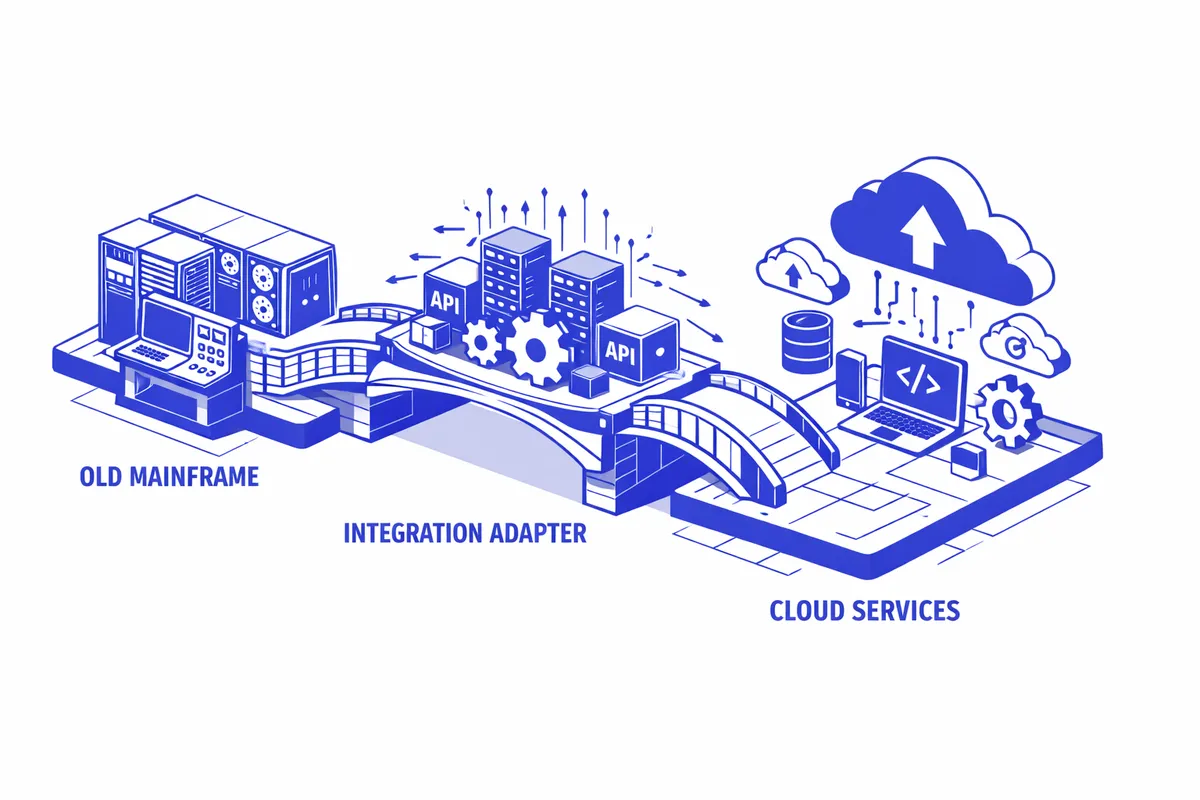
Legacy System Integration in Atlanta service illustration

Our Legacy System Integration Services in Atlanta

  • Legacy system discovery, documentation, and capabilities assessment
  • Integration architecture design and approach selection
  • Middleware and integration layer development
  • API wrapper creation for systems without native API capabilities
  • File-based and batch integration for systems with no real-time capability
  • Database-level integration for direct data access
  • Screen scraping and robotic process automation for UI-only legacy systems
  • Data mapping and transformation between legacy and modern formats
  • HL7 v2 and FHIR integration for Atlanta healthcare organizations
  • EDI integration for logistics and supply chain legacy systems
  • Data migration from legacy to modern systems with validation and reconciliation
  • Reconciliation monitoring and ongoing data consistency management
  • Modern web and mobile interface development on top of legacy data
  • Compliance logging and audit trail design for regulated industries
  • Incremental modernization planning and roadmap development

Industries We Serve in Atlanta

Healthcare and Hospital Systems: Emory Healthcare, Grady Memorial, Piedmont Healthcare, Northside Hospital, and WellStar collectively represent one of the most complex clinical legacy integration environments in the Southeast. HL7 message handling, FHIR API development, health information exchange connectivity, and HIPAA-compliant data architecture are all standard components of our healthcare legacy integration work in Atlanta.

Financial Services and Banking: Buckhead's financial services concentration and Midtown's growing fintech community both carry legacy system integration needs. Core banking platforms, wealth management systems, and financial data infrastructure need to connect to modern CRM, analytics, and compliance tools through integration layers that meet SEC, FINRA, and state banking regulation requirements.

Logistics and Supply Chain: The logistics companies along the Hartsfield-Jackson corridor, including the freight forwarders, 3PLs, and supply chain technology companies concentrated in College Park and the I-75 and I-85 industrial strips, rely on TMS and WMS systems that need to connect to modern visibility platforms, customer portals, and analytics tools.

Manufacturing and Industrial: Atlanta-area manufacturers, from the aerospace suppliers serving the military and commercial aviation sectors to the consumer goods manufacturers in the suburban industrial parks, manage production and quality systems with deep customization that makes replacement risky. Integration extends the value of these systems rather than forcing premature replacement.

Government and Public Sector: Georgia state agencies and Atlanta city government manage operations on systems built in previous generations of technology. Connecting these systems to modern citizen-facing portals and interagency data sharing platforms is ongoing legacy integration work we support.

Insurance and Financial Intermediaries: Atlanta's insurance industry, from the major carriers with Southeast operations to the independent agencies and brokers across the metro, runs policy and claims systems built before modern integration standards. Connecting these to modern distribution, CRM, and analytics platforms is a common engagement category.

What to Expect

Step 1: Legacy System Discovery. We begin by documenting the legacy system's actual behavior: its data structures, its integration points if any exist, its communication capabilities, and its performance characteristics under the transaction loads the integration will create. For undocumented systems, this discovery process is how we build the understanding necessary to design a reliable integration.

Step 2: Integration Architecture Design. Based on discovery, we design the integration architecture: whether API wrapper, database-level integration, file-based exchange, or RPA automation is the right approach; how data transformation and mapping will handle format differences between old and new systems; how the reconciliation and error handling framework will maintain data consistency.

Step 3: Development and Testing. We build the integration layer and test it against the legacy system using production-representative data and transaction volumes. Integration testing across system boundaries requires specific test scenarios that verify both the happy path and error conditions. We test reconciliation logic and error handling before any live data flows through the integration.

Step 4: Deployment and Monitoring. We deploy the integration with monitoring that alerts on errors, data inconsistencies, or performance degradation. Legacy integrations require sustained monitoring because legacy systems have behaviors that only surface under specific conditions that testing may not fully anticipate. We remain engaged post-launch to address issues as they arise.

Frequently Asked Questions

Healthcare legacy integration requires HIPAA compliance embedded in the architecture from the start, not added as a compliance review at the end. Patient data in transit between legacy and modern systems must be encrypted using current standards. Access to patient records through integration points must be role-restricted and logged for audit purposes. Business Associate Agreements must be in place for any third-party system receiving patient data through the integration. We design healthcare integrations using HL7 v2, HL7 FHIR, and CCD where appropriate, and we review all integration architectures against HIPAA technical safeguard requirements before development begins. The compliance framework is a design constraint, not a post-development checklist.

HL7 (Health Level 7) is the messaging standard that governs how clinical systems exchange patient data. Many legacy healthcare systems in Atlanta's hospital networks were built to send and receive HL7 v2 messages for patient registration, lab results, clinical notes, and discharge summaries. Modern systems often use FHIR (Fast Healthcare Interoperability Resources), the newer HL7 standard. Integration between legacy HL7 v2 systems and modern FHIR-based platforms is one of the most common healthcare integration projects we execute for Atlanta organizations. We build the translation layer that converts between formats so both old and new systems communicate accurately and the patient data flowing between them maintains clinical accuracy.

Yes. Undocumented legacy systems are common in Atlanta's established manufacturing, healthcare, and financial services organizations. When documentation does not exist, we begin with a discovery process that maps the system's behavior by observing it: what data flows in, what flows out, and how the system responds to different inputs. We use network traffic analysis, database schema examination, and behavioral testing to build an understanding of the system sufficient to design reliable integration. This approach is slower than working from documentation, and we scope accordingly, but it is often the only available path for systems that predate modern software documentation practices.

Cost depends on the complexity of the legacy system, the nature of the integration required, and the number of connected systems. A focused integration between a single legacy system and one modern platform, where the legacy system has some integration capability, typically costs $30,000 to $75,000. More complex integrations involving undocumented systems, multiple connected platforms, healthcare compliance requirements, or significant data migration components cost more. We provide detailed estimates after a discovery engagement where we assess the legacy system specifically. Legacy integration projects carry more uncertainty than greenfield projects because of the unknowns in the legacy environment. We scope conservatively to reflect that reality.

EDI integration for Atlanta logistics and supply chain companies typically involves connecting legacy TMS or WMS systems to modern EDI translation platforms that handle communication with trading partners. Legacy systems that produce flat files can be integrated through file-pickup-and-translation workflows. Systems with database access can be integrated through direct query and EDI translation. Systems with no accessible data interface may require RPA to extract data from the user interface and feed it to the EDI platform. We assess each legacy system's specific integration capabilities and design the approach that provides the most reliable and maintainable data flow for your specific trading partner requirements.

Integration carries significantly lower risk than full replacement. The legacy system continues to run as it always has, so the core business process it supports is not disrupted during the integration project. If the integration project encounters problems, the legacy system continues operating while issues are resolved. Full replacement projects, by contrast, require the new system to be ready and reliable before the old one is decommissioned. When replacement projects encounter problems, which is common at scale, the business is caught between a system being decommissioned and a replacement that is not ready. Integration avoids this risk entirely. The trade-off is that integration leaves the limitations of the legacy system in place. For most Atlanta businesses, integration is the right approach until the business case for full replacement is clear and the organization is prepared to manage the replacement risk carefully. Atlanta businesses looking to connect legacy systems with modern capabilities should contact Running Start Digital. We will start with a discovery conversation about your specific legacy environment and what modern connectivity would enable for your operations.

Ready to get started?

Let's talk about legacy system integration for your Atlanta business.