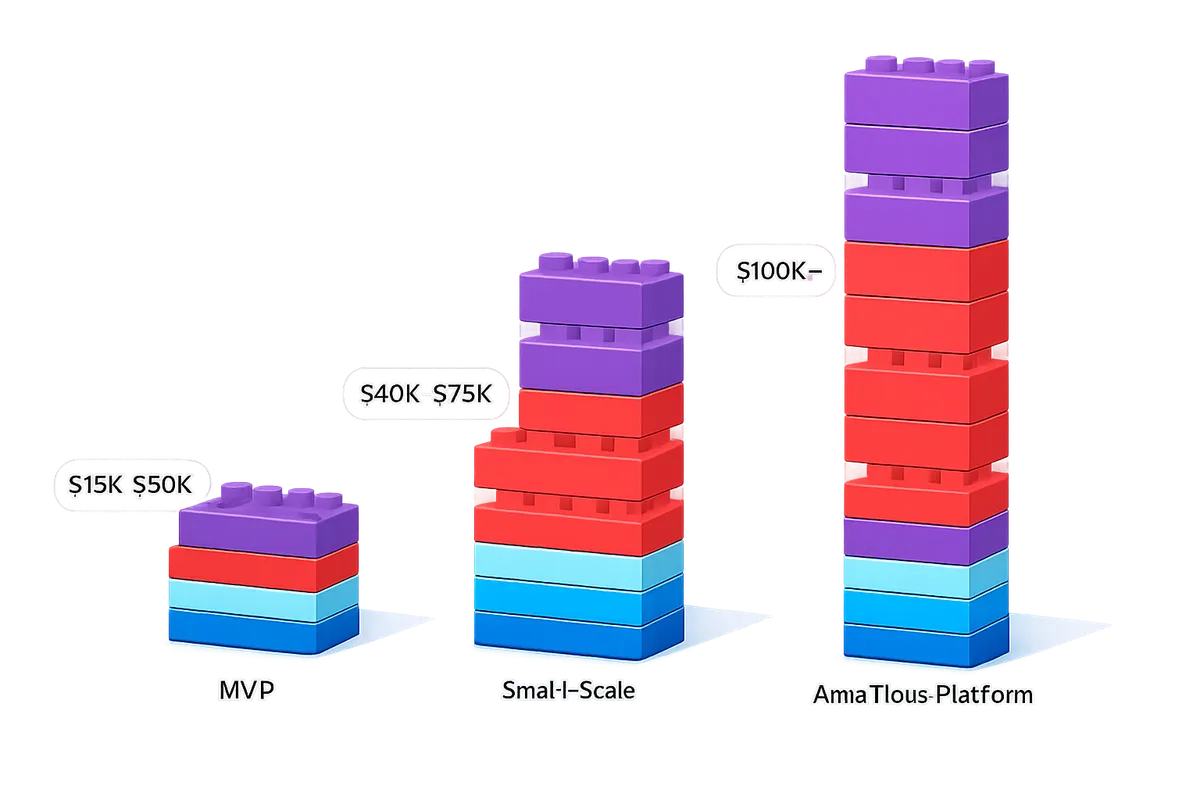
Minimum Viable Product: $5,997 to $9,997
A focused app solving one problem for one group of users. This tier validates whether your concept works before you invest in a full platform.
What this looks like in practice. A customer portal where clients log in, view their account status, and submit requests. An internal workflow tool that replaces a 12-step spreadsheet process with a guided form and automated notifications. A mobile app that lets field technicians log inspections with photos and GPS coordinates.
Scope characteristics. Single user type or two simple roles (admin and user). Core feature set of 5 to 8 screens. Basic reporting and data export. Simple, clean user interface focused on the primary workflow.
Timeline: 4 to 8 weeks with a team of 1 to 2 developers and a designer.
Includes: Discovery and requirements, UI/UX design, development, user testing, deployment to production, basic documentation.
Does not include: Advanced security features like SSO or role-based access beyond basic admin/user splits, large-scale infrastructure, white-glove training, or ongoing development beyond bug fixes.
Real example: A property management company needed a tenant portal where residents could submit maintenance requests, track status, and pay rent online. The MVP included request submission with photo uploads, a status tracker, and Stripe integration for payments. Total cost: $8,200. Time to launch: 6 weeks. The app handled 340 maintenance requests in its first quarter and reduced phone calls to the office by 60%.
Small-Scale Application: $14,997 to $29,997
Supporting multiple user types, more complex workflows, and integrations with your existing tools. This tier is for businesses with a proven process that needs to scale.
What this looks like in practice. A team collaboration platform with role-based permissions, task assignment, file sharing, and activity tracking. A client management system with intake forms, service tracking, invoicing, and client-facing dashboards. A mobile app with offline capability, push notifications, and real-time data sync.
Scope characteristics. Three to five user roles with distinct permissions. Feature set of 15 to 30 screens. Integrations with 2 to 4 external systems (CRM, payment processor, email platform, accounting). Automated workflows and notification systems. Analytics dashboard with custom reporting.
Timeline: 8 to 16 weeks with a team of 2 to 3 developers and a designer.
Includes: Full discovery process, user research, comprehensive UI/UX design, development, integration work, QA testing, analytics setup, deployment, and 30 days of post-launch support.
Does not include: Machine learning features, enterprise-grade security certifications (SOC 2, HIPAA), or large-scale data processing pipelines.
Real example: A home services company needed a scheduling and dispatch platform. The application included a booking and scheduling system for customers, a dispatch dashboard for managers, a mobile app for technicians with GPS routing and job checklists, and QuickBooks integration for automatic invoicing. Total cost: $24,500. Time to launch: 12 weeks. The platform processes 1,200 jobs per month and reduced scheduling errors from 15% to under 2%.
Ambitious Platform: $45,000 to $100,000+
Multi-user platforms with complex workflows, advanced reporting, third-party integrations, and scalable infrastructure. This tier is for businesses building technology as a core competitive advantage or launching a SaaS product.
What this looks like in practice. A marketplace connecting buyers and sellers with search, messaging, payments, reviews, and dispute resolution. A multi-tenant SaaS application where each customer gets their own workspace with customizable workflows. An enterprise operations platform handling inventory, logistics, billing, and reporting across multiple locations.
Scope characteristics. Five or more user roles with granular permissions. Feature set exceeding 50 screens. Integrations with 5 or more external systems. Real-time data processing, webhooks, and event-driven architecture. Advanced analytics with custom dashboards and scheduled reports. Mobile apps for iOS and Android alongside the web platform.
Timeline: 16 to 40 weeks with a full-service team including architects, senior developers, QA engineers, and DevOps.
Includes: Product strategy, market research, user research, comprehensive design system, full-stack development, performance optimization, security hardening, DevOps and CI/CD pipeline, documentation, training, and 90 days of post-launch support.
Real example: A staffing agency needed a platform connecting employers with temporary workers. The system included employer dashboards for posting shifts and managing workers, a mobile app for workers to browse and accept shifts, automated time tracking with GPS verification, payroll integration with ADP, and an admin panel for the agency. Total cost: $78,000. Time to launch: 28 weeks. The platform now processes 3,000 shift assignments monthly across 45 employer accounts.
What Drives App Development Costs Up
Understanding the cost multipliers helps you control your budget.
Undefined scope. Projects without clear requirements cost 2 to 3 times more than well-scoped projects. Every ambiguous feature becomes a discussion, a revision, and a delay. Writing a thorough requirements document before development starts is the single most effective way to control costs.
Complex integrations. Connecting to modern APIs with good documentation (Stripe, Twilio, SendGrid) adds $1,000 to $3,000 per integration. Connecting to legacy systems with poor documentation, SOAP APIs, or custom protocols can add $5,000 to $15,000 per integration.
Real-time features. Chat, live notifications, collaborative editing, and real-time dashboards require WebSocket infrastructure that adds 20 to 40% to development costs compared to standard request-response patterns.
Regulatory compliance. HIPAA compliance for healthcare apps, PCI-DSS for payment processing, SOC 2 for enterprise SaaS. Compliance requirements add $10,000 to $30,000 in security infrastructure, documentation, and audit preparation.
Cross-platform mobile development. A web app is one codebase. Adding native iOS and Android apps doubles or triples frontend development costs. React Native or Flutter can reduce this to a 50 to 70% increase, but the complexity of maintaining mobile apps alongside a web platform is significant.
Changing direction mid-project. Pivoting after 60% of development is complete can cost more than starting over. Lock your core requirements before development begins and save enhancements for post-launch iterations.
The Hidden Costs After Launch
Development is roughly 40% of your total app cost over five years. The other 60% is everything that happens after launch.
Hosting and infrastructure. Cloud hosting for a small to mid-size application runs $100 to $500 per month on platforms like AWS, Google Cloud, or Vercel. High-traffic applications with large databases can reach $2,000 to $5,000 per month. Budget $1,200 to $6,000 annually for a typical business application.
Maintenance and bug fixes. Plan for 15 to 20% of initial build cost annually. A $50,000 application costs $7,500 to $10,000 per year in maintenance. This covers security patches, dependency updates, OS and browser compatibility fixes, and bug resolution.
Feature development. Your users will request features. Your business will evolve. Budget for 1 to 2 development sprints per quarter at $3,000 to $8,000 each to keep the application advancing.
Third-party service costs. Payment processing fees (2.9% + $0.30 per transaction with Stripe), email delivery ($20 to $200/month), SMS notifications ($0.01 to $0.05 per message), analytics tools, and monitoring services add up. A typical SaaS application accumulates $300 to $1,500 in monthly third-party costs.
Total cost of ownership example. A $30,000 application with $200/month hosting, $5,000/year maintenance, $20,000/year feature development, and $500/month third-party services costs approximately $112,400 over three years. Plan for the full picture, not just the build.
How to Get the Most Value From Your Budget
Start with the smallest version that proves the concept. Launch with 5 core features, not 50. Validate with real users. Then invest in the features they actually request rather than the ones you assumed they would need.
Invest in discovery and planning. Spending $2,000 to $5,000 on a proper discovery phase with user research, workflow mapping, and technical architecture saves $10,000 to $30,000 in development rework.
Choose the right technology stack. Frameworks like Next.js, React Native, and PostgreSQL reduce development time compared to building from scratch. An experienced team recommends the stack based on your requirements, not their preferences.
Plan for iteration, not perfection. Ship version 1.0 in 8 weeks. Ship version 1.1 with user feedback improvements in 12 weeks. This approach costs less and produces better results than trying to build the perfect application in one 6-month cycle.
Why Running Start Digital
We do not build apps without understanding your business model first. Most development shops take a feature list and start coding. We start with your revenue model, growth targets, and user needs. Then we design the technology to support them.
We scope clearly. You see exactly what is building and when. No mystery invoices. Milestones and deliverables are defined before development begins. Weekly progress demos show you what is working so you can course-correct early, not after months of invisible development.
Our custom AI solutions and workflow automation capabilities mean your application can include intelligent features like automated document processing, chatbot functionality, and predictive analytics without hiring a separate AI team.
Frequently Asked Questions
How much does a simple mobile app cost to build?
A simple mobile app with a single user type, 5 to 8 screens, and basic functionality costs $5,997 to $9,997. This covers design, development, testing, and deployment. A cross-platform approach using React Native or Flutter keeps costs lower than building separate iOS and Android apps. Add $2,000 to $5,000 if you need backend API development in addition to the mobile frontend.
How long does app development take?
Timeline depends on complexity. An MVP takes 4 to 8 weeks. A small-scale application with integrations takes 8 to 16 weeks. An ambitious platform takes 16 to 40 weeks. These timelines assume clear requirements and responsive client communication. Add 30 to 50% if requirements are still being defined during development.
Should I build a web app or a mobile app?
Start with a web app unless your core use case requires native mobile capabilities like camera access, GPS, push notifications, or offline functionality. A responsive web app works on all devices, costs less to build and maintain, and can be enhanced with a mobile app later if user behavior justifies the investment. Progressive Web Apps (PWAs) offer a middle ground with some mobile capabilities at web app costs.
What is the difference between no-code, low-code, and custom development?
No-code tools (Bubble, Airtable, Webflow) cost $0 to $200/month and work for simple internal tools or prototypes. Low-code platforms (Retool, OutSystems) cost $500 to $5,000/month and work for moderately complex internal applications. Custom development costs $5,997 or more upfront but gives you full control, unlimited customization, and no platform dependency. Choose based on complexity, scale, and how critical the application is to your business.
How do I choose a development partner?
Look for teams that ask about your business model before discussing technology. Review their portfolio for applications similar to yours in complexity. Ask for references from clients who launched 12 or more months ago so you can assess long-term quality. Verify they provide a detailed scope document before starting development. Avoid teams that cannot estimate cost within a 30% range after a discovery conversation.
What happens if my app needs to scale significantly after launch?
Architecture decisions made before development determine scaling costs. Applications built on scalable infrastructure (cloud-hosted, containerized, with proper database indexing) handle 10x user growth with minimal changes. Applications built without scalability in mind may require partial or complete rebuilds. We architect every application for your projected 3-year growth trajectory so scaling is a configuration change, not a rewrite.
Book a strategy call with Running Start Digital. We will walk through your problem, recommend whether a custom app is the right solution, and outline what it would take to build and sustain it. Get started.