AI Tools That Are Working Right Now
AI Damage Assessment from Drone Imagery
Drones have already transformed roof inspections by eliminating the need to climb every roof for an initial assessment. But the raw drone footage still requires a human to review, identify damage, and document findings. That review process takes 20 to 45 minutes per property for an experienced estimator. During a storm season with hundreds of leads per week, that bottleneck limits how many properties you can inspect and estimate.
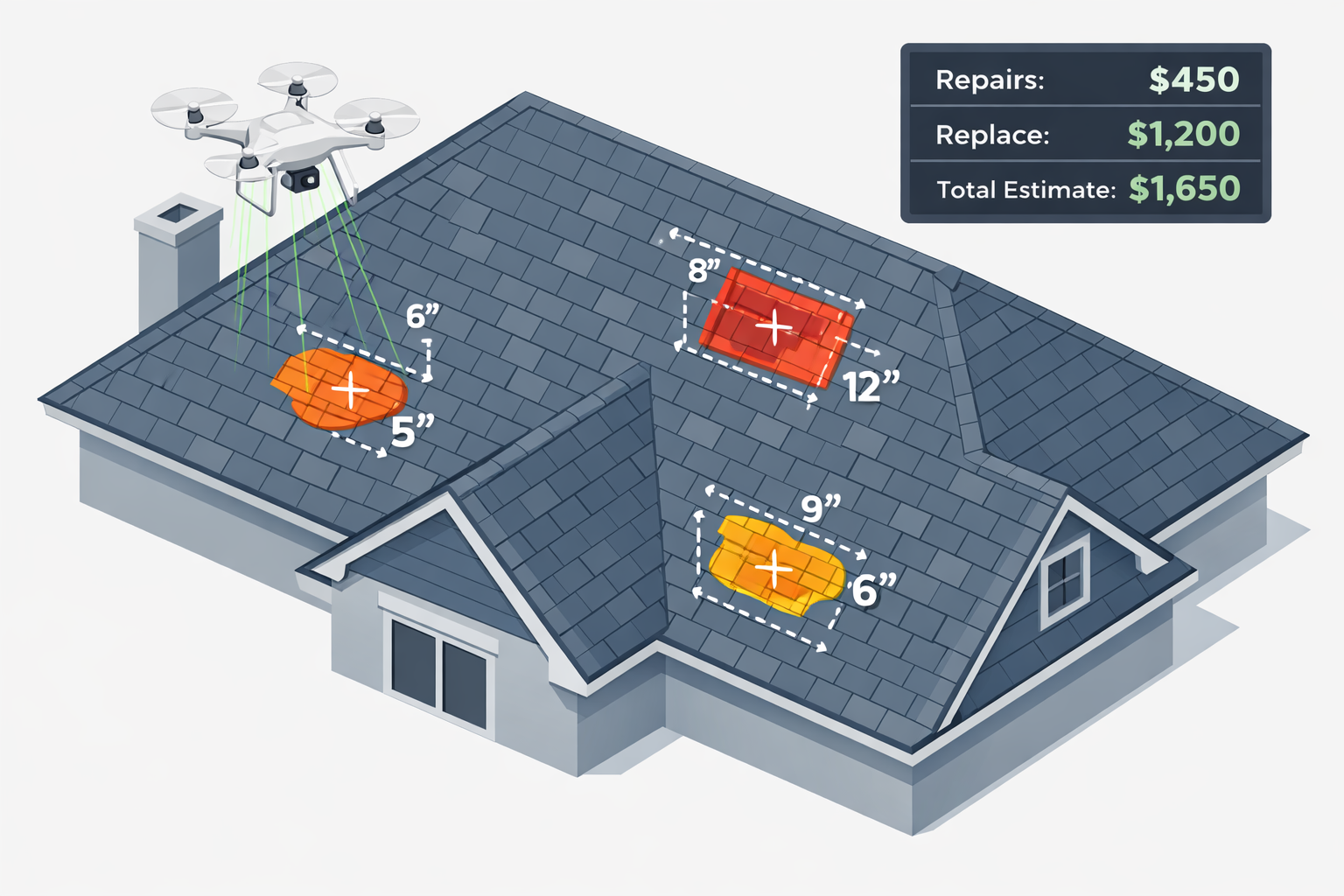
AI damage assessment processes drone imagery automatically. The system identifies hail impacts, wind damage, missing or displaced shingles, granule loss, flashing damage, and structural issues from aerial photos and video. It classifies damage by type and severity. It maps the damage locations onto the roof surface. And it generates a preliminary damage report with annotated images in minutes rather than the better part of an hour.
The accuracy is genuinely impressive. AI damage detection trained on hundreds of thousands of roof images identifies damage patterns that even experienced adjusters miss, particularly subtle hail impacts and early-stage granule loss. The system does not get tired, does not rush through inspections at the end of a long day, and applies the same criteria to every roof.
For storm restoration contractors, this capability is a game changer. A single drone operator can inspect 15 to 20 properties per day. AI analysis processes the imagery concurrently. By the time the drone operator returns to the office, damage reports are ready for every property inspected that day. Compare that to the traditional approach of one inspector per property spending 1 to 2 hours on site, and the throughput difference is staggering.
This speed matters because storm restoration is a race. The contractor who contacts the homeowner with a professional damage assessment first has an enormous advantage over competitors who are still trying to schedule their initial inspection.
Automated Insurance Scope Documentation
Insurance scoping is where most roofing contractors lose time and margin. The documentation requirements are precise. Xactimate line items need to match the damage findings. Photos need to support every claimed item. Measurements need to be accurate. Supplement documentation needs to be thorough enough to withstand adjuster pushback.
AI document processing takes damage assessment data (from drone imagery or manual inspection) and generates insurance-compliant scope documentation automatically. The system maps damage findings to appropriate Xactimate codes. It attaches supporting photography with annotations highlighting the damage. It calculates material quantities from roof measurements. And it generates supplement documentation with the supporting evidence needed to justify additional scope items.
For contractors who spend 1 to 3 hours per property on insurance documentation, AI automation reduces that to 15 to 30 minutes of review and approval. The quality is consistent because the AI applies the same documentation standards to every file. And the supplement success rate improves because the supporting evidence is comprehensive and well-organized.
The revenue impact goes beyond time savings. Better-documented scopes result in higher approval rates on initial submission, which reduces the back-and-forth with adjusters. More thorough supplement packages capture revenue that would otherwise be left on the table. And faster documentation means faster payment cycles.
Discover how AI document processing eliminates the documentation bottleneck.
Weather-Triggered Crew Scheduling
Every roofing contractor knows the pain of weather disruption. You schedule a crew for Tuesday, Monday's forecast shows rain, and now you need to rearrange an entire week of work. Multiply that by 5 to 10 active projects and the scheduling puzzle becomes a full-time job.
AI scheduling for roofing integrates real-time weather data at a granular level. Not just the daily forecast, but hourly precipitation probability, wind speed predictions, temperature ranges, and dew point forecasts that affect material installation requirements. The system knows that shingle installation needs dry conditions and moderate temperatures, while tear-off can proceed in light drizzle, and that metal roofing has different wind speed limits than composite.
When weather forecasts change, the AI automatically recalculates the schedule. It identifies which projects can proceed and which need to shift. It considers crew specializations (not every crew handles every material type), material delivery schedules, and permit inspection windows. It produces an updated plan that maximizes productive workdays across the weather window.
The system also looks ahead. If the 10-day forecast shows a dry window starting Thursday, the AI pre-positions materials and alerts crews to be ready. If extended rain is coming, it accelerates projects that can be completed before the weather turns and defers starts on projects that cannot.
For roofing companies running 5 or more crews, weather-triggered scheduling typically recovers 2 to 4 lost production days per month. At average daily crew revenue of $3,000 to $8,000, the recovered production days alone justify the cost of AI integration multiple times over.
See how booking and scheduling systems handle the complexity of weather-dependent trades.
AI Estimating from Aerial Measurements
Roof measurement and estimating is traditionally a manual process. Drive to the property. Measure the roof (or order a satellite measurement report and wait for delivery). Manually calculate quantities for each material. Build the estimate in your software. The process takes 1 to 3 hours per property and is only as accurate as the person doing the math.
AI estimating combines aerial measurement data (from drones, satellites, or measurement services) with material databases and local pricing to generate estimates in minutes. The system calculates not just square footage but accounts for roof complexity. Hips, valleys, ridges, penetrations, flashing requirements, ventilation needs, and waste factors for each roof configuration.
The AI also learns from your historical data. It knows that your actual labor costs on a cut-up hip roof run 15 percent higher than on a simple gable. It knows that your preferred supplier's delivery lead time is 3 days for standard materials and 7 days for specialty products. It factors in your overhead and margin targets. The result is an estimate that reflects your actual business economics, not industry averages.
For roofing sales teams, AI estimating is a productivity multiplier. A salesperson can produce accurate estimates on site during the initial inspection instead of promising "we will get back to you in a day or two." That speed-to-estimate improves close rates significantly because the homeowner gets a professional proposal while they are still thinking about their roof, not two days later when three other contractors have also provided quotes.
Learn how custom AI solutions can be built around your specific estimating workflow.
Material Waste Optimization
Material waste is one of the most controllable costs in roofing, and one of the most overlooked. Standard industry practice is to order 10 to 15 percent overage on shingles and other materials to cover waste. But actual waste varies dramatically based on roof geometry, material type, and crew efficiency. A simple gable roof might produce 5 percent waste while a complex hip roof with multiple dormers generates 20 percent or more.
AI material optimization calculates precise material quantities for each roof based on its specific geometry. It determines optimal cutting patterns that minimize waste. It identifies which sections of the roof should be worked in which order to reduce material handling and cutting waste. And it tracks actual waste versus estimated waste across projects to continuously improve its predictions.
For roofing companies installing 50 or more roofs per month, material optimization typically reduces waste by 3 to 7 percent. On a $10,000 material order, a 5 percent reduction is $500. Across 50 jobs per month, that is $25,000 in monthly material savings. Over a year, the savings dwarf the cost of the AI system.
The benefits extend beyond direct material costs. Less waste means fewer dumpster hauls, lower disposal fees, and smaller environmental impact. It also means fewer mid-project material runs when the initial order falls short because the AI calculated quantities more accurately.
Project Timeline Prediction
Roofing projects are notorious for schedule overruns. Material delays, weather disruptions, inspection hold-ups, and crew performance variations all contribute to timelines that drift. Customers get frustrated. Subcontractors get displaced. And the contractor absorbs the cost of crew downtime during delays.
AI project timeline prediction uses historical project data to generate realistic timelines for each new project. It factors in roof size and complexity, material type (asphalt vs. metal vs. tile vs. flat), crew assignment, seasonal weather patterns, local permit and inspection turnaround times, and supplier delivery reliability.
The system then monitors project progress against the predicted timeline and flags deviations early. If tear-off is taking longer than predicted, the AI recalculates the completion date and alerts the project manager. If materials are delayed, the system adjusts the schedule and identifies alternative work that crews can perform in the meantime.
For commercial roofing contractors where timeline commitments carry financial penalties, AI timeline prediction reduces the risk of overruns. For residential contractors, accurate timelines improve customer satisfaction because homeowners know when their project will actually finish.
What Custom AI Integration Looks Like
Roofing operations vary significantly by specialization. A storm restoration company has different AI needs than a commercial maintenance contractor or a new construction roofer. Off-the-shelf software tries to serve all segments with the same features. Custom AI integration is built around your specific workflow.
Running Start Digital builds AI solutions that fit your roofing operation. We start by understanding your workflow, your bottlenecks, and your growth objectives. Then we design integrations that address your specific challenges using your existing tools.
A storm restoration contractor might need AI damage assessment, automated insurance scoping, and a high-volume AI customer service system to handle the call surge after a major weather event. A commercial roofing company might need predictive maintenance scheduling, AI-powered inspection documentation, and automated compliance reporting. A new construction roofer might need AI estimating, material optimization, and weather-aware crew scheduling.
We build custom AI solutions that connect your drone software, your estimating tools, your CRM, your project management platform, and your accounting system into an integrated operation. Each component communicates with the others, so data flows automatically from inspection to estimate to contract to schedule to invoice.
For roofing companies that want to start with a single high-impact integration and expand over time, we design modular systems that grow with your operation. Start with AI estimating, add weather scheduling when you are ready, then layer on insurance documentation automation. Each module delivers standalone value and becomes more powerful as additional modules are added.
Results You Can Expect
Roofing companies implementing AI integration see the largest immediate impact in estimating speed and storm response capacity. Long-term gains come from material optimization and operational efficiency that compound over time.
Estimating speed: 60 to 80 percent reduction in time from inspection to estimate. AI-powered estimating produces accurate quotes during the initial property visit rather than 1 to 3 days later. Close rates improve 15 to 25 percent when estimates are delivered on the spot.
Storm response capacity: 3 to 5 times more properties inspected per day using drone plus AI assessment versus manual inspection. First-contact advantage in storm restoration translates directly to market share.
Insurance documentation: 70 to 80 percent reduction in time spent on insurance scoping and supplement documentation. Higher initial approval rates reduce adjuster negotiations. Better supplement packages capture more revenue per job.
Material waste: 3 to 7 percent reduction in material waste across all projects. For high-volume contractors, annual savings reach six figures.
Scheduling efficiency: 2 to 4 additional production days recovered per month per crew through weather-optimized scheduling. At $3,000 to $8,000 per crew per day, the revenue impact is substantial.
Project delivery: 15 to 25 percent improvement in on-time project completion. Fewer overruns mean fewer customer complaints, fewer penalty situations on commercial work, and better crew morale.
These results reflect real-world implementations across roofing companies from small residential operations to large multi-branch restoration companies. Your specific outcomes will depend on your current processes, your market conditions, and which integrations you prioritize.
Frequently Asked Questions
How accurate is AI drone damage assessment compared to a manual roof inspection?
AI damage assessment from drone imagery is highly accurate for identifying common damage types including hail impacts, wind damage, missing shingles, and flashing failures. Studies of AI roof analysis systems show accuracy rates of 90 to 95 percent for identifying damage presence and type. The AI excels at consistency. It applies the same detection criteria to every image, every time. Human inspectors remain important for edge cases, attic inspections, and damage types that are not visible from aerial imagery. The best approach combines AI aerial analysis with targeted manual inspection where the AI flags areas needing closer examination.
Does AI insurance scoping work with Xactimate and other industry standard tools?
Yes. AI insurance scoping generates documentation that maps to standard Xactimate line items. The system produces scope documentation in formats that adjusters are accustomed to reviewing. It attaches supporting photography with annotations and generates supplement packages that follow insurance industry conventions. The AI integration works alongside your existing Xactimate workflow, automating the data entry and documentation assembly rather than replacing the tools adjusters expect to see.
How does weather-triggered scheduling work when forecasts change frequently?
The AI scheduling system monitors weather forecasts continuously (hourly updates for the next 72 hours, daily updates for 4 to 10 days out) and recalculates schedules when significant changes occur. Significant means changes that affect workability. A shift from 20 percent to 30 percent precipitation probability might not trigger a reschedule, but a shift from 30 to 70 percent would. The system avoids over-reacting to minor forecast fluctuations while catching meaningful changes early enough to adjust plans. Your team approves major schedule changes before they are communicated to customers and crews.
What drone hardware and software does AI damage assessment require?
AI damage assessment systems work with standard commercial drones from DJI, Skydio, and other manufacturers. Most systems require a drone with at least a 20-megapixel camera and GPS capability. The AI analysis software runs in the cloud, so your drone uploads imagery after each flight and receives results within minutes. If your team already flies drones for inspections, AI analysis is an add-on to your existing workflow. If you are new to drone inspections, we recommend drone models and can help with FAA Part 107 compliance requirements.
Can AI estimating handle complex roof geometries and multiple material types?
AI estimating handles complex roofs better than simpler automated tools because it processes the actual roof geometry from measurements rather than applying generic formulas. Hips, valleys, dormers, turrets, and mixed-pitch roofs are all calculated based on measured geometry. The system handles multiple material types including asphalt composition, architectural shingles, standing seam metal, tile, slate, and flat roofing systems. Each material type has its own waste factor calculations, installation labor requirements, and accessory material lists.
What is the ROI timeline for roofing AI integration?
Most roofing companies see positive ROI within 30 to 60 days, faster than most other trades because roofing has high per-project revenue. AI estimating and drone assessment pay for themselves on the first few jobs through faster close rates and reduced inspection time. Insurance documentation automation typically generates ROI within the first month through faster claims processing and more complete supplement capture. Material optimization and scheduling efficiency take 2 to 3 months to fully calibrate but deliver ongoing savings that grow as the AI learns from your specific operation data.