AI Tools That Are Working Right Now
AI Safety Monitoring from Job Site Cameras
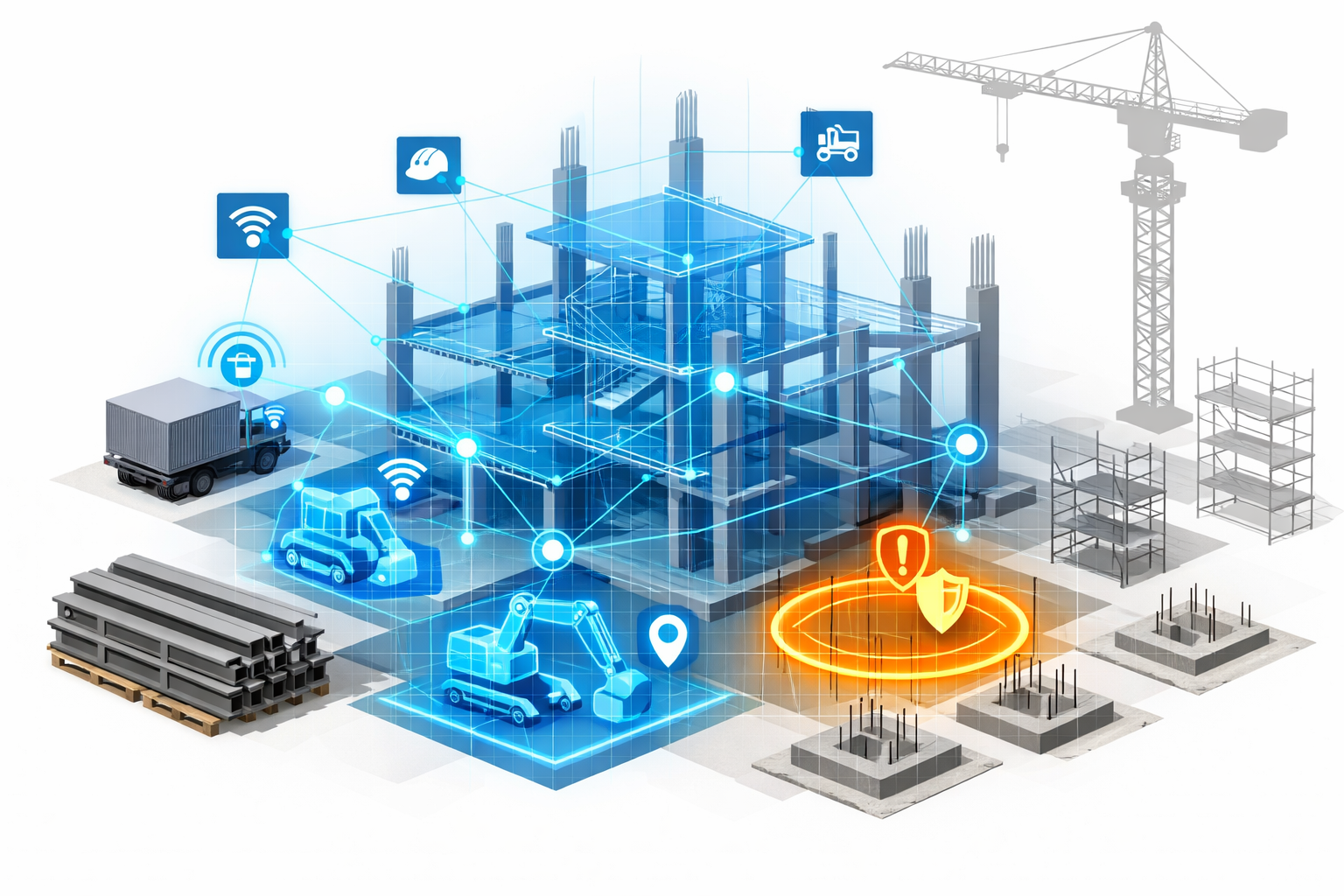
Safety is the highest-stakes application of AI in construction. Computer vision systems analyze live feeds from job site cameras to identify safety violations in real time. Workers without hard hats, missing fall protection, unauthorized personnel in restricted zones, unsafe equipment operation.
The AI does not replace safety managers. It gives them superhuman coverage. A safety director cannot watch every camera on every job site simultaneously. AI can, and it sends alerts the moment it detects a violation. Some systems can identify the specific type of violation, the location on site, and even whether the individual has been previously flagged.
The impact is measurable. Companies using AI safety monitoring report 30 to 50 percent reductions in recordable incidents within the first year. Beyond the human cost, fewer incidents mean lower insurance premiums, fewer OSHA citations, and less project downtime. Explore how computer vision applies to your operations.
Automated Progress Documentation
Documenting construction progress is critical for billing, dispute resolution, and schedule management. Traditionally, this means a superintendent walking the site with a camera, manually annotating photos, and updating project management software. It takes hours every week and the documentation is always incomplete.
AI-powered progress tracking uses 360-degree cameras, drones, or mounted cameras to capture comprehensive site imagery on a regular schedule. Computer vision algorithms compare the captured conditions against the BIM model and schedule to automatically determine percent complete for each scope of work. The system generates progress reports, highlights areas behind schedule, and creates a time-stamped visual record of the entire project.
This automated documentation serves multiple purposes. It accelerates pay applications by providing verifiable progress data. It reduces disputes with subcontractors by creating an objective record. It gives project managers early warning when specific scopes fall behind schedule.
BIM Integration with AI Clash Detection
BIM clash detection has existed for years, but traditional rule-based systems generate thousands of clashes, many of which are trivial or irrelevant. Teams spend hours sorting through clash reports to find the ones that actually matter.
AI-enhanced clash detection prioritizes results by severity and constructability impact. The system learns from historical project data to distinguish between clashes that will cause real construction problems and those that can be resolved during installation. It groups related clashes, suggests resolution sequences, and estimates the cost impact of unresolved clashes.
More advanced AI models go beyond geometric clash detection to analyze constructability. They identify sequences that will be difficult to build, flag areas where multiple trades will compete for the same space at the same time, and recommend scheduling adjustments to minimize conflicts.
Equipment Utilization Analytics
Construction equipment represents a massive capital investment, and most companies have no clear picture of how well that investment performs. AI analytics platforms connect to equipment telematics (GPS, engine data, operating hours) to provide real-time utilization dashboards.
The AI identifies patterns that indicate underutilization, excessive idle time, or inefficient deployment across job sites. It can recommend equipment moves between projects, predict maintenance needs based on operating patterns, and identify when renting makes more financial sense than deploying owned equipment. Companies implementing equipment AI analytics typically find 15 to 25 percent of their fleet is significantly underutilized, representing immediate cost savings. See our workflow automation solutions.
Labor Productivity Tracking
Labor is the largest cost category in construction, and productivity measurement has historically relied on rough estimates and superintendent observations. AI changes this by analyzing multiple data sources to quantify labor productivity by trade, crew, and task.
The AI correlates crew size, hours worked, weather conditions, and material availability against actual production rates. It identifies which crews consistently outperform and which conditions drive productivity losses. This data enables better crew assignments, more accurate scheduling, and targeted training.
Privacy considerations are important here. The best implementations focus on crew-level and task-level analytics rather than individual worker surveillance. The goal is operational improvement, not micromanagement.
Weather Delay Prediction and Schedule Adjustment
Weather is the most common cause of construction delays, and traditional scheduling treats weather as an unpredictable disruption. AI weather integration uses historical weather data, long-range forecasts, and your specific schedule to predict which activities are at risk and recommend preemptive schedule adjustments.
The AI knows which tasks are weather-sensitive (concrete pours, roofing, exterior painting) and monitors forecasts for the specific conditions that would prevent those activities. When it predicts a disruption, it recommends pulling forward interior work, rescheduling deliveries, or adjusting crew assignments to minimize lost productivity.
Over the course of a project, these small adjustments compound into significant schedule savings. Companies using AI weather integration report recovering 5 to 10 percent of weather-related lost days. Explore how predictive analytics works for construction.
AI-Powered Takeoff from Blueprints
Estimating starts with takeoff, and manual takeoff from blueprints is one of the most time-consuming tasks in construction. AI takeoff tools use computer vision to automatically identify and quantify building elements from plan sets. Walls, doors, windows, fixtures, structural members, mechanical equipment.
The AI reads architectural, structural, and MEP drawings and generates quantity takeoffs in minutes that would take an estimator hours or days. It handles multiple plan revisions by automatically identifying changes between versions and highlighting added, removed, or modified elements.
Accuracy depends on drawing quality, but AI takeoff tools consistently achieve 90 to 95 percent accuracy compared to manual methods. The remaining verification work takes a fraction of the time, freeing estimators to focus on pricing, vendor negotiation, and value engineering. See our document processing capabilities.
What Custom AI Integration Looks Like
Individual AI tools provide value on their own. Custom integration multiplies that value by connecting systems that currently operate in silos.
Consider a typical commercial construction workflow. The estimating team uses one platform for takeoff. Project management runs on Procore or a similar system. BIM coordination happens in Navisworks or BIM 360. Scheduling lives in Primavera or MS Project. Equipment tracking uses a fleet management platform. Safety documentation goes into a separate system.
Custom AI integration connects these systems so data flows automatically. When the schedule changes, the AI evaluates equipment needs, crew requirements, and material deliveries. When progress tracking shows a scope falling behind, the scheduling AI recommends adjustments across the entire project timeline. When safety monitoring flags a recurring violation type, the system triggers targeted toolbox talk content for the affected crews.
Running Start Digital builds these integrations for construction companies by connecting the platforms you already use with AI logic that matches your project delivery methods, safety protocols, and reporting requirements. Learn about our business software integration approach.
Results You Can Expect
Construction companies implementing AI across their operations are achieving results that directly impact profitability.
Safety performance. AI monitoring reduces recordable incidents by 30 to 50 percent. The financial impact includes lower insurance premiums, fewer OSHA penalties, and reduced project delays from incidents.
Schedule compression. AI weather integration, resource optimization, and progress tracking recover 5 to 15 percent of scheduled duration. On a 12-month project, that is 3 to 8 weeks of schedule savings.
Estimating speed. AI takeoff reduces estimating time by 60 to 80 percent. Your team can pursue more projects without adding estimating staff.
Cost control. AI-enhanced BIM clash detection and constructability analysis reduce rework costs by 15 to 30 percent. Equipment analytics reduce fleet costs by 15 to 25 percent.
Documentation quality. Automated progress tracking eliminates documentation gaps, accelerates billing cycles, and reduces payment disputes. Projects with comprehensive AI documentation resolve disputes faster and more favorably.
Labor efficiency. Productivity analytics and optimized crew scheduling improve output by 10 to 20 percent without increasing hours or headcount.
The construction companies that integrate AI now will have compounding advantages as their systems learn from more project data. Waiting means falling further behind competitors who are already building smarter.
Frequently Asked Questions
Is AI safety monitoring reliable enough to depend on?
AI safety monitoring is a supplement, not a replacement, for your safety program. Current systems detect common violations (missing PPE, fall protection, restricted zone breaches) with 85 to 95 percent accuracy depending on camera quality and conditions. The value is in continuous coverage. No safety manager can watch every angle of every site simultaneously, but AI can. False positives decrease as the system learns your specific site conditions.
How does AI takeoff handle complex or messy drawings?
AI takeoff accuracy depends on drawing quality. Clean, well-organized CAD-generated drawings produce the best results (90 to 95 percent accuracy). Hand-drawn details, poor scan quality, or unconventional formatting reduce accuracy. Most AI takeoff tools allow manual correction of errors, and the system learns from those corrections to improve on future projects. Even at 85 percent accuracy, the time savings are significant because verification is faster than starting from scratch.
Will AI replace project managers or superintendents?
No. AI handles data processing, pattern recognition, and routine monitoring. Project managers and superintendents provide judgment, relationship management, problem-solving, and leadership that AI cannot replicate. Think of AI as giving your team better tools and better information so they can make faster, more informed decisions.
What does it take to implement AI on an active job site?
Implementation requirements vary by tool. Camera-based systems (safety monitoring, progress tracking) require cameras installed at key locations and internet connectivity. BIM and scheduling AI tools work with your existing software platforms through API connections. Most implementations can be deployed on active projects without disrupting ongoing work. Setup time ranges from a few days for basic tools to 4 to 8 weeks for comprehensive custom integrations.
How do we handle data privacy and worker concerns?
Transparency is essential. Communicate clearly with crews about what AI monitors, what data is collected, and how it is used. Focus AI monitoring on safety compliance and operational efficiency rather than individual worker surveillance. Many companies find that crews support AI safety monitoring once they understand it is there to protect them. Establish clear data retention policies and ensure compliance with applicable labor regulations. Learn about our approach to AI implementation.
Can small construction companies afford AI tools?
Yes. Many AI tools are available as SaaS subscriptions with monthly costs that are reasonable for small to mid-size contractors. AI takeoff tools start around $200 to $500 per month. Safety monitoring systems can be deployed on a per-camera basis. The key is to start with the tool that addresses your biggest pain point and expand from there. A company doing $5 million in annual revenue can see positive ROI from a single AI tool within the first month of use.