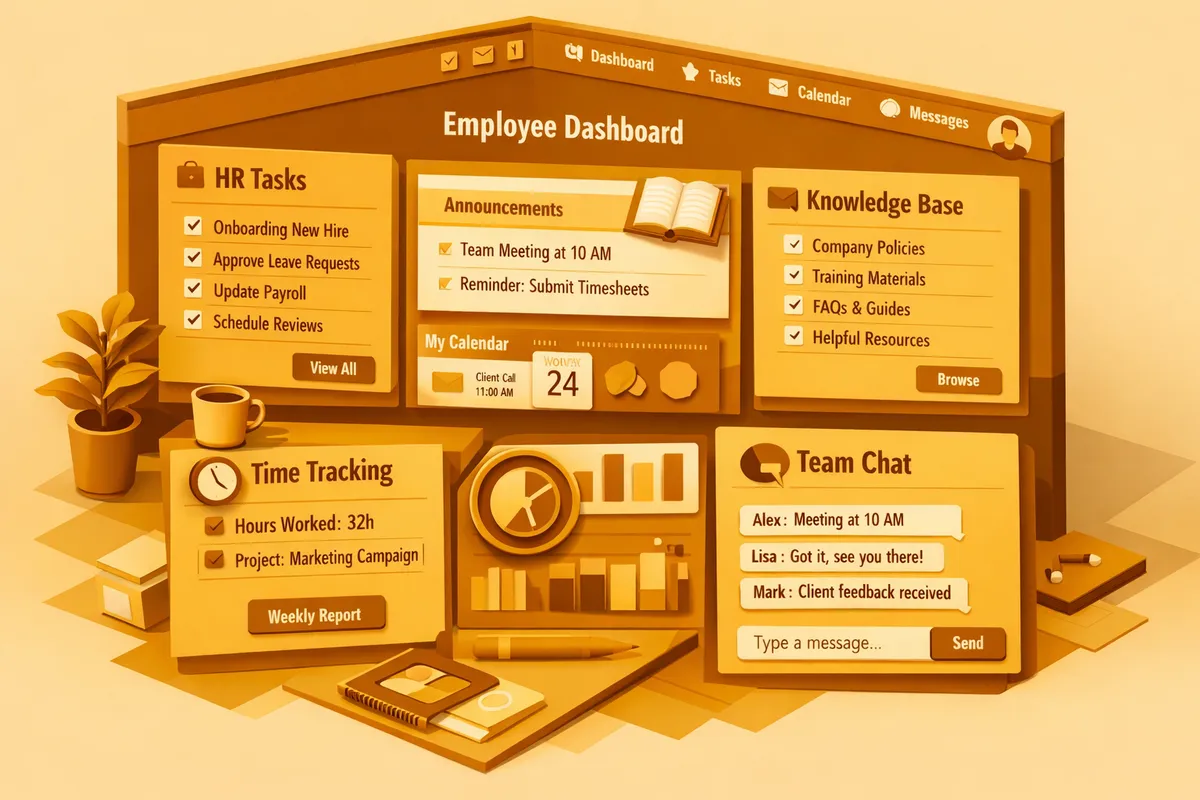
How We Build Employee Portals for Sioux Falls
We start with the workforce experience the portal has to support, not the screens it should have. Most failed internal portal projects in this market started by listing the HR features the SaaS vendor offered. We start instead by mapping how an employee actually moves through the organization (recruiting, offer, onboarding, training, daily operations, performance, growth, eventually offboarding), where the friction points are, and which moments are the highest-leverage ones to solve first. The mapping produces a written specification before any design begins, and it usually identifies two or three friction points the portal should attack in the first release.
Architecture is next. We design the portal data model, the integration surface to the systems already in place (HRIS, payroll, scheduling, learning management, ERP), the authentication layer including SSO with the identity provider you already run, and the access controls. For healthcare employers and any operator handling protected health information we capture HIPAA requirements into the design. For financial services employers we apply the same discipline to SOC standards. Implementation runs on Next.js and React on the frontend with a Node.js or Python tier and PostgreSQL on AWS, deployed in two-week sprints with working screens at the end of each one. We build mobile-first for any frontline workforce, because frontline employees in healthcare, manufacturing, and trades primarily access internal systems on their phones.
Industries We Serve in Sioux Falls
Construction and Home Services: Sioux Falls construction operators, HVAC firms, roofers, plumbers, and landscapers running crews across Brandon, Tea, Harrisburg, Hartford, and the East Side industrial corridor face heavy turnover during the April through October construction season when crews can move to a competitor for two dollars an hour. We build crew portals with mobile schedule access, time and materials capture, training video libraries, and pay-stub self-service that reduce the friction giving competitors an opening.
Real Estate: Sioux Falls brokerages and property management firms need agent portals that handle commission tracking, transaction document workflow, marketing-asset libraries, and continuing education tracking. We build portals that give agents the operational support that helps brokerages compete for talent in a market where every agent is being recruited.
Specialty Healthcare: Multi-provider, multi-location specialty practices on the Western Avenue and 41st Street corridors run clinical and administrative workforces with high turnover risk. We build HIPAA-compliant employee portals that handle credentialing tracking, training compliance, scheduling, and internal communication for dental groups, orthodontic practices, dermatology offices, mental health practices, and the broader specialty healthcare ecosystem competing with Sanford and Avera for clinical talent.
Financial Services: Sioux Falls wealth managers, insurance brokers, accounting firms, and the fintech operators emerging from the credit card services legacy near downtown need employee portals that handle compliance tracking, continuing education, document exchange, and audit-grade communication archive. We build to SOC standards because the buyers in this category, including the regulators, will check.
Senior Care: Senior living, memory care, home care, and hospice operators across the Sioux Empire run on workforces that face some of the highest turnover risk in the metro. We build portals that handle credentialing, mandatory training compliance, scheduling, family-communication archives, and shift-swap workflows, particularly during the Q4 and Q1 placement spike that follows holiday family visits.
Manufacturing and Professional Services: Sioux Falls manufacturers and the law firms, accounting firms, and A and E firms serving them need internal portals that handle plant-floor training compliance, ERP-driven work instructions, document workflow, and time and labor tracking. We build portals that bridge twenty-year-old back-office systems to modern employee-facing experiences without forcing a full ERP replacement.
What to Expect Working With Us
1. Discovery and Workforce Journey Mapping. We map the full employment experience, identify where friction is costing retention, and define the highest-leverage moments to solve first. This phase produces a written specification and an honest project estimate before either of us commits.
2. Architecture and Integration Design. We design the portal data model, the SSO and authentication layer, and the integration surface to HRIS, payroll, scheduling, learning, and ERP systems. The architecture is reviewed and approved before any code is written.
3. Sprint-Based Implementation. We build in two-week cycles with working screens at the end of each one. A pilot group of employees can test against real software early, which surfaces design misalignments before they reach the full workforce.
4. Launch, Adoption Measurement, and Evolution. We launch with rollout plans designed for your workforce, adoption metrics built into the portal itself, and an evolution roadmap. Most Sioux Falls clients stay on a maintenance retainer because the portal becomes operational infrastructure that needs ongoing attention as the business changes.