How We Build Business Intelligence for Sioux Falls
We start by mapping the systems the owner already pays for. A typical Sioux Falls operation has five to nine source systems: QuickBooks Online or Desktop, the trade software (ServiceTitan, Jobber, Housecall Pro, BuilderTrend, Open Dental, Dentrix), a CRM (HubSpot, Pipedrive, or a homegrown spreadsheet), Google Ads, Facebook Ads, the website analytics, and often a payroll system like Gusto or ADP. The data is there. The pipes between systems are not.
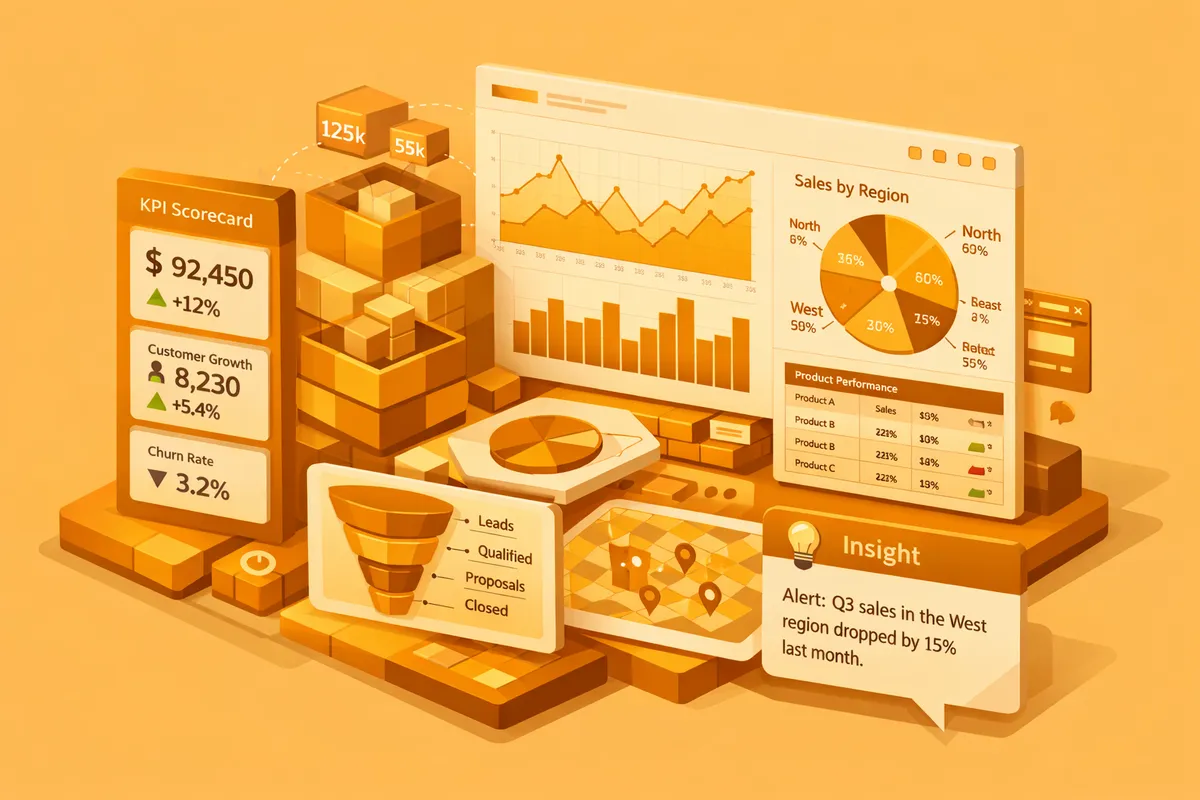
We build the data warehouse, typically on BigQuery or Snowflake at this scale, and the ETL pipelines that pull from each source nightly or hourly depending on how the owner needs to use the dashboard. Then we sit with the owner and identify the four to seven numbers that drive every decision: revenue by service line, gross margin by crew or provider, customer acquisition cost by channel, average ticket, lead-to-close conversion, and the cash position projection. The dashboard shows those numbers. Nothing else. Owner-operators do not need fifty visualizations. They need the four that tell them whether to slow down, speed up, or change something.
We deploy on phones first, web second. The owner of a Hartford framing company does not sit at a desk. The dashboard has to load on a Pixel in a truck parked at a job site in Crooks at 6:45am.
Industries We Serve in Sioux Falls
Construction and Home Services Sioux Falls runs over a billion dollars in annual building permits. Contractors, remodelers, HVAC, roofing, plumbing, electrical, and landscaping operators on the East Side and across Brandon, Tea, Harrisburg, and Hartford are scaling crew counts faster than they can scale management visibility. We build owner dashboards that combine job-cost data from the trade software with QuickBooks margin data, ad spend from Google and Meta, and lead conversion from the CRM into one Monday-morning view. The owner sees crew-level margin, channel-level CAC, and weekly cash without exporting anything.
Real Estate The migration flow into Sioux Falls from Iowa, Minnesota, and the rest of the country produces a lead funnel that brokers and agents need to see daily. We build BI for brokerages and large agent teams that combines MLS data, transaction management activity from Dotloop or Brokermint, marketing spend, and commission accrual into a single dashboard. The broker-owner sees agent-by-agent production and pipeline health in real time.
Specialty Healthcare Dental, ortho, chiropractic, PT, OB-GYN, and med spa practices along Western Avenue and the 41st Street corridor running multiple locations need BI that pulls patient flow from the practice management system, insurance reimbursement from the 835 file, and marketing spend into a single owner view. We build practice dashboards showing provider-level production, location-level margin, and patient acquisition cost without HIPAA exposure on the analytical layer.
Financial Services The mid-market of Sioux Falls insurance brokers, wealth managers, accounting firms, and credit unions needs BI that stays inside compliance boundaries. We build financial services dashboards with role-based access, full audit logging, and the data governance the SD Division of Insurance and SEC expect for any platform touching client data.
Senior Care South Dakota is the sixth-ranked retirement state and the senior care operators running assisted living, memory care, and home care across the Sioux Empire need BI that combines census data, payor mix, staffing ratios, and occupancy trending. We build dashboards that flag census gaps before they become quarterly margin problems.
Manufacturing and Professional Services The 1,146 manufacturers in South Dakota and the regional ecosystem around Raven Industries and Daktronics run on production metrics, work-in-process inventory, and standard cost variance. Law firms in the Cathedral Historic District and accounting firms downtown run on billable utilization and matter profitability. We build BI for both, sized to a mid-market operation that does not have a full BI team.
What to Expect Working With Us
1. Discovery and Source Audit We spend three to five days mapping every system you pay for, the data each one holds, and the questions you currently cannot answer without a Saturday spreadsheet session. The audit is $500 and credits against any larger engagement.
2. Architecture and Metric Design We propose a data warehouse, the ETL pipelines we will build, and the four to seven owner metrics the dashboard will show. You approve the metric list before we touch infrastructure.
3. Build and Phased Rollout First dashboard ships in four to six weeks. The owner sees real numbers from real data inside the first month. We add depth and additional roles in subsequent phases rather than holding everything for one big launch.
4. Monitor and Refine Every pipeline runs with alerting. We meet monthly the first quarter, then quarterly, to add metrics as the operation grows and the owner's questions evolve.