What We Build for Home Security Companies
AI Surveillance Analytics Platform
The foundation of intelligent home security is the ability to understand what cameras and sensors are actually detecting. Our surveillance analytics platform processes video and sensor data to deliver actionable intelligence rather than raw feeds.
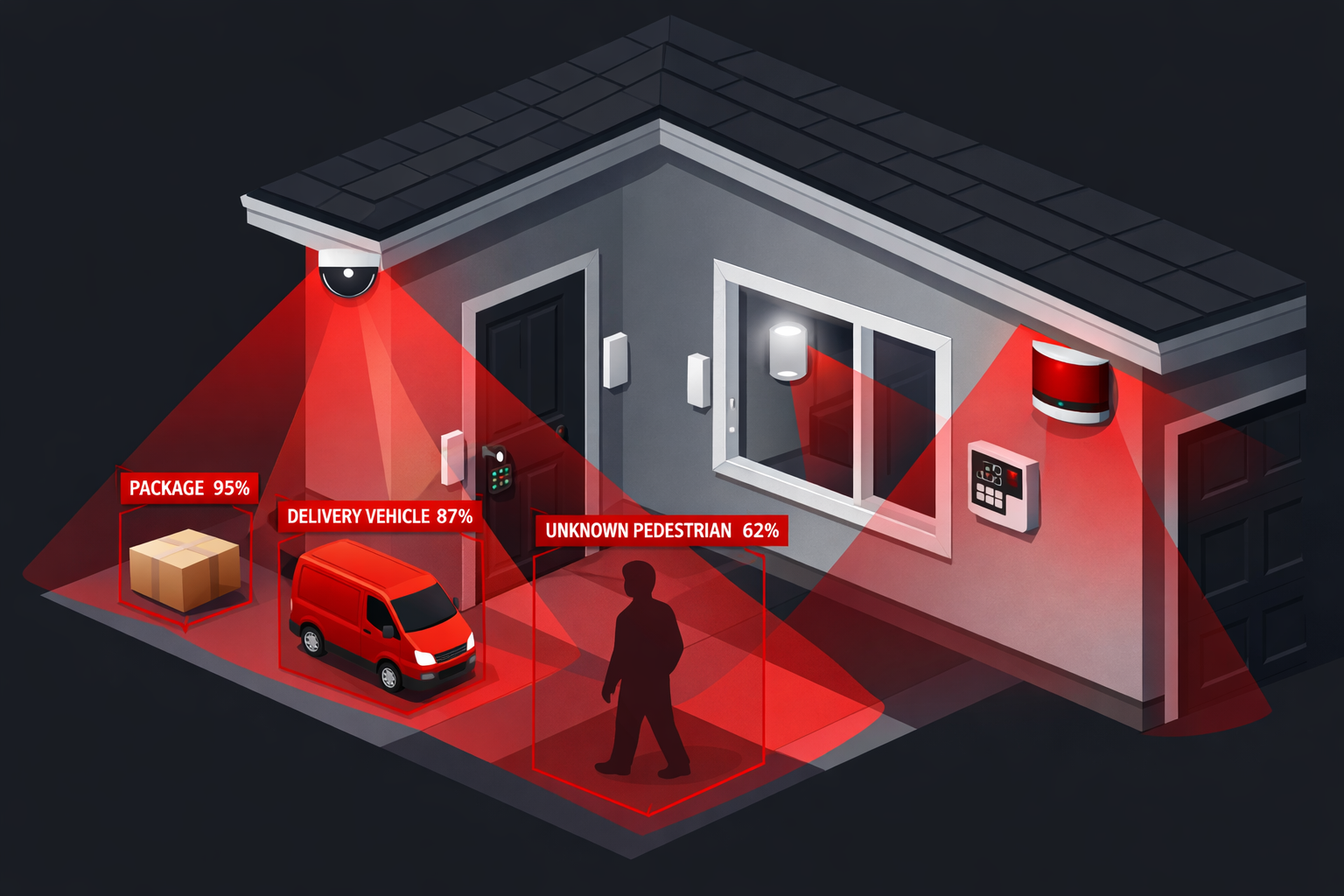
The platform's computer vision layer performs real-time classification on camera feeds. Person detection identifies human activity and distinguishes between residents, known visitors, and unfamiliar individuals. Vehicle detection identifies cars in driveways and at curb fronts, flagging unfamiliar vehicles and unusual parking patterns. Package detection monitors porch and entryway areas, identifying delivery events and tracking packages until they are retrieved. Animal detection prevents pet-triggered false alarms while still alerting on wildlife activity that customers want to know about (deer in the garden, raccoons at the trash).
Beyond basic object classification, the system performs behavioral analysis. A person walking past the house on the sidewalk is normal. A person stopping at the house, walking to the side yard, and checking the gate is suspicious. A person approaching the front door during business hours is likely a delivery. A person approaching a basement window at 2 AM is a high-priority alert. The AI does not just identify what is in the frame. It interprets what is happening and assigns appropriate alert levels.
Environmental context improves accuracy further. The system learns normal patterns for each property. Regular visitors. Typical delivery times. Resident schedules. Neighborhood activity levels. Seasonal changes in lighting and vegetation. This baseline understanding means the system gets smarter over the first weeks of deployment, progressively reducing false positives as it learns the normal rhythm of each customer's property.
Alert delivery is customizable by event type and severity. Routine events (package delivered, familiar person arrived) can push a quiet notification to the customer's phone. Moderate events (unfamiliar person at door, unusual vehicle) can push a notification with a video clip and option to activate two-way audio. High-priority events (forced entry, glass break, loitering near access points) can trigger monitoring center escalation with live video feed for the operator.
Learn more about our computer vision solutions
Smart Home Integration and Automation Programming
Modern home security extends far beyond alarm panels and cameras. Customers expect their security system to integrate with and control smart home devices across their entire property. Lights, locks, thermostats, garage doors, irrigation systems, and entertainment systems all connect to create an integrated living environment where security is one layer of a comprehensive automation platform.
Programming these integrations is time-consuming and error-prone when done manually. Each customer's setup is unique. Different combinations of devices from different manufacturers with different communication protocols and different automation requirements. A technician who manually configures each automation rule for each customer spends hours on programming that could be standardized and streamlined.
Our automation programming system generates integration plans and automation routines based on the customer's device inventory and preferences. The system maintains a compatibility database covering major smart home platforms and device categories. When a customer's device list is entered, the system identifies integration opportunities, flags compatibility issues, and generates a recommended automation package.
Standard automation templates cover common scenarios. Security mode activation: when the alarm is armed away, lock all doors, close the garage, set thermostats to energy-saving mode, and activate exterior cameras with enhanced sensitivity. Arrival routine: when a resident unlocks the front door, disarm the alarm, turn on entryway lights, adjust thermostat to comfort setting, and deactivate interior motion cameras. Sleep mode: at 11 PM, arm perimeter sensors, lock all doors, turn off exterior lights except security lighting, and reduce camera notification sensitivity for indoor sensors.
These templates are starting points that technicians customize for each customer. The system handles the technical programming while the technician handles the customer conversation about preferences and lifestyle patterns. Installation time for smart home integration drops by 40% to 60% because the programming work is semi-automated rather than manual.
Learn more about our workflow automation solutions
Predictive Maintenance for Cameras and Sensors
Security systems are only as reliable as their weakest component. A camera that loses connection, a sensor with a dying battery, a doorbell with degraded WiFi signal. Any single point of failure can leave a blind spot in the customer's protection. Traditional maintenance is reactive. The customer notices their camera is offline, calls for service, and waits for a technician visit. During the gap, they have no coverage from that device.
AI-powered predictive maintenance monitors the health and performance of every device in every customer's system continuously. The system tracks battery voltage curves to predict when sensors will need replacement, typically four to six weeks before they die. Camera connectivity patterns are analyzed to identify devices experiencing intermittent connection issues before they fail completely. Image quality degradation from lens fouling, IR LED fading, or mechanical issues is detected through periodic image analysis.
When the system predicts a device will require attention, it generates a service ticket automatically. For battery replacements and simple fixes, the customer can be shipped a replacement part with instructions. For issues requiring a technician visit, the service is scheduled proactively and combined with nearby service calls for routing efficiency.
The operational impact is significant. Proactive service visits are planned, efficient, and appreciated by customers. Reactive emergency visits are unplanned, expensive, and frustrating for everyone. Shifting the ratio from mostly reactive to mostly proactive reduces service costs, improves truck utilization, and transforms the customer experience from "my system broke and I had to fight to get it fixed" to "my security company noticed an issue and took care of it before I even knew about it."
Predictive maintenance also extends equipment life. A camera whose failing IR LEDs are identified early can have the LED board replaced rather than the entire camera. A sensor with a degrading seal can be resealed rather than replaced. These interventions are less expensive than full replacements and reduce the environmental waste of discarding devices that are 90% functional.
Learn more about our predictive analytics solutions
Automated Customer Onboarding and System Documentation
New customer onboarding in the security industry involves a significant documentation burden. The system configuration must be recorded in detail. Device locations, zone designations, user codes, automation routines, monitoring protocols, and emergency contacts all must be documented and communicated to both the monitoring center and the customer. Missing or inaccurate documentation causes problems that surface during the worst possible moment: when the customer actually needs their system to work.
Our onboarding automation generates comprehensive system documentation from the installation data. As the technician installs and configures each device, the system records the configuration details automatically. Upon completion, it produces a customer-facing system manual specific to their installation. This manual includes device locations mapped to a floor plan, zone designations and what each zone protects, instructions for arming and disarming in each mode, user code management, mobile app setup and configuration, automation routine descriptions, troubleshooting steps for common issues, and warranty and service contact information.
The manual is delivered digitally with searchable content so the customer can find answers quickly when they need them. No more paper manuals that get lost in a drawer. No more customers calling your office to ask how to change their user code because they cannot find the generic manufacturer instructions.
For the monitoring center, the onboarding system generates the account configuration document that operators need to handle signals correctly. Zone descriptions, verification protocols, emergency contacts, pet information for false alarm assessment, gate codes for responder access, and any special instructions are compiled and transmitted electronically. The monitoring center has the correct information from day one rather than updating it piecemeal over the first few weeks as gaps are discovered.
Learn more about our AI document processing solutions
Insurance Integration and Discount Program Management
One of the strongest selling points for home security systems is the insurance discount. Most major homeowner's insurance carriers offer premium reductions of 5% to 20% for homes with monitored security systems. For a homeowner paying $2,000 annually in insurance premiums, a 15% discount saves $300 per year, which offsets a significant portion of the monitoring cost. This financial incentive frequently tips the buying decision for homeowners who are on the fence.
But capturing the discount requires documentation. The homeowner needs a certificate of monitoring from their security company, often in a specific format that the insurance carrier requires. Some carriers require annual renewal certificates. Some require details about system components. Some have specific requirements for monitoring type (central station versus self-monitoring). Managing these documentation requirements across hundreds of customers with dozens of different insurance carriers is an administrative burden that most security companies handle poorly or not at all.
Our insurance integration system automates certificate generation and delivery. When a new customer's system is activated, the system generates a monitoring certificate in the format required by their insurance carrier. The certificate is delivered to the customer for submission and stored in their account for annual renewal. When renewal time approaches, updated certificates are generated and delivered automatically. If the customer changes their system (upgrades equipment, adds cameras, modifies monitoring level), the certificate is updated to reflect the current configuration.
For your sales team, the insurance discount becomes a documented, quantified benefit presented during the consultation. "Your Allstate policy qualifies for a 15% monitored security discount. That is $285 per year. Your monitoring fee is $45 per month, or $540 per year. After the insurance discount, your net cost for 24/7 professional monitoring is $255 per year." That math closes sales.
What to Expect
Phase 1: Assessment (Weeks 1-2)
We audit your current operations from installation through ongoing monitoring. We analyze your false alarm rates by cause category (pet, environmental, equipment, user error). We review your installation process, technician training, and average installation time by system type. We assess your monitoring center's signal processing workflow and operator efficiency metrics. We examine your maintenance and service operations, including reactive versus proactive visit ratios. We evaluate your customer onboarding documentation and insurance certificate processes.
Phase 2: System Design (Weeks 3-4)
Based on the assessment, we design the AI integration stack prioritized by impact. For most security companies, surveillance analytics and false alarm reduction deliver the fastest ROI due to their direct effect on customer satisfaction and churn rates. We present the plan with projected improvements in false alarm reduction, installation efficiency, maintenance cost reduction, and customer retention. You review and approve before build begins.
Phase 3: Build and Integration (Weeks 5-12)
Systems are built and deployed in priority order. Surveillance analytics and the false alarm reduction engine deploy first, working with your existing camera infrastructure. Smart home automation programming tools follow, immediately improving installation efficiency. Predictive maintenance launches once enough device health data accumulates to train the models (typically two to four weeks of monitoring). Customer onboarding automation and insurance integration complete the build. Each system integrates with your existing monitoring platform, CRM, and service management tools.
Phase 4: Optimization and Scaling
After 30 days, we measure false alarm reduction rates against the pre-AI baseline. Installation time per system type is compared against historical averages. Predictive maintenance accuracy is evaluated by tracking predicted versus actual device failures. Customer satisfaction and churn rates are monitored monthly. The surveillance analytics models improve continuously as they process more events from your customer base, with false alarm rates declining progressively over the first six months.
Industry Connections
Home security companies work closely with several related trades. Electricians collaborate on hardwired system installations, backup power integration, and electrical panel work required for comprehensive security systems. General contractors and home builders specify security systems in new construction where pre-wiring during build is significantly less expensive than retrofit installation. HVAC companies coordinate on smart home projects where thermostat integration, air quality monitoring, and environmental sensors bridge the gap between comfort and security systems.
Smarter Monitoring. Fewer False Alarms. Better Security.
The home security industry is in the middle of a fundamental shift from passive alarm systems to intelligent security platforms. The companies that integrate AI into their technology stack deliver better protection, generate fewer false alarms, install more efficiently, maintain systems proactively, and retain customers longer. The companies that do not integrate AI compete on price for a commodity service that customers increasingly expect to be intelligent.
Running Start Digital builds the AI infrastructure that transforms your security company from an alarm installer into an intelligent security provider. Surveillance analytics that distinguish real threats from false triggers. Smart home automation that programs itself. Predictive maintenance that prevents failures before customers notice. Onboarding documentation that eliminates confusion. And insurance integrations that make the financial case for your service undeniable.
Schedule a consultation and let us show you how AI tools can elevate your security operation from monitoring to intelligence.