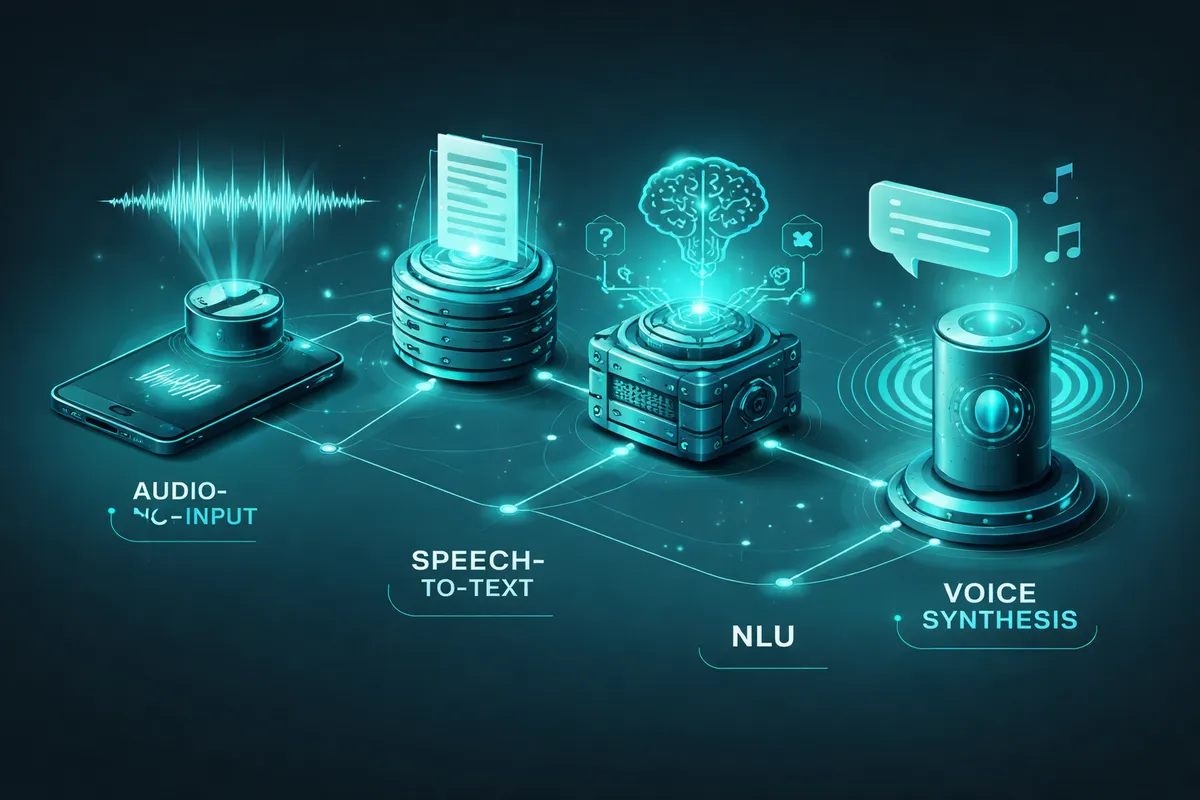
Our Voice AI Work in Atlanta
- Custom voice assistant design and development tailored to your business workflows and caller vocabulary
- IVR modernization: replacing rigid phone tree menus with conversational AI that understands natural language
- Appointment scheduling and booking automation integrated with EHR and scheduling platforms
- Intelligent call routing and triage that reaches the right team member with full caller context
- Speech-to-text transcription and automatic call documentation for compliance and quality review
- Outbound voice AI for appointment reminders, follow-up surveys, and proactive client communication
- Multi-language voice support for Atlanta's diverse Spanish-speaking, Korean-speaking, and Vietnamese-speaking communities
- Integration with Epic, Cerner, Athenahealth, Salesforce, HubSpot, and property management platforms
- Voice analytics and conversation intelligence dashboards for operations visibility
- Contact center AI augmentation: AI-assisted agents who receive real-time suggestions during live calls
- After-hours AI handling with seamless morning handoff to live staff
Industries We Serve in Atlanta
Healthcare Providers and Hospital Systems: Atlanta's healthcare sector, anchored by Emory Healthcare, Piedmont Health, Northside Hospital, and the growing network of urgent care and specialty practices spreading across the metro, has the most immediate and measurable ROI case for voice AI. Appointment scheduling calls, prescription refill requests, referral inquiries, and insurance verification calls are high-volume, rule-driven interactions that a well-trained voice AI handles completely. We integrate with Epic, Cerner, and Athenahealth to give the AI access to real-time scheduling availability and patient account data.
Legal and Professional Services: Atlanta's Buckhead legal and professional services corridor, along with the growing professional services cluster in Midtown and Sandy Springs, fields inbound inquiries from potential clients who are evaluating multiple firms simultaneously. A firm that answers immediately, gathers preliminary information, and schedules a consultation call in the first contact wins that client evaluation over a firm that puts the caller on hold or into voicemail.
Real Estate Companies and Property Management: Atlanta's real estate market, one of the most active in the country, generates property inquiry calls at all hours and across all days. Real estate companies in Buckhead, Sandy Springs, Alpharetta, and throughout the metro use voice AI to respond to property inquiries instantly, qualify buyers and renters, schedule showings, and handle tenant service requests without relying on available agent time.
Fintech and Financial Services: The fintech companies scaling out of Atlanta Tech Village and Midtown, alongside the established financial services firms in Buckhead, use voice AI for account inquiry handling, fraud alert confirmation, payment processing guidance, and intelligent routing to licensed advisors. Financial voice AI must balance accessibility with the compliance and security protocols that regulated services require.
Restaurant and Hospitality Groups: Atlanta's restaurant and hospitality sector, from the Beltline food and beverage corridor to the large hospitality groups operating across the metro, uses voice AI for reservation management, event booking inquiries, catering consultation scheduling, and after-hours information provision. OpenTable integration and reservation system connectivity are standard components of hospitality voice AI deployments.
Retail and Home Services: Atlanta's home services businesses, serving the expanding suburban footprint across Gwinnett, Cherokee, Forsyth, and Fulton counties, deal with after-hours emergency calls that require immediate response but cannot justify overnight staffing. Voice AI captures these calls, gathers the necessary information, dispatches accordingly, and ensures nothing falls through the gap between business hours.
What to Expect
Discovery and Use Case Mapping: We begin by mapping your current call volume, call type distribution, escalation patterns, and the specific business outcomes you need voice AI to achieve. The most effective voice AI deployments are those that target the highest-volume, most rule-driven call types first, where automation rates are highest and ROI is most immediate. We identify these use cases, define success metrics, and build the deployment scope around them.
Integration Planning: Voice AI effectiveness depends on access to real-time business data. Appointment scheduling only works if the AI can see actual scheduling availability. Property inquiries only convert if the AI can access current listing information. We map your existing systems, identify the integrations required, and build the data access layer that makes the AI genuinely useful rather than a sophisticated hold message.
Design and Training: We design the conversation flows, voice personality, and escalation logic for your specific business context and caller population. We train the system on your specific vocabulary, your service offerings, and the patterns of how Atlanta callers in your category actually phrase their requests. A healthcare caller in Sandy Springs phrases a scheduling request differently than a legal inquiry caller in Buckhead, and the system is trained to handle both accurately.
Deployment and Optimization: Initial deployment is followed by an active monitoring and optimization period. We review call transcripts, measure automation rates against baseline, identify where the AI struggles, and refine the training and conversation design. Voice AI systems improve continuously with operational data, and the optimization period is where the initial deployment is turned into a production-grade system.
Ready to Deploy Voice AI for Your Atlanta Business?
Atlanta businesses that answer every call instantly and handle routine requests without proportional staffing costs are building operational advantages that compound over time. Every call answered is a relationship preserved. Every after-hours inquiry handled is a conversion that would otherwise wait until morning. Running Start Digital builds voice AI that works in the real conditions of Atlanta's service economy. Schedule a consultation to discuss your call volume, your highest-priority automation use cases, and what voice AI can accomplish for your Atlanta business.