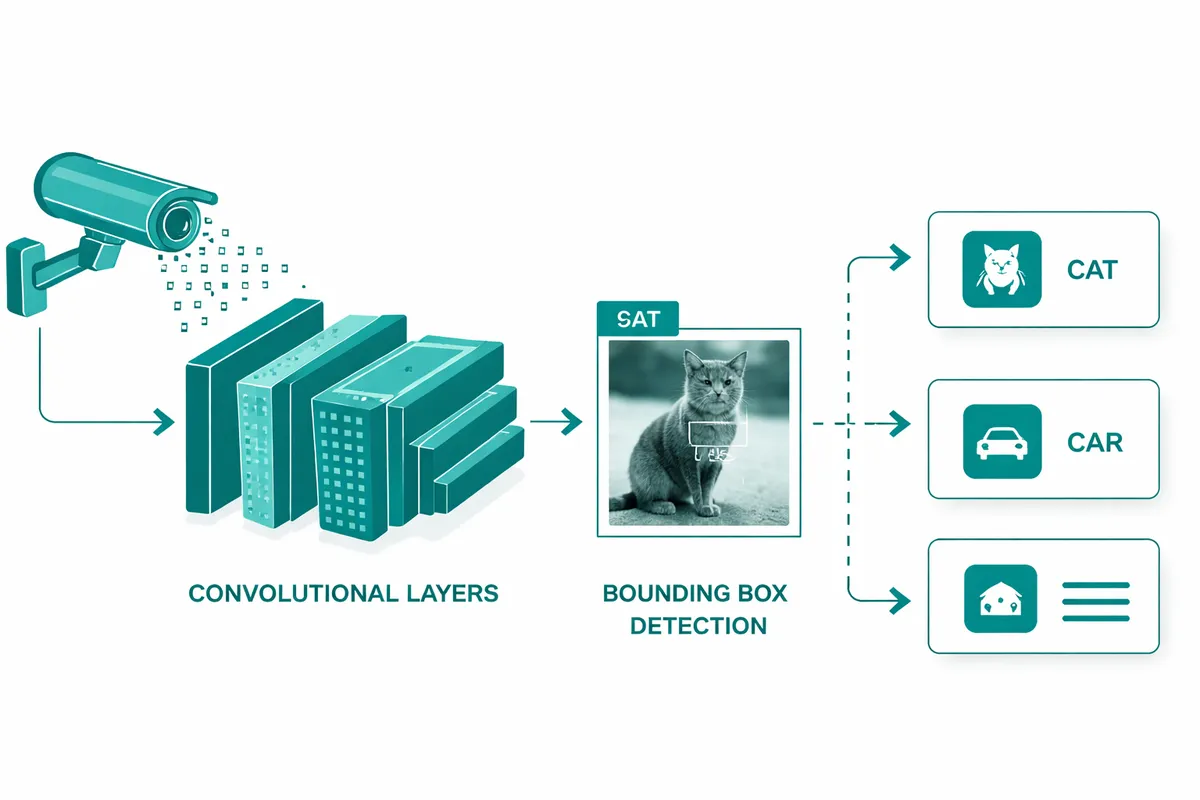
Our Computer Vision Work in Atlanta
- Freight and baggage damage inspection systems for logistics operations at and around Hartsfield-Jackson International Airport
- Package label verification, barcode reading, and dimensional capture for distribution centers along I-285 and the airport cargo area
- Medical image pre-screening and anomaly detection for Atlanta's major hospital systems and diagnostic imaging centers
- Manufacturing quality control and defect detection for aerospace and automotive parts suppliers in the metro area
- Document digitization, data extraction, and classification for legal and financial firms in Buckhead and the Perimeter corridor
- Retail shelf compliance and inventory monitoring for consumer goods companies and wholesale distributors
- Food safety and quality visual inspection for Atlanta's food processing and restaurant supply companies
- Construction site safety monitoring for active development projects in Old Fourth Ward, Westside, and the BeltLine corridor
- Access control and security video analytics for commercial properties and mixed-use developments
- Agricultural and food product grading systems for Georgia's agricultural supply chain
Industries We Serve in Atlanta
Logistics, Freight, and Supply Chain. Hartsfield-Jackson is the world's busiest airport, and the logistics ecosystem surrounding it handles freight volumes that create constant visual inspection demand. Package damage detection, label verification, dimensional capture, and exception flagging are all processes that computer vision automates at conveyor speed. We build systems that output structured data directly into your WMS or TMS so downstream operations trigger automatically. The result is faster processing, fewer manual inspection errors, and reduced labor cost per package processed.
Healthcare and Medical Imaging (Emory, Piedmont, Children's, Grady). Atlanta's healthcare systems generate enormous volumes of medical imaging that require efficient triage and review. Computer vision assists radiologists by pre-screening studies for anomalies, prioritizing urgent findings in worklists, and automating routine measurements. Pathology departments use image analysis to assist with slide review. Every deployment we build for healthcare clients is HIPAA-compliant from architecture through deployment, using de-identified training data, appropriate access controls, and compliant infrastructure.
Automotive and Aerospace Manufacturing. Atlanta's manufacturing sector includes a significant number of Tier 2 and Tier 3 suppliers to automotive assembly plants in the Southeast and aerospace component manufacturers serving Lockheed Martin and other primes. Quality inspection for stamped parts, machined components, and assembled subassemblies is a natural application for computer vision. We train models on your specific part geometry and defect taxonomy, deploy on industrial hardware at your inspection stations, and integrate with your quality management system for real-time defect logging.
Legal and Financial Services (Buckhead, Perimeter). High document volume in legal and financial services creates significant demand for automated processing. Contract review intake, insurance document classification, loan application document extraction, and compliance filing verification are all visual processing tasks that computer vision handles faster and more accurately than manual review. We build document processing pipelines that connect to your existing document management and case management systems.
Retail and Consumer Goods. Atlanta's consumer goods companies and regional retail chains use computer vision for shelf compliance monitoring, inventory counting, and planogram verification. Retail systems built around vision capture consistent data across locations and provide merchandising intelligence that manual audit processes cannot supply at sufficient frequency.
Food and Beverage Processing. Georgia's food processing industry, from Pilgrim's Pride poultry operations to Coca-Cola's Atlanta distribution infrastructure, uses computer vision for product quality inspection, foreign object detection, and packaging integrity verification. We build food safety vision systems that meet FDA and USDA documentation requirements.
What to Expect
Discovery. We spend two weeks evaluating your specific visual challenge: the objects, defects, or documents you need to process, the volume and speed requirements, the integration environment, and the data you have available. We produce a feasibility assessment that includes accuracy projections, hardware requirements, and a realistic timeline before any development commitment is made.
Strategy. We design the complete system architecture: camera and hardware selection, model design approach, training data plan, integration specifications, and deployment environment. For Atlanta clients with specific compliance requirements (healthcare, food safety, aerospace quality), we map those requirements into the architecture during this phase.
Implementation. We handle data collection and annotation, model training and validation, system integration, and staged deployment. We test against your actual production conditions before sign-off. Most Atlanta projects run 10 to 16 weeks from feasibility assessment to production deployment, with the timeline compressed significantly when labeled training data already exists.
Results. Every deployment includes a monitoring dashboard tracking accuracy, throughput, and exception rates. We provide ongoing maintenance, model retraining as production conditions evolve, and expansion support when you add new product lines, defect classes, or inspection stations.