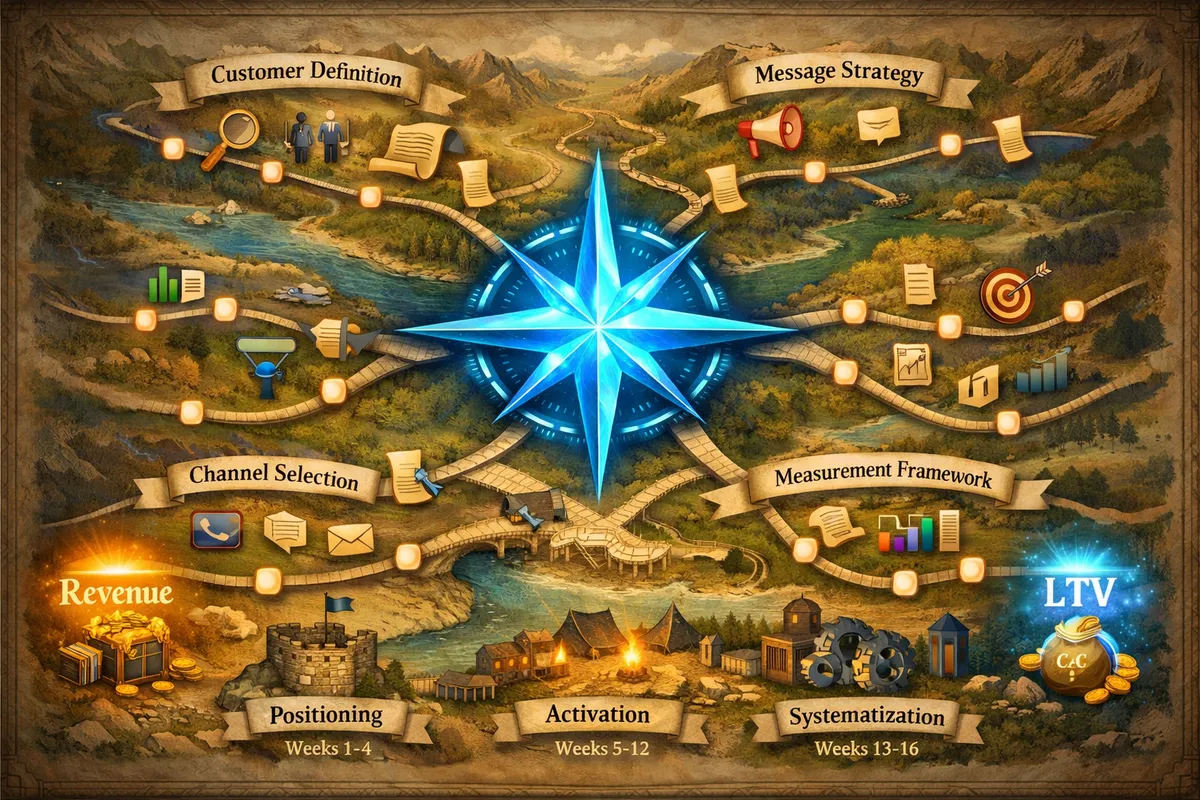
The 90-Day Marketing Execution Plan
Strategy without execution is a waste of time. Here is the 90-day execution framework we use with startup clients.
Days 1 Through 30: Foundation and First Tests
Week 1 through 2: Setup. Define your ICP, positioning, and core messaging. Set up your marketing technology stack: analytics, email, CRM, and ad accounts. Create your brand identity and marketing website.
Week 3 through 4: First content and first tests. Publish your first 3 blog posts targeting high-intent keywords. Launch your first paid ad tests with $500 to $1,000 budget across 2 to 3 channels. Set up your email capture and nurture sequence. Start posting in communities where your customers gather.
Month 1 deliverables: Marketing website live. Analytics tracking all key events. 3 blog posts published. 2 to 3 ad tests running. Email list growing.
Days 31 Through 60: Learn and Optimize
Week 5 through 6: Analyze first test results. Review ad performance by channel. Identify which content topics generate the most engagement. Analyze website conversion rates and optimize your landing pages. Kill ad tests that are not producing results.
Week 7 through 8: Double down on winners. Increase budget on the best-performing ad channel. Publish 4 more content pieces focused on topics that resonated. Launch a partnership or co-marketing initiative. Begin building backlinks through guest posts and PR outreach for SEO authority.
Month 2 deliverables: Clear data on which channels work. Optimized landing pages. 7+ pieces of content published. One partnership initiated. First customers acquired through marketing.
Days 61 Through 90: Scale What Works
Week 9 through 10: Build systems. Create repeatable processes for your winning channels. Document your content production workflow. Set up automated email sequences for lead nurturing. Build reporting templates for weekly marketing reviews.
Week 11 through 12: Accelerate growth. Scale ad spend on proven channels. Launch a referral or ambassador program. Publish case studies from early customers. Begin planning a content series or lead magnet for demand generation.
Month 3 deliverables: Predictable lead flow from 1 to 2 proven channels. 12+ pieces of content published. Automated nurture sequences running. Clear CAC and LTV metrics by channel. Documented marketing playbook for ongoing execution.
Marketing Budget Allocation by Stage
Your marketing budget should match your stage. Over-spending too early wastes money. Under-spending at the right moment costs you growth.
Pre-Revenue ($0 to $2,000/month)
Focus entirely on free and low-cost channels. Content marketing and SEO, community engagement, social media, personal outreach, and email list building. Your time is your primary marketing investment at this stage.
Post-Revenue, Pre-Product-Market-Fit ($2,000 to $5,000/month)
Add small paid tests to accelerate learning. Run $500 to $1,000 ad experiments each month to test messaging and channels. Invest in better content production. Start building your email marketing infrastructure.
Post-Product-Market-Fit ($5,000 to $20,000/month)
Scale your proven channels aggressively. Invest in content production at 8 to 12 pieces per month. Increase ad spend on channels with proven CAC. Hire your first marketing contractor or part-time marketer. Invest in marketing automation to handle increased volume.
Series A and Beyond ($20,000+/month)
Build a marketing team. Invest in brand building alongside performance marketing. Launch multi-channel campaigns. Build sophisticated automation workflows connecting your marketing stack. Invest in advanced analytics and attribution.
Common Marketing Plan Mistakes
Targeting too broad an audience. "Our product is for everyone" means your marketing speaks to no one. Narrow your ICP until it feels uncomfortably specific. You can always expand later.
Confusing activity with progress. Publishing 20 blog posts is activity. Generating 50 qualified leads from those posts is progress. Your plan tracks outcomes, not output.
Copying competitor tactics without understanding their context. Your competitor's $50K/month Google Ads budget works because they have 3 years of conversion data and a sales team of 10. You need a different approach at your stage.
Ignoring distribution. Great content with no distribution plan gets zero readers. Every content piece needs a distribution plan: email to your list, post in communities, share on social, syndicate to newsletters. Content creation is 50% of the work. Distribution is the other 50%.
Not measuring or measuring the wrong things. If you do not know your CAC by channel after 90 days of marketing, your plan is missing its most important component. Set up CRM and analytics tools from day one.
Frequently Asked Questions
How long does it take to create a startup marketing plan?
A focused marketing plan takes 1 to 2 weeks to create. This includes customer research, competitive analysis, channel selection, messaging development, and budget allocation. Do not spend more than two weeks. A good-enough plan executed immediately beats a perfect plan delivered in two months. You will revise it monthly based on real data anyway.
Do I need a marketing plan before I have a product?
Yes. Your pre-product marketing plan focuses on audience building, market validation, and waitlist growth. Start building your email list, establishing your social media presence, and creating content around the problems you plan to solve. When you launch, you will have an audience ready to try your product instead of launching to silence.
How often should I update my marketing plan?
Review your plan monthly and do a major revision quarterly. Monthly reviews check whether you are hitting your targets and make tactical adjustments: shift budget between channels, update messaging based on what resonates, and kill underperforming experiments. Quarterly revisions reassess your strategy: update your ICP based on who your actual customers are, revise your positioning based on competitive changes, and set new targets based on growth trajectory.
What is the most important part of a startup marketing plan?
The channel strategy with specific budget allocation and success metrics. Many founders write great vision statements and customer profiles but never specify how they will actually reach those customers. Your plan needs to name the channels, assign the budget, define the metrics, and set the timeline. Without that specificity, it is a wishful thinking document, not a marketing plan.
Should I hire a marketing agency or do marketing in-house?
For seed-stage startups, a hybrid approach works best. Use an agency for strategy, channel setup, and specialized execution (like PPC advertising or SEO). Handle community engagement, social media, and customer conversations in-house because those require authentic founder voice. As you scale, bring more execution in-house while keeping the agency for specialized channels and strategic guidance.
Can I create a marketing plan with no marketing experience?
Yes, but expect a learning curve. Start with the five questions framework in this guide. Interview 10 to 15 potential customers. Study what your competitors are doing. Pick 2 channels and test them for 30 days. Track everything. The data will teach you what works better than any marketing textbook. If you want to accelerate the process, an experienced agency or advisor can compress months of learning into weeks.
Build Your Marketing Plan
Your marketing plan is your roadmap to predictable growth. We help startups build plans they can actually execute, plans that drive revenue from the first month and scale with the business.