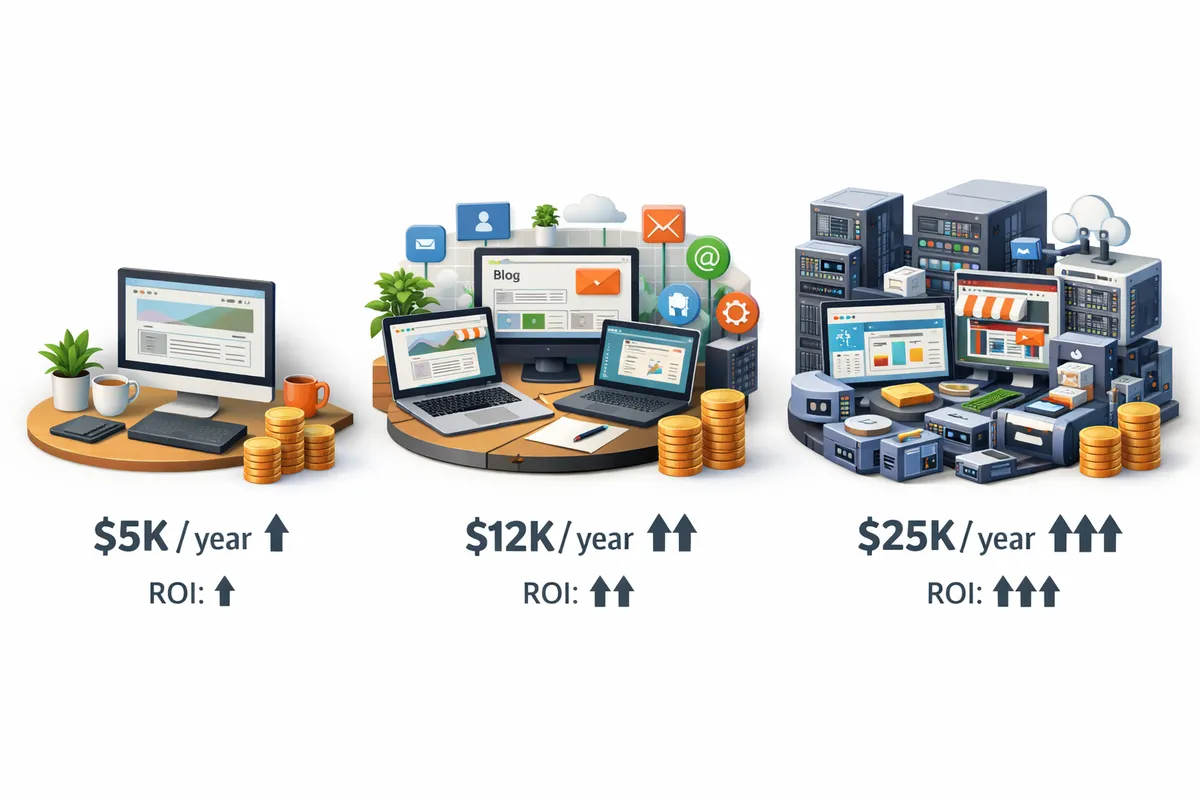
Website Pricing Tiers
Startup Lift: $2,500 to $4,500
This tier works for founders bootstrapping their first website. You need a professional online presence without overbuilding.
What is included: 5 to 7 custom-designed pages, mobile-responsive layout, basic SEO setup with title tags and meta descriptions, Google Analytics and Search Console integration, SSL certificate, hosting configuration, domain setup, and a 30-day launch support window.
Typical build time: 2 to 3 weeks from kickoff to launch.
Best for: Consultants, freelancers, service providers, coaches, and early-stage startups that need a clean professional site to start generating leads. If your primary goal is establishing credibility and having a place to send prospects, this tier delivers that without unnecessary complexity.
Growth Platform: $5,000 to $9,000
This tier fits startups ready to use their website as a marketing engine. Beyond looking professional, you need the site to attract organic traffic, capture leads, and support content marketing.
What is included: 10 to 15 custom-designed pages, advanced design with custom graphics and illustrations, blog or resource center with CMS, SEO optimization including keyword research and on-page strategy, lead capture forms with CRM integration, analytics dashboard setup, content management training so your team can publish independently, and a 30-day launch period.
Typical build time: 3 to 5 weeks.
Best for: Service businesses, SaaS startups, and agencies that have validated their offering and need their website to actively generate inbound leads. If you plan to invest in content marketing or PPC advertising, this tier gives you the landing pages and conversion infrastructure to make those channels work.
Scale System: $10,000 to $15,000
This tier serves businesses with specific technical requirements that off-the-shelf solutions cannot handle.
What is included: Custom page count based on your needs, advanced integrations (CRM, payment processing, booking systems, client portals), e-commerce functionality if needed, advanced SEO with competitive analysis, performance optimization for sub-2-second load times, custom animations or interactive elements, API integrations with your existing tools, and priority support.
Typical build time: 5 to 8 weeks.
Best for: Businesses with complex workflows, multi-location companies, e-commerce stores, and startups building a platform where the website itself is part of the product. If you need custom software capabilities integrated into your web presence, this tier provides that foundation.
What Is Included in Every Build
Regardless of tier, every Running Start Digital website includes these fundamentals at no additional cost.
Hosting and domain configuration. We set up your hosting environment and connect your domain. No surprise infrastructure bills.
SSL certificate. Every site runs on HTTPS. This is non-negotiable for security and search rankings.
Mobile optimization. Over 60% of web traffic comes from mobile devices. Every page is designed mobile-first, then adapted for desktop. Not the other way around.
Google Analytics and Search Console. Tracking is configured from day one so you can measure traffic, conversions, and search performance immediately after launch.
SEO foundation. Title tags, meta descriptions, heading structure, image alt text, sitemap generation, and robots.txt configuration. Your site is discoverable from launch day.
Speed optimization. Image compression, code minification, lazy loading, and caching configuration. Our standard builds achieve Google PageSpeed scores above 90, which directly impacts both search rankings and conversion rates. For sites that need additional performance work, explore our site speed optimization services.
30-day launch support. Bug fixes, content adjustments, and minor tweaks during the first month after launch are included. You are not abandoned after the site goes live.
Hidden Costs to Watch For
The website industry is full of pricing surprises. Here is what to ask about before signing with any agency.
Ongoing hosting fees. Some agencies lock you into $100 to $300 per month hosting plans that cost them $10 per month. We configure your hosting on reliable infrastructure at fair market rates.
Content management fees. If you need to update your own site, some agencies charge monthly fees for CMS access. Your site should come with a CMS you can use independently.
Plugin and license renewals. WordPress sites often depend on premium plugins that require annual renewals of $50 to $500 each. Clarify which licenses are included and which are your responsibility.
Revision limits. Some agencies include two rounds of revisions and charge $150 per hour after that. We include reasonable revisions at every stage because getting the design right matters.
SEO as an upsell. Basic SEO should be part of every website build, not a $2,000 add-on. Our competitors frequently strip SEO from their base pricing, then charge separately for title tags and meta descriptions that take 30 minutes to configure.
Calculating Your Website ROI
A website is not an expense. It is infrastructure that generates revenue. Here is how to estimate your return.
Start with your average customer value. If a typical customer is worth $2,000 over their lifetime, and your website generates just 3 new customers per month, that is $6,000 in monthly revenue from a $5,000 website investment. The site pays for itself in less than 30 days.
For service businesses, the math is even more compelling. A consulting firm charging $5,000 per engagement needs one client from their website to justify a $4,500 Startup Lift build. Most of our clients report their first inbound lead within the first two weeks after launch.
For e-commerce businesses, track revenue per visitor. If your site converts at 2% with a $75 average order value, every 1,000 visitors generates $1,500. Driving 1,000 monthly visitors through SEO and paid advertising is achievable within the first 90 days for most markets.
The businesses that struggle with ROI are those that build a website and then do nothing to drive traffic. A website without a marketing strategy is a brochure nobody sees. Pair your site with lead generation and content marketing to make the investment compound.
Cheap Websites vs. Professional Websites
A $300 Wix or Squarespace template seems like a smart way to save money. In practice, it costs you more than a professional build.
Search performance. Template sites share code patterns with millions of other sites. Google has seen your exact layout thousands of times. Custom sites with unique content, optimized structure, and proper technical SEO consistently outrank template builds.
Conversion rates. The average template website converts visitors at 1 to 2%. Professionally designed sites with intentional user flows convert at 3 to 5% or higher. On 1,000 monthly visitors, that difference is 20 to 30 additional leads per month.
Scalability. Template builders hit walls fast. Need a custom booking flow? A client portal? Dynamic pricing? An integration with your CRM? You are rebuilding from scratch. A professionally built site accommodates growth without starting over.
Brand perception. Your website is your first impression. A template site signals that your business is not yet established. A custom site signals credibility, investment, and permanence. For B2B companies, this distinction directly impacts whether prospects take meetings.
When to Invest More (and When Not To)
Not every business needs a $15,000 website on day one. Spend more when your website is your primary sales channel, when you are entering a competitive market where brand perception matters, or when you need custom functionality that templates cannot provide.
Spend less when you are validating a business idea, when you have strong referral networks and do not depend on inbound leads, or when your product is pre-revenue and you need to conserve capital.
The smartest approach is to build for your current stage and plan for upgrades. A $3,500 Startup Lift site that generates leads can fund a Growth Platform upgrade six months later. Start where you are, not where you hope to be.
Our Process: From Briefing to Launch
Week 1: Discovery and positioning. We clarify your target customer, core message, and conversion goals. No lengthy workshops. One focused session that produces a clear creative brief.
Week 2: Design. Homepage and key page designs delivered for review. You provide feedback. We iterate until the design matches your vision.
Weeks 3 to 4: Development. We build the site, integrate your tools, configure analytics, and optimize performance. You receive a staging link to review progress.
Week 4 to 5: Launch and optimization. We go live, monitor performance, fix any issues, and ensure everything works across devices and browsers. Your 30-day support window begins.
Throughout this process, you have a single point of contact. No getting passed between departments. No explaining your project to a new person at every stage.
Frequently Asked Questions
How much should a small business spend on a website?
Most small businesses should budget between $3,000 and $8,000 for a professional website. Businesses that rely heavily on inbound leads or e-commerce should budget $8,000 to $15,000. The right number depends on how central the website is to your revenue model. A service business that gets most clients through referrals needs less than an online store that depends entirely on web traffic.
Is it worth paying for a custom website over a template?
For businesses that depend on their website for lead generation or sales, yes. Custom websites outperform templates on search rankings, conversion rates, and scalability. The upfront investment is higher, but the long-term cost of rebuilding a template site when it stops meeting your needs typically exceeds what a custom build costs from the start.
What are the ongoing costs after my website launches?
Ongoing costs include hosting ($10 to $50 per month for most small business sites), domain renewal ($12 to $20 per year), and optional maintenance or content updates. If you want ongoing SEO services or content marketing, those are separate investments. The website itself does not require significant ongoing expenses.
How long does it take to build a small business website?
A standard 5 to 10 page business website takes 2 to 4 weeks from kickoff to launch. More complex sites with custom functionality, e-commerce, or extensive content take 5 to 8 weeks. The biggest variable is client feedback speed. Projects where stakeholders provide timely feedback launch on schedule. Projects where feedback takes two weeks per round take twice as long.
Can I update my website myself after it launches?
Yes. Every site we build includes a content management system that lets you update text, images, blog posts, and basic page elements without touching code. We provide training on how to use it. For structural changes or new functionality, we offer support packages or project-based work.
Do I need a new website or can you redesign my existing one?
That depends on your current site's technical foundation. If your existing site runs on a modern platform with clean code, a redesign is often faster and cheaper than a ground-up rebuild. If your site is built on outdated technology, has security vulnerabilities, or performs poorly on mobile, a new build is the better investment. We assess your current site and recommend the most cost-effective approach. Our website design services cover both redesigns and new builds.