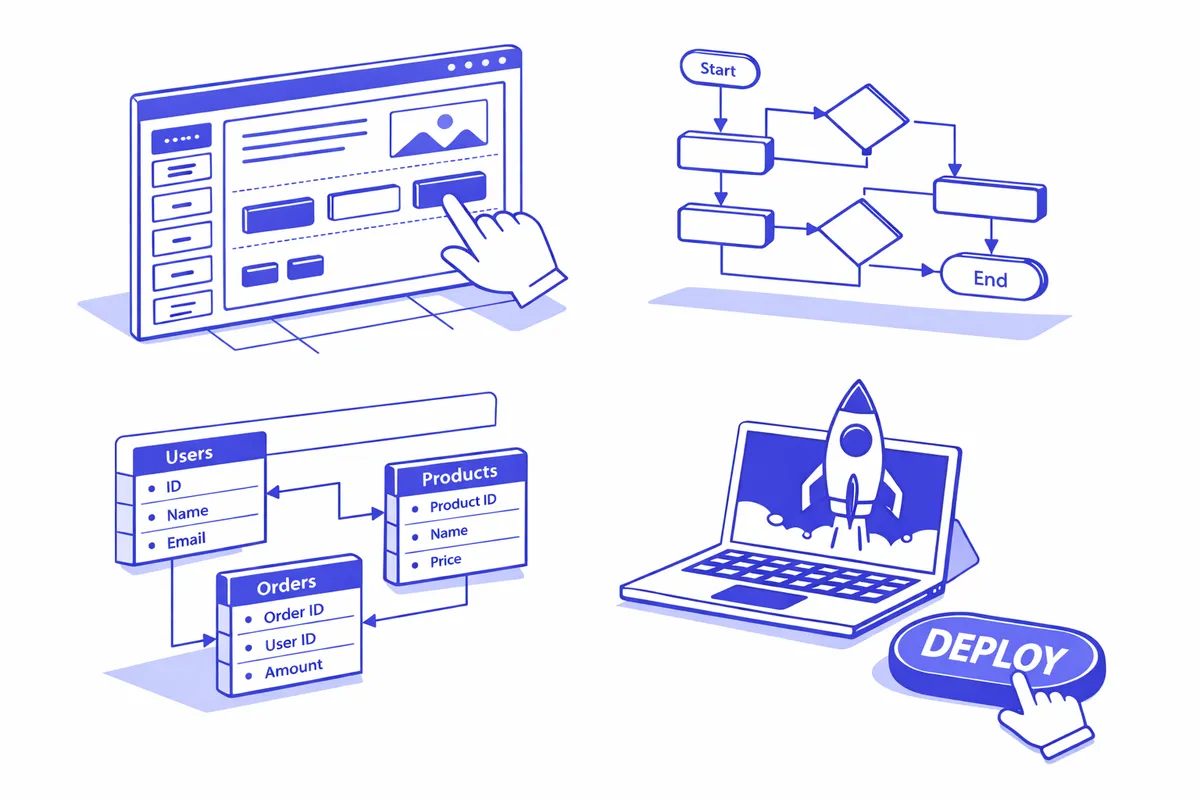
What Is Custom AI Development?
Custom AI development involves building machine learning models, data pipelines, and AI-powered applications from the ground up using code. Data scientists and ML engineers design architectures, train models on your specific data, optimize performance metrics, and deploy into your infrastructure with full monitoring and retraining pipelines.
Custom development gives you complete control over every aspect of the solution. Model architecture, training data selection, feature engineering, performance tuning, deployment strategy, and integration points are all tailored to your exact requirements. Nothing is constrained by a platform's limitations or opinionated defaults.
Where Custom AI Wins
The solutions custom development produces fit your business precisely. A recommendation engine trained on your customer behavior patterns. A predictive model tuned to your specific market dynamics and seasonal patterns. An NLP system that understands your industry's terminology, abbreviations, and context. A computer vision system that inspects your specific products on your specific production line.
These solutions become genuine competitive advantages because competitors cannot buy the same thing off a shelf. When a custom churn prediction model prevents $200,000 in annual revenue loss, the $80,000 development cost produces a 2.5x return in the first year alone. When a custom lead scoring model increases sales team efficiency by 35%, the impact compounds every month.
Custom AI also provides data sovereignty that many industries require. Healthcare organizations bound by HIPAA, financial institutions under SOC 2 compliance, and government contractors with FedRAMP requirements need models and data that stay within controlled environments. No-code platforms rarely meet these standards.
Side-by-Side Comparison
| Factor | No-Code AI | Custom AI Development |
|---|---|---|
| Initial Cost | $50 to $500/month platform fees | $30K to $300K+ project investment |
| Implementation Time | Days to weeks | 8 to 20 weeks |
| Customization | Limited to platform capabilities | Unlimited, built to your specifications |
| Scalability | Constrained by platform pricing tiers | Scales with your infrastructure |
| Maintenance | Platform handles updates | Your team or agency manages everything |
| Data Ownership | Often stored on platform servers | Full ownership and control |
| Performance Ceiling | Good for standard use cases | Optimized for your specific data and needs |
| Integration Depth | API-level, sometimes limited | Deep integration with any system |
| Compliance | Platform-dependent | Full control over data handling |
When to Choose No-Code AI
No-code AI is the right starting point when several conditions align with your situation.
You need to validate an AI concept quickly. Before committing $50,000 or more to custom development, prove the concept works with a $200/month no-code tool. If customers respond positively and the business case holds, you have a clear specification for custom development.
The use case is standard and well-served by existing platforms. Customer support chatbots, email classification, simple data extraction, and workflow automation are all solved problems. No-code platforms have refined these solutions across thousands of customers. You benefit from that collective learning.
Your team lacks technical AI expertise. Hiring machine learning engineers costs $150,000 to $250,000 per year per engineer. If AI is supplementary to your business rather than core to it, the no-code approach lets you capture value without building an engineering team.
Budget is under $10K and you need results now. Custom development requires significant upfront investment. If your budget for AI is limited and you need to show results to stakeholders this quarter, no-code platforms deliver working solutions within your constraints.
Speed to market matters more than long-term flexibility. A no-code chatbot live this week is more valuable than a custom solution launching in four months, especially if you are still learning what your customers actually need.
When to Choose Custom AI Development
Custom development becomes the right choice when the stakes are high enough to justify the investment.
Your use case is unique. If no platform template addresses your specific problem, custom is the only path. Proprietary algorithms, industry-specific models, and novel applications require purpose-built solutions.
Performance requirements exceed platform capabilities. No-code AI models typically achieve 70 to 85% accuracy on standard tasks. Custom models trained on your data can reach 90 to 98% accuracy for well-defined problems. When that accuracy gap translates to significant revenue or risk, custom development pays for itself.
Data privacy and compliance are non-negotiable. Regulated industries need full control over how data is processed, stored, and accessed. Custom AI solutions keep everything within your compliance boundary.
The AI capability is central to your product or competitive advantage. If AI is what differentiates your product in the market, you cannot afford to depend on a third-party platform's roadmap, pricing changes, or continued existence.
You have outgrown a no-code prototype. This is the most common trigger for custom development. Your no-code tool works, but it is hitting performance limits, costing more than a custom solution would, or cannot integrate deeply enough with your other systems.
The Hybrid Approach: Prototype to Production
The most cost-effective strategy is usually sequential: prototype with no-code, scale with custom.
Phase 1: No-Code Validation (1 to 4 weeks, $500 to $3,000)
Build a working prototype on a no-code platform. Test it with real users. Measure engagement, accuracy, and business impact. Document what works, what does not, and what users request that the platform cannot deliver.
This phase is worth its weight in gold because it prevents investing six figures in something that might not solve the right problem. The prototype also serves as a detailed specification for custom development. You know exactly what the system needs to do because you have already built a working version.
Phase 2: Evaluate Honestly (1 to 2 weeks)
If the no-code solution handles 90% or more of what you need and you can live with the constraints, stay on the platform. Many businesses operate successfully on no-code AI tools for years. There is no shame in pragmatic technology choices.
Calculate the crossover point. If your no-code platform costs $400/month and growing at 20% per quarter, it will cost $14,000 annually within 18 months. If a custom solution costs $60,000 to build and $8,000 annually to maintain, the custom path becomes cheaper by year two.
Phase 3: Custom Build (8 to 20 weeks, $30K to $300K+)
If you are hitting walls, whether that is performance limitations, customization constraints, data ownership concerns, or scaling costs that exceed custom development, that is when you build. You build with confidence because you have already proven the concept and documented exactly what success looks like.
The no-code prototype accelerates custom development by 20 to 30% because your engineering team starts with clear requirements rather than abstract specifications.
Real-World Cost Scenarios
Small Business: Customer Support Automation
A 20-person e-commerce company wants to automate 40% of support tickets.
No-code approach: Intercom with AI features at $300/month. Setup in 2 weeks. Handles 35% of tickets automatically. Annual cost: $3,600.
Custom approach: Purpose-built classification model trained on 2 years of ticket data. $45,000 development. Handles 55% of tickets with higher accuracy. Annual maintenance: $8,000.
Verdict: No-code wins for this scale. The 20% accuracy gap does not justify 12x the cost.
Mid-Market: Sales Lead Scoring
A B2B SaaS company with 500 monthly leads needs to prioritize sales effort.
No-code approach: HubSpot predictive scoring at $800/month. Limited to HubSpot data. 65% accuracy in identifying qualified leads.
Custom approach: Model trained on CRM data, website behavior, firmographic data, and intent signals. $80,000 development. 88% accuracy. Deep integration with existing CRM and martech stack.
Verdict: Custom wins. The 23% accuracy improvement means the sales team spends 35% less time on unqualified leads. That efficiency gain pays for the development cost within 8 months.
Enterprise: Demand Forecasting
A manufacturer with $50M in annual revenue needs to optimize inventory.
No-code approach: No platform adequately handles multi-variable manufacturing demand forecasting at this scale.
Custom approach: Predictive analytics model incorporating historical sales, seasonality, economic indicators, and supply chain data. $150,000 development. Reduces inventory carrying costs by $600,000 annually.
Verdict: Custom is the only viable option. The ROI is 4x in the first year.
Common Mistakes to Avoid
Building custom before validating demand. The most expensive mistake in AI development is building a solution nobody needs. Always validate the concept with a prototype first, even a rough one.
Staying on no-code too long. Platform costs that grow 20% per quarter compound quickly. If you are paying $1,000/month and the platform is becoming a constraint, evaluate custom sooner rather than later.
Underestimating data requirements. Custom AI models need clean, labeled training data. If your data is scattered across spreadsheets, siloed databases, and employee knowledge, budget for data preparation. It often takes 30 to 40% of the total project timeline.
Ignoring integration complexity. An AI model in isolation is a science project. It needs to integrate with your CRM, ERP, marketing tools, and operational workflows to deliver business value. Plan for integration from day one.
Frequently Asked Questions
Can I start with no-code and switch to custom later?
This is the approach we recommend most often. No-code prototypes prove value quickly and cheaply. When you outgrow the platform, the prototype serves as a detailed specification for custom development. You know exactly what the system needs to do because you have already built a working version. The transition is smoother than starting custom from scratch, typically saving 20 to 30% on development time.
What is the total cost of ownership for each approach?
No-code AI typically runs $600 to $6,000 annually in platform fees, with costs rising as usage scales. Custom AI development costs $30K to $300K+ initially, with $5K to $20K annually for hosting and maintenance. Custom becomes more cost-effective when platform fees at scale exceed what you would spend maintaining your own solution. Most businesses hit that crossover point between 18 and 36 months of growth.
Which option is better for small businesses?
No-code is the clear winner for most small businesses. The low cost, fast deployment, and minimal technical requirements align perfectly with small business constraints. Start there. If your AI needs grow beyond what the platform supports, you will have the revenue and clarity to justify custom development at that point.
How long before I see results with each approach?
No-code AI can deliver a working product in days to weeks. You test with real users almost immediately. Custom AI development takes 8 to 20 weeks to reach initial deployment, depending on complexity. The longer timeline produces a more tailored result, but the faster feedback loop of no-code often reveals requirements you would not have discovered otherwise.
Does Running Start Digital help with both options?
We do. Our team includes specialists who can spin up rapid prototypes using no-code platforms and engineers who build production-grade custom AI systems. We also help businesses set up AI-powered marketing automation and workflow automation that leverage both approaches. We recommend based on your actual needs, timeline, and budget rather than our revenue preference.
What if my no-code AI tool shuts down or raises prices dramatically?
This is a real risk. Platform dependency means your AI capability is tied to another company's business decisions. Mitigate this by exporting your data regularly, documenting your workflows independently of the platform, and maintaining a migration plan. If a platform is critical to your operations, evaluate custom alternatives before you are forced into an emergency migration.
Choose the Right AI Path for Your Business
The no-code vs. custom decision is not permanent. It is a starting point. Most successful AI implementations begin with validation and evolve toward custom solutions as the business case strengthens and requirements become clear.
Running Start Digital works across this entire spectrum. We help businesses evaluate no-code platforms, build prototypes, and transition to custom solutions when the time is right.
Talk to Us About Your AI Project Explore Custom AI Solutions