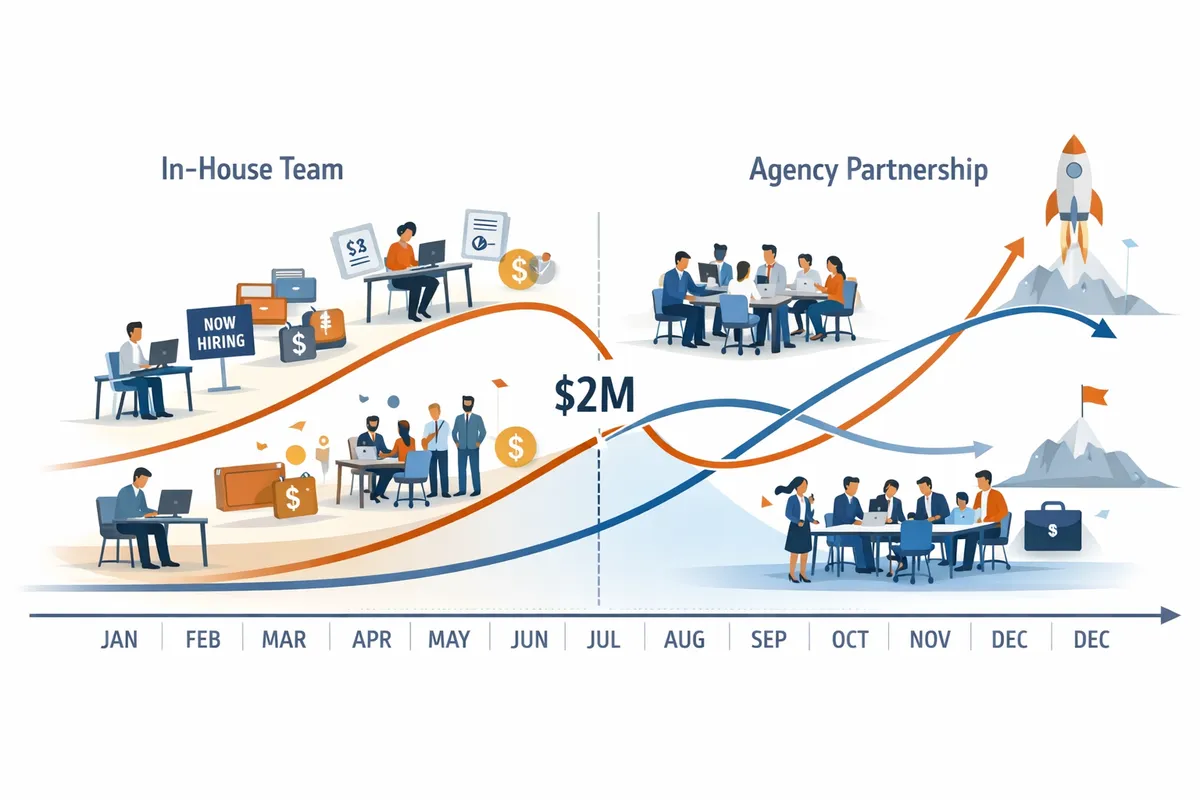
Agency Partnership: The Full Cost Picture
Agency pricing varies widely based on scope, specialization, and the level of strategic involvement you need.
Monthly retainer model. Agencies charge $400 to $5,000 per month depending on the scope of services. A focused engagement covering one discipline like SEO or content runs $1,000 to $3,000 per month. A comprehensive engagement covering strategy, content, paid media, and analytics runs $3,000 to $8,000 per month for a small to mid-size business.
Total year-one cost: $5,000 to $60,000. Plus potential setup fees of $1,000 to $5,000 for strategy development, account configuration, and initial content creation.
What you get for that investment. A team. Not one person with gaps, but a strategist, content writers, a paid media specialist, a designer, and an analytics person. You access five to eight skill sets for less than the cost of one full-time senior hire. If someone on the team is not delivering, the agency replaces them. You do not pay recruitment costs. You do not manage their professional development. You scale up during busy seasons and scale down during slow ones.
The trade-offs. An agency does not live inside your business. They work with multiple clients, which means divided attention. It takes four to eight weeks for a new agency to understand your business, customers, and competitive landscape deeply enough to produce their best work. Communication requires more structure because the team is external. And if the agency is overbooked, quality can suffer.
Cost Comparison at Every Stage
Pre-revenue and seed stage (under $100K ARR). You cannot afford a full-time marketing hire, and even if you could, a junior hire does not have the strategic experience to build your marketing foundation. A focused agency engagement at $1,000 to $2,000 per month provides senior strategic guidance and execution that a $55,000 junior hire cannot match. Winner: agency.
Early stage ($100K to $500K ARR). You might afford one marketing person, but they will be stretched across too many responsibilities to excel at any of them. An agency provides the breadth of skills you need while your single hire (if you make one) focuses on the area of highest impact. Some businesses at this stage operate entirely with agency support and no in-house marketing headcount. Winner: agency, or agency plus one in-house person.
Growth stage ($500K to $2M ARR). You can justify one to two marketing hires. The question becomes which skills you bring in-house and which you keep external. The strongest pattern: hire a marketing manager who owns strategy, brand voice, and cross-functional coordination. Keep specialized execution like SEO, paid media, and email marketing with an agency that has deeper expertise and better tools than any single hire could. Winner: hybrid model.
Scale stage ($2M to $10M ARR). At this stage, marketing volume justifies a team of three to five people. In-house hires own day-to-day execution, content production, and campaign management. Agency partners handle specialized work like conversion optimization, advanced analytics, and new channel launches where bringing in outside expertise produces better results than developing it internally. Winner: in-house team supplemented by specialized agency work.
Enterprise stage ($10M+ ARR). Full in-house marketing departments are standard. Agencies serve as specialized consultants for specific initiatives: rebrands, technology migrations, market expansion, and emerging channels like AI marketing automation. Winner: in-house with selective agency partnerships.
The Hybrid Model in Detail
Most successful growing businesses end up with a hybrid model. It costs less than a full in-house team and produces better results than either model alone.
Structure. One in-house person (marketing manager or coordinator) at $60,000 to $90,000 salary plus an agency retainer at $1,500 to $3,000 per month. Loaded annual cost: $95,000 to $145,000.
How the work divides. The in-house person owns brand voice, internal stakeholder communication, content calendar management, and day-to-day coordination. They are your institutional memory and your marketing command center. The agency owns specialized execution: SEO strategy and implementation, paid media management, technical analytics, and creative production. They bring skills and tools that no single hire possesses.
Why this outperforms either model alone. The in-house person eliminates the agency's biggest weakness (lack of deep business knowledge) while the agency eliminates the in-house hire's biggest weakness (limited skill breadth). Communication flows smoothly because the in-house person translates business context into marketing direction. The agency translates marketing strategy into execution across multiple disciplines.
Evaluating Agency Quality
Not all agencies deliver equal value. Knowing how to evaluate them prevents the most common bad experiences.
Signs of a strong agency. They ask detailed questions about your business before proposing solutions. They show results from similar clients, not just pretty portfolios. They explain their process clearly and set realistic expectations about timelines. They assign a dedicated point of contact who knows your account. They proactively share insights and recommendations rather than waiting for direction.
Signs of a weak agency. Generic proposals that could apply to any business. Promising specific results (such as "we will get you to page one in 30 days") without understanding your competitive landscape. Difficulty explaining what they will actually do each month. Rotating account managers who do not know your business. Billing for hours without showing what those hours produced.
Questions to ask potential agencies. What does the first 90 days look like? Who specifically will work on my account, and what is their experience? How do you measure and report results? What happens if I am not satisfied with the work? Can I speak with two to three current clients in my industry or at my stage?
The Real Gotcha: Hiring the Wrong Type
Bad in-house hires. Someone experienced at a Fortune 500 company who does not know how to operate with a startup budget. They are used to managing agencies and vendors, not doing hands-on work. Someone who knows one discipline deeply but is hired to cover five. A generalist who can do everything but nothing at a level that moves the needle. Hiring the wrong person costs $50,000 to $100,000 in salary, recruitment, and lost opportunity cost before you recognize the mistake.
Bad agency picks. Generalist agencies spreading attention too thin across 50 clients. Agencies that build dependency rather than capability. They keep their processes opaque so you cannot function without them. Agencies that lock you into long contracts with vague deliverables. Agencies that present impressive case studies from years ago but cannot show recent results.
Good agencies teach you. They invest in your success because healthy clients renew and refer. They share their thinking so you understand why decisions are being made, not just what decisions are being made. That knowledge compounds when you eventually hire internally, because you understand marketing architecture well enough to hire, manage, and evaluate talent effectively.
When to Switch Models
Signals you need to add in-house talent. Your agency relationship is strong but you are spending $5,000+ per month and the work volume justifies a dedicated person. You need someone who lives and breathes your brand voice daily. Your marketing requires constant real-time coordination with sales, product, or customer success teams.
Signals you need agency support. Your in-house team is maxed out and quality is slipping. You need specialized skills (advanced SEO, paid media optimization, reputation management) that do not justify a full-time hire. You want strategic perspective from someone who sees patterns across multiple businesses and industries.
Signals you need a hybrid model. You need both institutional knowledge and specialized execution. Your budget allows for one strong in-house hire but not a full team. Your marketing spans multiple disciplines that no single person can master.
FAQ
How much should a small business budget for marketing overall?
The SBA recommends 7 to 8 percent of gross revenue for businesses under $5M in revenue. Growth-stage companies often invest 10 to 20 percent. For a business generating $500,000 in annual revenue, that translates to $35,000 to $100,000 per year across all marketing activities. This includes agency or team costs, advertising spend, tools, and content production. Allocate 50 to 60 percent to execution (agency or team) and 40 to 50 percent to media spend and tools.
Can I start with an agency and transition to in-house later?
Yes, and this is one of the most effective growth patterns. Start with agency support to build your marketing foundation, develop your strategy, and generate initial results. As revenue grows and you can justify headcount, hire an in-house marketing manager. Transition day-to-day execution to them while keeping the agency for specialized work. Many businesses maintain some agency relationship even after building a full team because the specialized expertise remains valuable.
What is a reasonable timeline to evaluate an agency?
Give an agency 90 days before making a judgment. The first 30 days involve onboarding, strategy development, and setup. Results begin appearing in months two and three. For SEO and content, meaningful results may take four to six months due to the nature of organic growth. Evaluate based on progress indicators (content produced, campaigns launched, optimizations implemented) in the first 90 days and outcome indicators (leads, traffic, conversions) at the six-month mark.
How do I know when my business is too big for agency-only marketing?
When your monthly agency spend exceeds $6,000 to $8,000 and marketing requires daily coordination with internal teams, adding in-house talent becomes more efficient. Another signal is when your agency cannot keep up with the volume of content, campaigns, and requests your growth requires. At that point, bringing repetitive, high-volume execution in-house while keeping specialized strategy and execution with the agency optimizes both cost and quality.
What skills should my first in-house marketing hire have?
Your first hire should be a generalist who can execute across multiple channels rather than a specialist in one. Look for someone who can write competent content, manage basic paid campaigns, coordinate with vendors and agencies, and analyze performance data. Strategic thinking and communication skills matter more than mastery of any single tool. They will grow with your business and the agency fills the specialist gaps they cannot cover yet.
How do agencies handle the transition when we bring skills in-house?
Good agencies welcome it because it signals a healthy client relationship. They help train your new hire, transfer knowledge and processes, and adjust their scope to focus on areas where agency expertise still adds the most value. Great agencies proactively recommend this transition when it makes financial sense for the client, even though it reduces their own revenue. That is the sign of a partner invested in your success rather than their own billing.