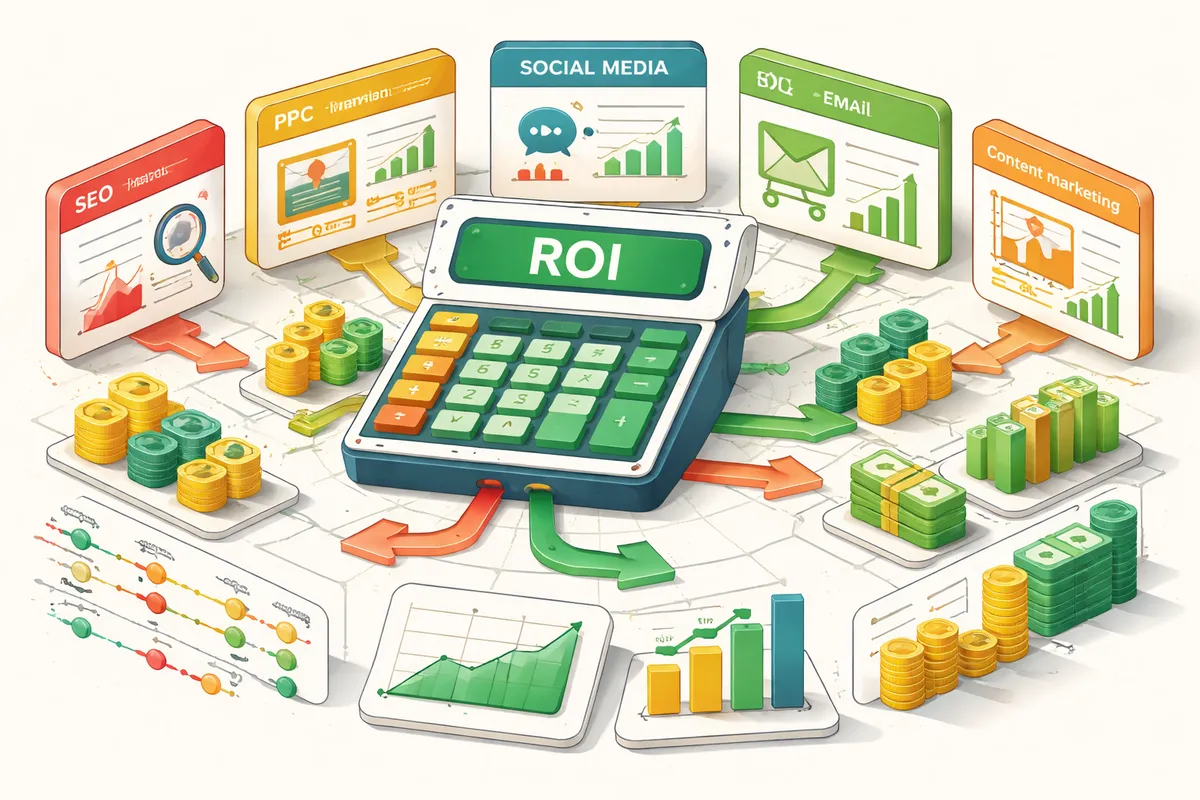
ROI by Marketing Channel
Each marketing channel has different cost structures, timelines, and measurement approaches. Understanding these differences prevents the common mistake of applying the same ROI expectations to every channel.
SEO (Search Engine Optimization)
SEO is a long-term compounding investment. The initial months show little return, but by month 8 to 12, well-executed SEO delivers some of the highest ROI of any digital channel.
How to measure: Track organic traffic, organic conversions, and revenue from organic visitors using Google Analytics 4 with proper conversion tracking and UTM parameters.
Key metrics to track: - Organic traffic growth (month over month and year over year) - Organic conversion rate (typically 2% to 5% for service businesses) - Revenue attributed to organic search visitors - Cost per organic acquisition (total SEO spend / organic conversions) - Keyword ranking improvements for target commercial terms - Organic click-through rate from search results
Typical ROI timeline: 6 to 12 months to break even on investment. 12 to 24 months for strong compounding returns. After 24 months, SEO becomes your most cost-effective channel because content continues generating traffic without additional spend.
Benchmark: Companies investing $1,000 to $3,000/month in SEO consistently for 18+ months typically see 5:1 to 10:1 ROI. A local service business we tracked spent $1,200/month on SEO for 14 months. By month 14, organic traffic was generating 35 leads per month worth approximately $8,500 in monthly revenue, representing a 7:1 return on cumulative investment.
Content Marketing
Content marketing overlaps with SEO but extends to lead generation, email list building, and establishing topical authority that supports every other marketing channel.
How to measure: Track content consumption, lead generation from gated content, and content-assisted conversions using multi-touch attribution.
Key metrics to track: - Leads generated from gated content (guides, templates, calculators) - Blog traffic to conversion rate - Content-assisted conversions (content touched during the buyer journey even if it was not the last click) - Cost per content-generated lead - Email subscribers gained from content - Average time on page and pages per session for content readers
Typical ROI timeline: 3 to 6 months for lead generation from gated content. 12 months for significant organic traffic contribution. Each piece of content is an appreciating asset that generates returns for years.
Benchmark: Content marketing generates 3x more leads per dollar than paid advertising according to DemandMetric research. A well-optimized blog post costs $200 to $500 to produce and can generate traffic and leads for 3+ years without additional investment.
Paid Advertising (PPC)
PPC advertising delivers the fastest feedback loop. You launch a campaign and see results within days. This makes ROI measurement more straightforward than organic channels.
How to measure: Direct attribution from ad click to conversion using platform tracking plus Google Analytics 4 confirmation.
Key metrics to track: - Return on ad spend (ROAS): Revenue / Ad Spend - Cost per acquisition (CPA): Total Spend / Number of Conversions - Cost per click (CPC): varies by industry from $1 to $50+ - Conversion rate by campaign and keyword (benchmark: 3% to 5% for search ads) - Quality Score (affects CPC and ad placement) - Customer lifetime value vs acquisition cost
Typical ROI timeline: Immediate. Results appear within days of launching campaigns. Optimization improves results over 4 to 8 weeks. Mature campaigns (3+ months of optimization) significantly outperform new ones.
Benchmark: Google Ads average ROAS is 2:1 across all industries. Well-optimized campaigns in service industries achieve 4:1 to 8:1. The key variable is landing page conversion rate. Improving conversion rate from 3% to 6% doubles your ROAS without any change in ad spend.
Email Marketing
Email marketing consistently delivers the highest ROI of any digital marketing channel because the cost per send is near zero and the audience has already opted in.
How to measure: Track email-driven website visits, conversions, and revenue using UTM-tagged links and conversion tracking.
Key metrics to track: - Revenue per email sent (benchmark: $0.08 to $0.15 per email for service businesses) - Email conversion rate (benchmark: 1% to 5% depending on list quality and offer) - List growth rate (aim for 2% to 5% monthly growth) - Revenue from automated sequences vs one-time campaigns - Customer retention rate attributable to email engagement - Unsubscribe rate (keep below 0.5% per send)
Typical ROI timeline: Immediate for promotional emails to an engaged list. 1 to 3 months for automated sequence optimization. Welcome sequences, abandoned cart flows, and re-engagement campaigns generate revenue on autopilot once configured.
Benchmark: Email marketing averages $36 return for every $1 spent according to Litmus research. A 5,000-person email list sending weekly, with a 2% conversion rate and $200 average order value, generates approximately $80,000 in annual revenue from email alone.
Social Media Marketing
Social media marketing serves dual purposes: direct lead generation and brand awareness that supports every other channel.
How to measure: Track social traffic, social conversions, brand awareness metrics, and social-assisted conversions.
Key metrics to track: - Social media referral traffic to website - Social conversion rate (typically lower than search at 0.5% to 2%) - Engagement rate and reach - Social-assisted conversions (social was a touchpoint but not last click) - Cost per engagement for paid social - Brand mention volume and sentiment
Typical ROI timeline: 3 to 6 months for measurable traffic and lead generation from organic social. Paid social campaigns produce results within 1 to 2 weeks.
Benchmark: Organic social ROI is difficult to quantify directly because much of its value appears in other channels (branded search increases, email list growth, referral traffic). Paid social ROAS averages 2:1 to 4:1 depending on platform, industry, and creative quality.
Attribution Models Explained
Attribution determines which marketing touchpoints get credit for a conversion. A customer might see your social media post, read your blog, click a Google ad, and then convert via email. Which channel gets the credit? The model you choose significantly affects how you evaluate each channel's ROI.
### Last-Click Attribution Credits 100% of the conversion to the last touchpoint before purchase. Simple to implement but misleading for businesses with multi-touch buyer journeys. It ignores all the marketing that brought the customer to the decision point and overvalues bottom-of-funnel channels.
### First-Click Attribution Credits 100% of the conversion to the first touchpoint. Useful for understanding what drives initial awareness. Ignores the nurturing and persuasion that actually closed the deal. Overvalues top-of-funnel channels.
### Linear Attribution Credits each touchpoint equally. If a customer had 4 touchpoints, each gets 25% credit. Fair but does not account for the relative importance of different interactions. A casual social media impression is weighted the same as a high-intent search click.
### Time-Decay Attribution Credits more to touchpoints closer to the conversion. Recent interactions receive more weight than earlier ones. Reasonable for most businesses because it reflects the reality that recent interactions have more influence on the purchase decision while still acknowledging earlier touchpoints.
### Data-Driven Attribution Uses machine learning to assign credit based on actual conversion patterns in your data. Most accurate but requires significant data volume (typically 300+ conversions per month). Available in Google Analytics 4 for businesses with enough conversion data.
Our recommendation: Start with time-decay attribution if your analytics platform supports it. It provides the most balanced view for most businesses. Move to data-driven when you have sufficient conversion volume. The important thing is picking a model, being consistent, and not switching models mid-analysis.
Building Your ROI Dashboard
Every business spending money on marketing needs a dashboard that answers one question every month: is our marketing investment generating a positive return?
Track these metrics monthly at minimum:
| Metric | Source | Cadence |
|---|---|---|
| Total marketing spend (all channels) | Finance records | Monthly |
| Marketing-sourced revenue | CRM + attribution | Monthly |
| Leads by channel | CRM + analytics | Weekly |
| Cost per lead by channel | Calculated | Monthly |
| Customer acquisition cost (CAC) | Calculated | Monthly |
| Customer lifetime value (LTV) | CRM + billing | Quarterly |
| ROAS by paid channel | Ad platforms | Weekly |
| Organic traffic growth | Google Analytics | Monthly |
| Email revenue | Email platform + analytics | Monthly |
| Overall marketing ROI | Calculated | Monthly |
For businesses working with us, our CRM and MarTech consulting services include dashboard setup and ongoing reporting configuration. We use tools like Looker Studio, Metabase, or custom reporting depending on your tech stack.
Common ROI Measurement Mistakes
Measuring too early. SEO and content marketing need 6 to 12 months to compound. Declaring them failures after 3 months is like planting a tree and complaining it has not produced fruit in a week. Set expectations with leadership before starting organic campaigns.
Ignoring customer lifetime value. A $200 acquisition cost looks expensive if your average sale is $150. It looks like a bargain if your customer spends $2,000 over 3 years. Always calculate ROI against LTV, not first purchase value. This single shift in perspective changes which channels and campaigns appear profitable.
Mixing brand and performance metrics. Brand awareness campaigns and direct response campaigns serve different purposes. Measuring a brand awareness campaign by direct ROI misses its value entirely. Separate brand metrics (reach, impressions, branded search volume) from performance metrics (leads, sales, ROAS).
Not accounting for all costs. Marketing ROI must include agency fees, ad spend, tools, and internal staff time. Omitting any of these inflates your ROI calculation and creates a false sense of performance. A campaign that looks like 500% ROI might be 200% ROI once you include the 20 hours your team spent supporting it.
Single-touch attribution for long sales cycles. If your sales cycle is 3 to 6 months, last-click attribution misses all the marketing that influenced the decision over those months. B2B and high-ticket service businesses need multi-touch attribution to get an accurate picture.
Comparing channels unfairly. Comparing PPC ROI at 30 days against SEO ROI at 30 days will always make PPC look better. Compare each channel against its appropriate timeline and against its own benchmarks, not against other channels at the same time horizon.
How to Improve Marketing ROI
If your current ROI is below your targets, focus on these high-impact improvements:
1. Fix your tracking first. Inaccurate tracking makes every ROI calculation wrong. Verify that Google Analytics 4 is properly configured, conversion events are firing correctly, and your CRM is capturing lead sources. Bad data leads to bad decisions.
2. Optimize conversion rates. Improving your website conversion rate from 2% to 4% doubles the revenue from every marketing dollar without increasing spend. Conversion rate optimization delivers the fastest ROI improvement.
3. Cut underperforming channels ruthlessly. If a channel has not produced positive ROI after a reasonable timeline (3 months for paid, 12 months for organic), reallocate that budget to channels that are working.
4. Increase customer lifetime value. Email marketing nurture sequences, upsell campaigns, and retention programs increase LTV, which improves the ROI of every acquisition channel retroactively.
5. Narrow your targeting. Broad targeting wastes budget on unqualified traffic. Use local SEO for geographic targeting, long-tail keywords for intent targeting, and audience segmentation for paid campaigns.
Frequently Asked Questions
What is a good ROI for digital marketing?
A 5:1 ratio (500% ROI) is considered strong across most industries. A 10:1 ratio is exceptional. Anything below 2:1 may not cover your costs after accounting for overhead, product costs, and other expenses. The acceptable ROI depends on your margins: a SaaS business with 80% margins can afford a 3:1 ROI, while a product business with 30% margins needs 5:1 or higher.
How do I measure ROI for brand awareness campaigns?
Brand awareness ROI is measured through proxy metrics: branded search volume growth, direct traffic growth, social mentions, share of voice in your market, and survey-based brand recall. Over 6 to 12 months, these translate to lower acquisition costs across all performance channels and higher conversion rates from other marketing efforts.
How long should I run a marketing campaign before measuring ROI?
PPC advertising: 2 to 4 weeks for initial data, 8 to 12 weeks for optimization. Content marketing and SEO: 6 to 12 months minimum. Email marketing: 4 to 8 weeks for sequence optimization. Social media: 3 to 6 months for organic, 4 to 8 weeks for paid campaigns.
Should I measure ROI differently for B2B vs B2C?
Yes. B2B has longer sales cycles (often 3 to 6 months), higher customer values, and more touchpoints before purchase. Use multi-touch attribution and measure pipeline influence, not just last-click conversions. B2C can rely more on direct attribution because purchase decisions are faster. B2B should also track sales-qualified leads and pipeline value as intermediate ROI indicators.
What tools do I need to measure marketing ROI?
At minimum: Google Analytics 4 (free), your CRM with lead source tracking, and your ad platform dashboards. For more sophisticated measurement, add a data warehouse and BI tool like Looker Studio, Metabase, or Tableau. Our CRM and MarTech consulting helps businesses set up the right measurement stack for their budget.
How do I calculate ROI when multiple channels contribute to one conversion?
Use multi-touch attribution. Most businesses start with time-decay attribution, which gives more credit to touchpoints closer to the conversion while still acknowledging earlier influences. If a customer found you through organic search, read three blog posts, clicked a retargeting ad, and then converted via email, time-decay would attribute roughly 10% to organic, 15% to content, 25% to retargeting, and 50% to email. The specific percentages depend on your attribution platform and configuration.