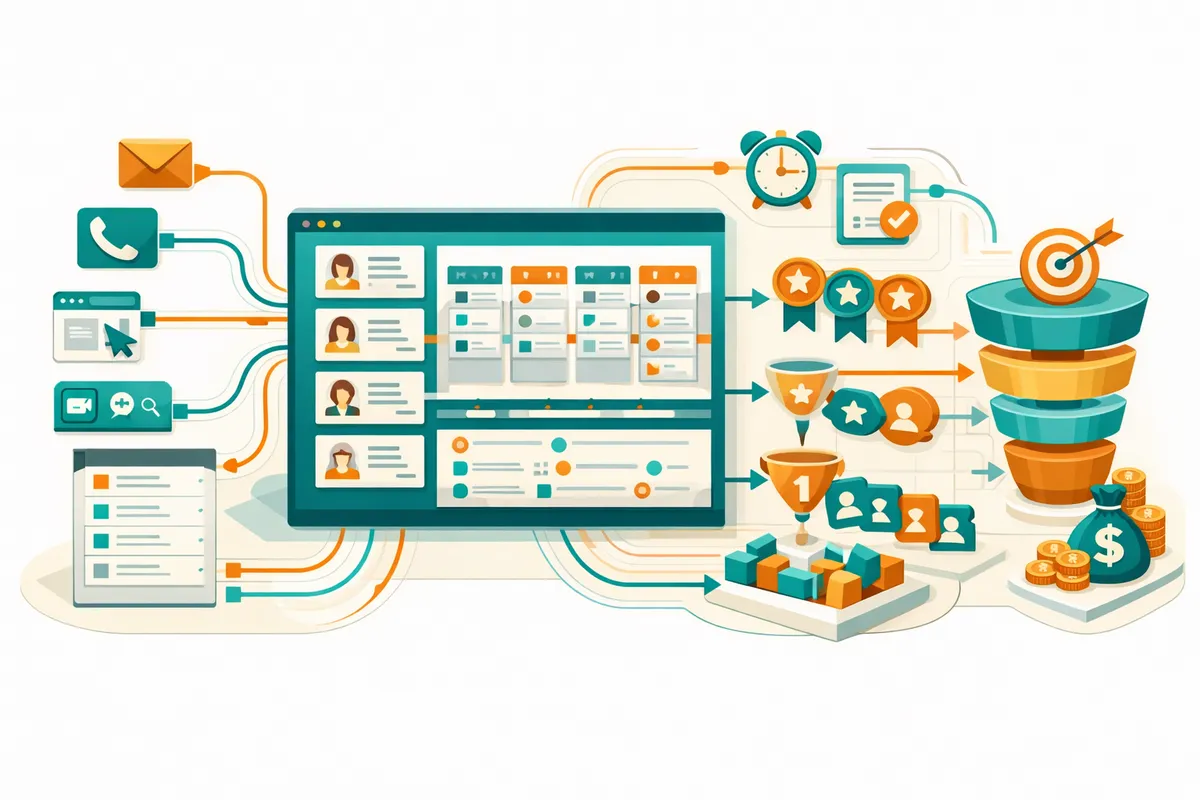
Choosing the Right CRM Platform
The CRM market is crowded. HubSpot, Salesforce, Pipedrive, Close, Zoho, Monday Sales CRM, and dozens of other options all claim to be the best fit. The truth is that the best CRM depends on your business model, team size, budget, and technical capabilities.
Platform Comparison for Growing Businesses
HubSpot CRM. Best for businesses that want marketing and sales in one platform. Free tier is genuinely useful for up to 5 users. Paid plans start at $20/user/month for Sales Hub Starter. Strengths: intuitive interface, excellent email integration, strong marketing automation. Weaknesses: gets expensive quickly at Professional tier ($100/user/month), and some features require multiple Hub subscriptions.
Salesforce. Best for businesses planning to scale past 50 users or needing extensive customization. Starts at $25/user/month for Essentials. Strengths: virtually unlimited customization, massive app ecosystem, enterprise-grade reporting. Weaknesses: steep learning curve, implementation typically requires a consultant, overkill for teams under 10.
Pipedrive. Best for sales-focused teams that prioritize pipeline management over marketing features. Starts at $15/user/month. Strengths: visual pipeline interface, fast setup, excellent for teams that live in their pipeline. Weaknesses: limited marketing automation, basic reporting compared to HubSpot or Salesforce.
Close CRM. Best for inside sales teams doing high-volume outreach. Starts at $29/user/month. Strengths: built-in calling and SMS, sequence automation, designed for speed. Weaknesses: less suited for complex B2B sales with long cycles, limited customization.
Zoho CRM. Best for budget-conscious businesses that need comprehensive features. Starts at $14/user/month. Strengths: affordable, extensive feature set including AI-powered predictions, strong integration with Zoho suite. Weaknesses: interface feels dated, customer support can be slow.
How We Help You Choose
Our recommendations are platform-agnostic. We evaluate your requirements across these dimensions:
- Sales process complexity. Simple transactional sales need a different CRM than 6-month enterprise deals
- Integration requirements. What tools must the CRM connect to? Your email platform, booking system, accounting software, and marketing tools all factor in
- Team technical comfort. A powerful CRM that your team refuses to use is worse than a simple one they adopt
- Budget over 3 years. The cheapest option in year one is not always the cheapest over time. We project total cost of ownership including seats, integrations, and tier upgrades
- Growth trajectory. A 5-person team choosing a CRM should evaluate how that platform performs at 20 and 50 users
We implement whatever tool is right for your business, not the tool that pays us the highest commission.
Implementation and Data Migration
The most common reason CRM implementations fail is poor setup. A Merkle Group study found that 63% of CRM initiatives fail, and the primary cause is not technology. It is implementation: default configurations that do not match real business processes, poor data migration, and insufficient customization.
Configuring for Your Workflow
Default CRM configurations rarely match how your team actually works. Custom fields, pipeline stages, deal properties, and automation rules need to reflect your real sales process, not the vendor's generic template.
We configure your CRM to match your specific workflow:
Pipeline stages. We map your actual deal progression, not generic stages. If your sales process goes from "Website Inquiry" to "Discovery Call Scheduled" to "Needs Assessment Complete" to "Proposal Sent" to "In Negotiation" to "Verbal Commitment" to "Contract Signed," those become your pipeline stages. Not "Lead" to "Qualified" to "Proposal" to "Closed."
Custom properties. We identify the data points that drive your decisions. Industry vertical, company size, referral source, decision timeline, budget range, and competitive situation. These fields populate automatically where possible and inform your reporting.
Contact and company records. We structure records to capture relationship history, not just contact details. Meeting notes, email threads, document shares, and support interactions all live in one place.
Data Migration
Data migration from spreadsheets, email, or legacy systems requires careful handling. Bad data migration means duplicate records, lost history, and a CRM that your team does not trust from day one.
Our migration process:
1. Audit existing data. We catalog every data source, including spreadsheets, email contacts, old CRM exports, and business card scans 2. Clean and standardize. Duplicate records are identified and merged. Phone numbers, addresses, and company names are standardized. Incomplete records are flagged for review 3. Map fields. We map every data point from your old system to the new CRM structure, ensuring nothing gets lost in translation 4. Test import. We run a test migration with a subset of data, verify accuracy, and adjust mapping before the full import 5. Full migration. Complete data transfer with verification checks at each stage 6. Validation. We verify record counts, spot-check data accuracy, and confirm all relationships (contact-to-company, deal-to-contact) are intact
For businesses with more than 5,000 records or complex data relationships, we build custom migration scripts that handle transformations automatically rather than relying on CSV imports.
Workflow Automation
A CRM without automation is just a fancy database. The real value comes from automated workflows that save your team hours every week and ensure consistency in your customer-facing processes.
Lead Management Automation
Lead assignment. New leads get routed to the right salesperson based on territory, industry, deal size, or round-robin distribution. No more leads sitting in a shared inbox waiting for someone to claim them.
Lead scoring. Assign point values based on engagement (opened emails, visited pricing page, downloaded a resource) and fit criteria (company size, industry, title). When a lead crosses a score threshold, they get flagged for immediate follow-up.
Lead nurture sequences. Leads that are not ready to buy enter automated email sequences that deliver value over weeks or months. When they re-engage (visiting your pricing page, for example), they get routed back to sales automatically.
Sales Process Automation
Follow-up reminders. When a deal sits in a stage for longer than your defined threshold, the salesperson gets a reminder. No more deals going stale because someone forgot to follow up after a promising call.
Stage-based task creation. Deal moves to "Proposal Sent"? The CRM automatically creates a follow-up task for 3 days later. Deal moves to "Contract Sent"? A task appears to check in after 5 business days.
Email sequences. Multi-touch outreach sequences send automatically based on deal stage, saving salespeople from manually sending follow-up emails. A typical sequence includes 4 to 6 touchpoints over 2 to 3 weeks.
Pipeline alerts. Management gets notified when high-value deals are at risk (stale pipeline, missed follow-ups) or when the pipeline falls below target thresholds.
Post-Sale Automation
Onboarding workflows. When a deal closes, the CRM triggers an onboarding sequence: welcome email, kickoff call scheduling, document requests, and task assignment to the delivery team.
Renewal reminders. For subscription or contract-based businesses, automated reminders start 90, 60, and 30 days before renewal. The account manager gets tasks, and the customer receives check-in emails.
Satisfaction surveys. Automated NPS or CSAT surveys at key milestones (30 days post-onboarding, quarterly check-ins) feed data back into the CRM for account health scoring.
For businesses that need automation beyond what CRM platforms offer natively, our workflow automation services build custom integrations that connect your CRM to your entire tech stack.
Reporting and Dashboards
Executive Dashboard
Your leadership team needs answers at a glance: total pipeline value, deals closing this month, revenue forecast, and team performance. We build dashboards that answer these questions without requiring anyone to run reports manually.
Key metrics we configure: - Pipeline value by stage - Win rate by source, rep, and product - Average deal cycle length - Revenue closed vs. target - Lead-to-opportunity conversion rate - Customer acquisition cost by channel
Sales Rep Dashboards
Individual salespeople need a different view: their active deals, overdue tasks, today's follow-ups, and personal performance against quota. A well-designed rep dashboard replaces the morning "What should I work on?" question with a clear priority list.
Marketing Attribution
For businesses that invest in lead generation and content marketing, attribution reporting shows which channels produce the highest quality leads. First-touch attribution identifies what brought the lead in. Multi-touch attribution shows every interaction that influenced the deal. This data informs where to invest marketing budget.
Integration with Your Tech Stack
A CRM in isolation loses much of its value. The power comes from connecting it to every tool that touches your customer relationship.
Common integrations we implement: - Email platforms (Gmail, Outlook) for automatic email logging - Calendar tools for meeting scheduling and logging - Marketing automation platforms for lead scoring and nurture - Accounting software (QuickBooks, Xero) for invoice and payment visibility - Booking and scheduling tools for appointment management - Customer support platforms for ticket visibility - Proposal and contract tools (PandaDoc, DocuSign) for deal stage automation
Each integration reduces manual data entry and gives your team a complete picture of the customer relationship in one place.
Training and Adoption
The best CRM in the world is useless if your team does not use it. Nucleus Research found that CRM adoption rates average only 47% without proper training. We approach training as a change management project, not a one-time tutorial.
Our Training Approach
Role-based training. Salespeople learn the pipeline view, activity logging, and sequence management. Managers learn reporting, forecasting, and team oversight. Marketing learns lead capture, scoring, and campaign tracking. Everyone learns what they need, nothing they do not.
Hands-on workshops. We train using your actual data and real scenarios, not generic examples. Participants practice logging a real deal, setting up a real follow-up sequence, and generating a real report during training.
Quick reference guides. Every training session produces a 1 to 2 page guide that covers the 5 most common tasks for each role. These guides live in a shared folder and serve as ongoing reminders.
30-day support. After training, we provide 30 days of support for questions, refinements, and troubleshooting. This period is when most adoption issues surface and get resolved.
Driving Adoption
We also set up dashboards and reports that make the CRM valuable to individual users, not just management. When your team sees the CRM helping them close more deals, save time on admin work, and keep track of their pipeline without manual effort, adoption follows naturally.
The biggest adoption killer is a CRM that creates work without delivering visible value. We configure the system to minimize data entry (through automation, email sync, and integration) and maximize the information each user gets back.
Frequently Asked Questions
How long does a CRM implementation take?
A straightforward implementation for a team of 5 to 10 with clean data takes 2 to 4 weeks. Complex implementations with data migration from multiple sources, custom integrations, and advanced automation take 6 to 12 weeks. The timeline depends primarily on data complexity (how messy is your current data?), integration requirements (how many tools need to connect?), and your team's availability for training and feedback sessions.
How much does CRM implementation cost?
Platform costs vary from free (HubSpot free tier) to $100+ per user per month for enterprise features. Implementation services typically run $3,000 to $15,000 for small businesses and $15,000 to $50,000 for mid-market companies with complex requirements. The implementation cost pays for itself within 3 to 6 months through time savings, improved close rates, and reduced lead leakage.
Should I use HubSpot's free CRM or pay for a premium platform?
HubSpot's free CRM is genuinely excellent for teams of 1 to 5 with straightforward sales processes. It includes contact management, deal tracking, email logging, and basic reporting. You will outgrow it when you need marketing automation, custom reporting, lead scoring, or more than basic pipeline management. Most growing businesses use HubSpot Free for 6 to 12 months before upgrading to Sales Hub Starter or Professional.
Can I migrate from one CRM to another without losing data?
Yes, but the quality of migration depends on planning and execution. Simple migrations (contacts and deals) take 1 to 2 weeks. Complex migrations with custom fields, activity history, email threads, and automation workflows take 4 to 8 weeks. The biggest risk is data loss during migration, which is why we always run test imports before the full transfer and maintain your old system as a backup for 90 days.
What if my team refuses to use the CRM?
Adoption failure usually traces back to three causes: the CRM creates work without delivering value, the configuration does not match actual workflows, or training was insufficient. We address all three proactively. If adoption is still low after 30 days, we diagnose the specific friction points and reconfigure. Sometimes the fix is simplifying a form that asks for 15 fields when 5 would suffice. Sometimes it is adding a dashboard that shows each rep exactly what to work on each morning.
Do I need a CRM consultant or can I set it up myself?
You can set up a basic CRM yourself using vendor tutorials and templates. Self-setup works well for simple use cases with clean data. You benefit from a consultant when you have data migration needs, complex sales processes, integration requirements, or a team that has previously failed to adopt a CRM. A consultant typically reduces implementation time by 50% and increases adoption rates significantly because the system is configured for your workflows from day one rather than requiring months of trial-and-error adjustments.