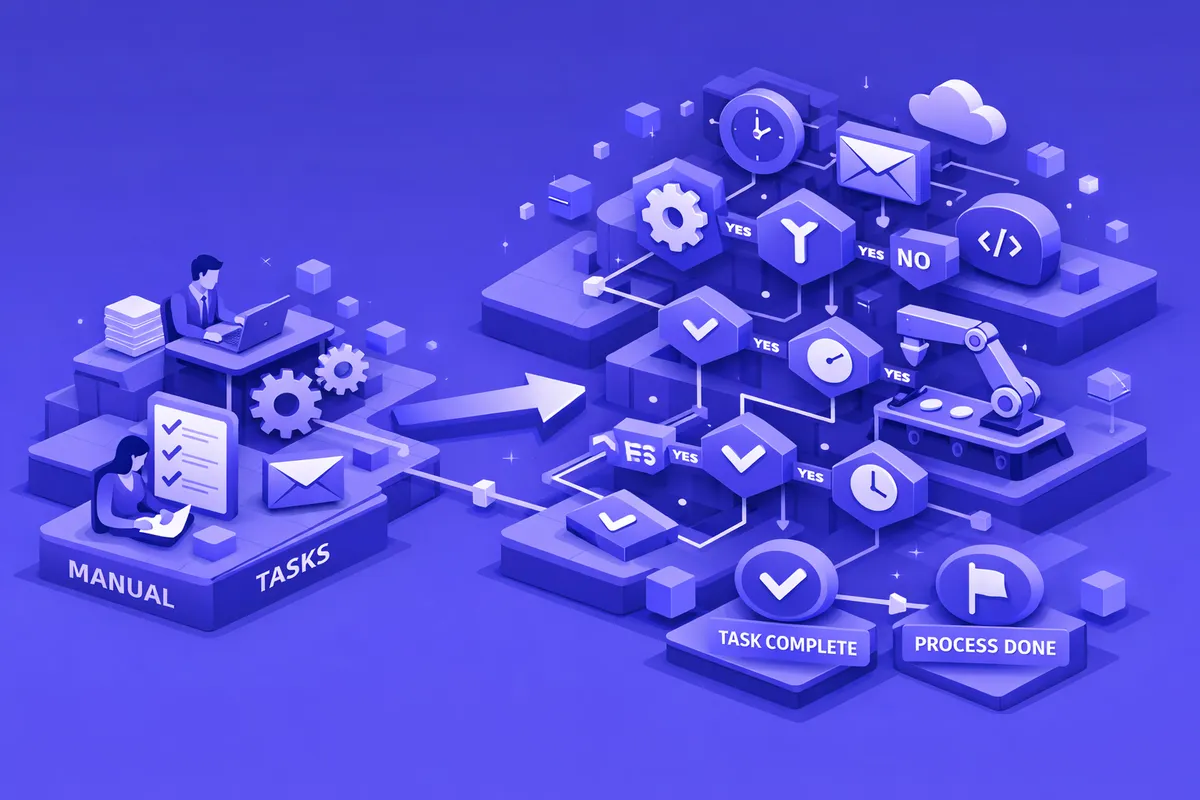
What We Automate for Logistics Companies
Route Optimization. Automated routing that accounts for traffic patterns, delivery windows, vehicle capacity, driver hours-of-service limits, fuel costs, and priority levels. The system recalculates in real time when conditions change, whether that is a road closure, a delayed pickup, or a rush order added mid-route. Typical results: 15 to 25% reduction in total route miles, 20 to 35% improvement in on-time delivery rates, and fuel savings of $800 to $2,000 per vehicle per year for a fleet running 5 days per week. See our workflow automation services for the technology behind these systems.
Warehouse Management. Receiving automation with barcode scanning that updates inventory in real time as pallets come off the truck. Putaway optimization that assigns locations based on product velocity, weight, and pick frequency. Pick path routing that sequences orders to minimize travel distance across the warehouse floor. Packing verification with weight checks and photo documentation. Automated shipping label generation and carrier rate shopping that selects the cheapest carrier meeting the delivery window for each shipment. A 50,000 square foot warehouse we automated saw picking accuracy improve from 96.2% to 99.7% and throughput increase by 28%.
Shipment Tracking and Visibility. Real-time tracking dashboards for your operations team with map views, status timelines, and exception alerts. Customer-facing tracking portals with branded interfaces showing current location, estimated delivery, and proof of delivery documents. Automated status updates via email and SMS triggered by GPS geofencing, driver check-ins, and carrier API integrations. Exception alerts when shipments deviate from plan: late pickups, route deviations, temperature excursions for cold chain, or missed delivery windows. This visibility layer transforms customer service from reactive to proactive.
Document Processing. Automated extraction from bills of lading, commercial invoices, purchase orders, customs declarations, and proof of delivery. AI-powered document processing uses optical character recognition combined with natural language understanding to read documents in any format, extract the relevant data fields, validate against your business rules, and feed the data directly into your TMS, WMS, or ERP. A freight forwarder processing 2,000 documents per week reduced their document handling team from 6 people to 2 while eliminating the 4% error rate that was causing customs delays and billing disputes.
Supply Chain Coordination. Automated communication flows between suppliers, carriers, warehouses, and customers. Purchase order acknowledgments trigger supplier shipment notifications. Carrier pickup confirmations trigger warehouse preparation workflows. Delivery confirmations trigger invoicing and customer satisfaction surveys. Exception events trigger escalation chains with the right stakeholder notified at each step. Your supply chain operates as one connected system instead of siloed teams passing information through email and phone calls. Explore our custom AI solutions for intelligent supply chain decision-making.
Customer Communication Automation. Automated delivery notifications at key milestones: order confirmed, shipped, out for delivery, delivered. ETA updates that recalculate based on real-time conditions and proactively notify customers of changes before they ask. Post-delivery feedback requests that capture satisfaction data while the experience is fresh. Exception alerts that explain delays with honest context and revised timelines. Our AI customer service solutions handle the routine inquiries so your team focuses on complex situations.
The ROI of Logistics Automation
Logistics automation delivers measurable returns quickly because the processes being automated are high-volume and high-frequency. Here are documented results from logistics automation projects.
Route optimization. 20 to 30% reduction in route miles. For a 25-vehicle fleet averaging 150 miles per day, that is 1,125 fewer miles daily. At $0.65 per mile in fuel and wear costs, the savings exceed $267,000 annually. Implementation cost: $25,000 to $60,000. Payback period: 2 to 3 months.
Document processing automation. 40 to 60% reduction in processing time per document. For a company processing 500 documents per week at 15 minutes each, that is 125 to 187 hours saved weekly. At $22 per hour loaded cost, annual savings range from $143,000 to $214,000. Implementation cost: $15,000 to $35,000. Payback period: 6 to 10 weeks.
Customer communication automation. 50% fewer inbound "where is my shipment" calls. For a company fielding 200 such calls per day at an average of 4 minutes each, that is 6.7 fewer hours of phone time daily. Annual savings: $35,000 to $50,000 in labor plus measurable improvements in customer satisfaction scores. Implementation cost: $10,000 to $20,000. Payback period: 3 to 6 months.
Warehouse picking optimization. 25 to 35% improvement in picks per hour. Accuracy improvement from 96% to 99.5%+. For a warehouse processing 5,000 picks per day, the accuracy improvement alone eliminates 150 to 175 mis-picks per day, each costing $10 to $50 in correction costs. Annual savings from error reduction alone: $375,000 to $2.1 million depending on product value and correction costs.
These are not theoretical projections. They are outcomes we deliver for logistics companies by eliminating manual steps and connecting systems that currently operate in isolation.
Implementation Approach
Automation projects fail when they try to automate everything at once. We use a phased approach that delivers value fast and builds momentum.
Phase 1: Audit and prioritize (Weeks 1-2). We map your current processes end to end, identify every manual step, and calculate the cost of each one. We rank automation opportunities by ROI, implementation complexity, and dependencies. You get a prioritized roadmap with projected returns for each phase.
Phase 2: Quick wins (Weeks 3-8). We implement the highest-ROI automation first. This is typically document processing, customer communication, or a specific warehouse workflow where the manual steps are clearly defined and the volume is high. Quick wins generate savings that fund subsequent phases and build team confidence in the automation program.
Phase 3: Core systems (Weeks 9-20). We implement the more complex automations: route optimization, warehouse management integration, supply chain coordination. These require deeper integration with your existing TMS, WMS, and ERP systems and more extensive testing before going live.
Phase 4: Optimization and expansion (Ongoing). Every automated process is monitored for performance, error rates, and actual time savings. Dashboards show the cumulative ROI of each automation. We adjust rules, thresholds, and workflows based on real operational data. New automation opportunities surface as your team uses the systems and identifies additional manual steps that could be eliminated.
Integration With Your Existing Systems
We do not ask you to rip and replace your technology stack. Automation layers connect to and enhance the systems you already use.
Transportation Management Systems. We integrate with Oracle Transportation Management, MercuryGate, Trimble, Descartes, and custom TMS platforms. Automation fills the gaps your TMS does not cover and connects TMS data to warehouse, accounting, and customer-facing systems.
Warehouse Management Systems. We connect with Manhattan Associates, Blue Yonder, Korber, and custom WMS platforms. Automation extends your WMS with capabilities like intelligent putaway optimization, dynamic pick path routing, and cross-system inventory visibility.
ERP Platforms. Integration with SAP, Oracle, NetSuite, and QuickBooks ensures financial data flows automatically from operational systems. No more manual invoice entry or month-end reconciliation marathons.
Carrier APIs and IoT Devices. Real-time data from carrier APIs (FedEx, UPS, USPS, regional carriers), GPS trackers, temperature sensors, and barcode scanners feeds into your automation layer for live visibility and automated exception handling.
Our business software team handles the integration architecture so your automation works with your existing technology investment rather than competing with it.
Frequently Asked Questions
What logistics processes benefit most from automation?
Route planning, document processing, shipment tracking, and customer communication deliver the fastest ROI. These processes are high-volume, repetitive, and prone to manual errors. A company processing 500+ shipments per week will typically see payback within 2 to 4 months on these automations. Warehouse operations and supply chain coordination follow as higher-complexity, higher-impact opportunities.
Can you integrate automation with our existing TMS or WMS?
Yes. We build integrations with major transportation management systems and warehouse management systems including Oracle, MercuryGate, Manhattan Associates, Blue Yonder, and many others. We also integrate with ERP platforms, carrier APIs, and IoT devices. Integration is a core part of every logistics automation project. If your system has an API or database we can connect to, we can integrate with it.
How long does a logistics automation project take?
Focused automations like document processing or customer communication take 6 to 10 weeks from kickoff to production. Route optimization systems take 10 to 16 weeks. Comprehensive logistics platforms with multiple automation components take 4 to 8 months. We deliver in phases so you capture value early rather than waiting for the entire system to be complete.
Do we need to replace our current systems to implement automation?
No. We build automation layers that connect to and enhance your existing systems. Your TMS, WMS, and ERP stay in place. Automation fills the gaps between them and eliminates manual steps in your current workflows. Think of it as adding an intelligent coordination layer on top of the systems your team already knows.
How do you handle the complexity of multi-modal logistics automation?
We design automation systems that account for multiple transportation modes (truck, rail, ocean, air), international regulations, customs requirements, and complex routing scenarios. Our approach starts with understanding your specific operational complexity before designing solutions. We typically start with the highest-volume mode and expand to additional modes in subsequent phases.
What is the typical ROI timeline for logistics automation?
Most logistics automation projects achieve full payback within 3 to 6 months. Document processing and customer communication automations often pay back within 6 to 10 weeks due to the high volume and clear labor savings. Route optimization typically pays back within 2 to 3 months through fuel and time savings. The compounding effect of multiple automations working together usually delivers 300 to 500% ROI within the first year.
Your logistics operation is too important to run on manual processes and disconnected systems. Contact Running Start Digital for an automation audit that identifies your highest-ROI opportunities and builds a roadmap to capture them.