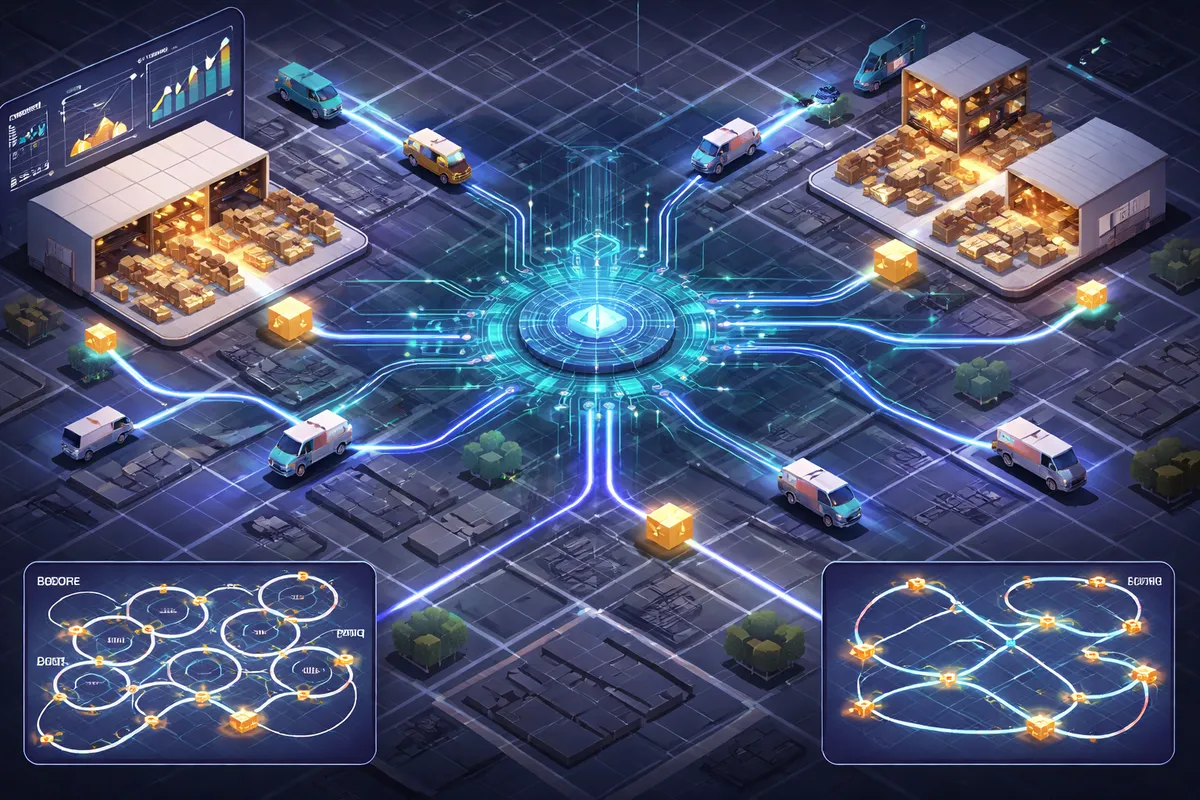
Key AI Applications for Logistics
- Dynamic Route Optimization: AI calculates optimal routes in real time accounting for traffic, weather, delivery windows, and vehicle constraints. Reduces fuel costs by 15 to 25 percent and improves on-time delivery rates.
- Demand Forecasting: Machine learning predicts order volume by SKU and location, enabling optimal inventory positioning across your network. Reduces stockouts and excess inventory simultaneously.
- Warehouse Optimization: AI optimizes pick paths, slotting, and labor allocation. Increases pick rates by 20 to 35 percent without adding headcount.
- Predictive Shipment Monitoring: AI tracks shipments in transit, predicts delays, and triggers automatic exception handling. Customers get proactive updates instead of reactive apologies.
- Carrier Selection and Rate Optimization: AI evaluates carrier performance, pricing, and capacity to recommend the optimal carrier for each shipment. Reduces shipping costs by 8 to 15 percent.
Our Approach to AI in Logistics
We start with your data. Logistics businesses generate enormous amounts of operational data, but most of it sits unused in TMS, WMS, ERP, telematics, and EDI logs. Our discovery phase maps your data sources, identifies gaps, and prioritizes the AI applications that deliver the fastest ROI for your specific operation. A typical discovery produces a data readiness scorecard, a ranked list of three to five use cases with projected dollar impact, and a 90-day pilot plan.
We deploy in phases. Route optimization or demand forecasting typically comes first because the data requirements are manageable and the impact is measurable within weeks. Warehouse optimization and predictive monitoring follow as we build deeper integration with your operational systems. Our AI implementation guide outlines this approach in detail, and for clients who need operator dashboards we pair the AI build with UI and UX design so dispatchers and warehouse managers get interfaces they can read in three seconds.
Integration is non-negotiable. AI must work with your existing TMS, WMS, ERP, and carrier systems. We connect to platforms you already run rather than introducing new ones. Data flows between systems automatically over EDI, API, and flat file where needed. For carriers who need a public-facing shipment tracking experience, we bolt on website design that reads the same AI layer driving the back office.
Common Failure Modes to Avoid
The biggest logistics AI failures happen when teams optimize a single lever without looking at the system. A brokerage that optimizes carrier rates in isolation can save 6 percent on line haul while quietly adding 3 days to transit time, blowing up service level agreements and triggering chargebacks. AI optimization has to carry constraints for service, safety, and compliance, not just cost.
The second failure is deploying AI on top of dirty master data. If your SKU dimensions are wrong in the WMS, no slotting algorithm in the world will fix the pick path. If driver hours are logged inconsistently across your ELD providers, route optimization will propose illegal shifts. Spend the first month cleaning masters. The model you build on top will be worth 3 to 4 times more.
The third is treating AI as a one-time deployment. Demand shifts, lanes change, carriers adjust capacity. An AI model trained on 2024 freight data and left untouched through 2026 will underperform a spreadsheet. Plan for quarterly retraining and a monthly human-in-the-loop review of edge cases.
Results You Can Expect
Logistics companies implementing our AI solutions report consistent operational improvements.
- 15 to 25 percent reduction in fuel and transportation costs
- 20 to 35 percent improvement in warehouse pick rates
- 30 to 50 percent fewer stockout events through better demand forecasting
- 10 to 20 percent improvement in on-time delivery rates
- 8 to 15 percent reduction in overall shipping costs through carrier optimization
- 35 to 45 percent reduction in inbound customer service inquiries about shipment status
Results compound as AI models learn your specific patterns and the system covers more of your operation.
A fourth common trap is optimizing for the current network rather than the future one. A carrier that automates dispatch around today's 22 lanes will have to retrain the entire system when it adds its 23rd. Build models with flexibility: parameterized inputs for lanes, carriers, and service levels so the system accommodates growth without a six-week rebuild.
How to Evaluate Your Options
When comparing logistics AI vendors, look past the dashboards and ask four questions. Does the model explain its recommendations? A route that says "take I-294 instead of I-80" is useful. A route that says "this is 4.2 miles shorter and avoids a construction zone reported at 9:07" is actionable. Dispatchers need the why, not just the what.
Does the system integrate with your real stack? If the vendor supports Oracle TMS but not MercuryGate, or Manhattan WMS but not Blue Yonder, you will spend the savings on middleware. Get integration proof before the pilot, not during.
How does it handle exceptions? Logistics is 80 percent standard operations and 20 percent chaos. The AI has to flag the chaos to a human and give them enough context to decide in under 60 seconds. Systems that generate 400 alerts a day train operators to ignore all of them.
What is the total cost of ownership over three years? Add platform fees, integration costs, retraining services, and the internal analyst time to maintain the system. Divide by projected savings. If payback is under 14 months, proceed.
Frequently Asked Questions
### How much does AI implementation cost for logistics? Logistics AI projects range from $15,000 to $80,000 for initial deployment. Route optimization for a mid-size fleet of 15 to 30 vehicles starts at the lower end, typically $18,000 to $25,000. Multi-facility implementations with warehouse optimization, demand forecasting, and predictive monitoring sit higher. Fuel savings and labor efficiency improvements typically generate positive ROI within 3 to 6 months, and most clients self-fund phase two from phase one savings.
### How long does it take to see ROI from AI in logistics? Route optimization shows fuel savings within the first month and on-time delivery improvements by week six. Warehouse optimization delivers measurable throughput improvements within 30 to 45 days as pickers adapt to new paths. Demand forecasting needs 60 to 90 days of learning before predictions reach peak accuracy, and seasonal accuracy improves over the first full annual cycle. Most logistics operations see net positive ROI across all implementations within 90 days.
### Do I need a large dataset to use AI in my logistics business? You need operational data, and most logistics companies have plenty. Six months of order history, delivery records, GPS traces, and shipment data provides a strong foundation. Route optimization works with your current fleet and delivery data from day one. Demand forecasting improves with more history but delivers useful predictions from a dataset as small as 90 days of shipment-level records. What matters is consistency: the same fields captured the same way across systems.
### Can AI integrate with my existing logistics software? Yes. We integrate with TMS platforms like Oracle TMS, MercuryGate, BluJay, and Transplace. We connect with WMS systems like Manhattan, HighJump, Fishbowl, and Blue Yonder. ERP integrations include SAP, NetSuite, and Microsoft Dynamics. Carrier API connections, GPS telematics feeds from Samsara and Motive, and IoT sensor data from cold-chain providers all feed into the AI layer over API or EDI.
### What about driver and operator adoption? Adoption is won or lost in the first 30 days. We train drivers and warehouse operators on the exact scenarios where AI recommendations change their behavior, show them the payoff in their own pay-impacting metrics, and build a simple override path so they never feel trapped by the system. Facilities that invest 8 hours of training per operator hit 85 percent adoption by week four. Facilities that skip training stall at 40 percent.
### What is the first step to implementing AI in logistics? Schedule a discovery session. We will review your operational data, map your biggest efficiency gaps, and identify which AI application will deliver the fastest return for your specific operation. The session covers fleet size, lane mix, warehouse count, current TMS and WMS configuration, top service level penalties, and your last 12 months of fuel and labor spend. You will leave the call with a one-page opportunity map showing projected savings by use case and a recommended 90-day pilot scope. No obligation. Contact us to start the conversation.