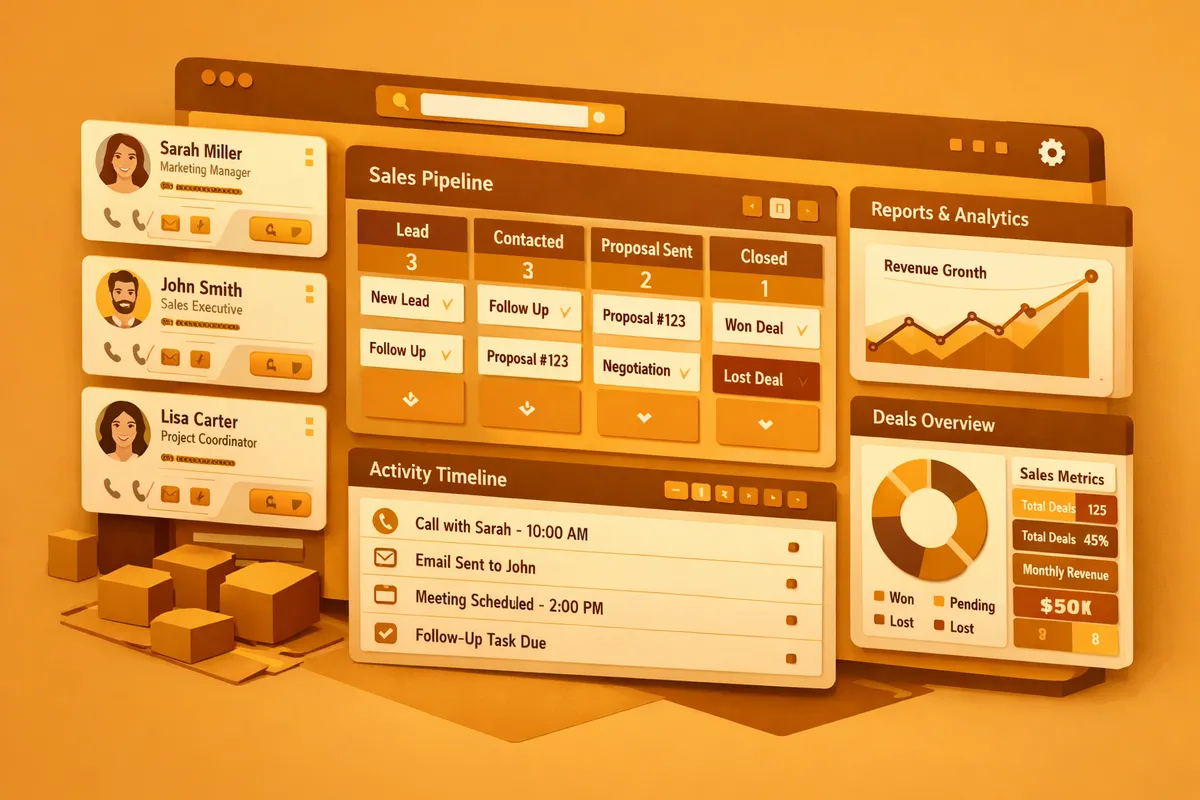
What Is a Traditional CRM?
A traditional CRM is a database and workflow tool for managing customer relationships. Platforms like Salesforce (without Einstein), HubSpot Free, Zoho CRM, and Pipedrive provide contact management, deal tracking, pipeline visualization, task management, and basic reporting.
Traditional CRMs are proven and reliable. They give teams a shared view of every customer interaction, enforce sales processes, and generate reports that leadership needs. They have been the backbone of sales operations for two decades.
The core capability is organization. Before CRM, customer data lived in spreadsheets, email inboxes, sticky notes, and individual rep's memories. When a rep left, their relationships walked out the door. CRM solved the institutional memory problem and gave managers visibility into pipeline health.
The limitation is that traditional CRMs are fundamentally passive. They store what you put in and report what you ask for. They do not tell you what to focus on, which deals are slipping, or which contacts need attention. That analysis falls entirely on your team.
A sales manager using a traditional CRM reviews the pipeline every Monday and makes judgment calls about which deals to push. An AI CRM flags the three deals most likely to slip before the manager even opens the dashboard. That is the fundamental difference: reactive versus proactive.
Side-by-Side Comparison
| Factor | AI CRM | Traditional CRM |
|---|---|---|
| Cost | $75-$300/user/month | $15-$75/user/month |
| Implementation | 4-12 weeks with data integration | 1-4 weeks for basic setup |
| Lead scoring | Automatic, learns from your data | Manual rules or none |
| Deal prediction | ML-based probability scoring | Manual stage-based percentages |
| Data entry | Automated activity logging | Manual entry by reps |
| Contact enrichment | Automatic from external sources | Manual research or paid add-ons |
| Next best action | AI-recommended actions per deal | Manager judgment only |
| Churn prediction | Automated risk scoring | None or basic last-activity rules |
| Reporting | Predictive and diagnostic analytics | Historical reporting only |
| Email assistance | AI-drafted follow-ups and sequences | Template library, manual selection |
| Scalability | Intelligence improves as data grows | Database grows but insights stay manual |
| Data ownership | Varies by vendor, often cloud-hosted | Varies by vendor, export usually available |
The Real Cost Difference
The per-user licensing comparison understates the true cost difference. Here is what a realistic implementation looks like for a 15-person sales team.
Traditional CRM (Year 1). Licensing: $15 to $65 per user per month ($2,700 to $11,700 annually). Implementation: $2,000 to $10,000 for setup and data migration. Training: $1,000 to $3,000. Total Year 1: $5,700 to $24,700. Ongoing annual: $2,700 to $11,700.
AI CRM (Year 1). Licensing: $100 to $300 per user per month ($18,000 to $54,000 annually). Implementation: $10,000 to $30,000 for data integration, model training, and workflow configuration. Training: $3,000 to $8,000 (more complex system requires more training). Total Year 1: $31,000 to $92,000. Ongoing annual: $18,000 to $54,000.
The AI CRM costs 3 to 5 times more. The question is whether it generates 3 to 5 times more value.
Where AI CRM pays for itself. If your 15 reps each close one additional deal per quarter because AI identified the right leads to prioritize, and your average deal value is $8,000, that is $480,000 in incremental annual revenue. If AI reduces your churn rate by 5 percentage points on a $2M recurring revenue base, that is $100,000 in retained revenue. If automated data entry saves each rep 5 hours per week, that is 3,900 hours per year reinvested in selling.
Where it does not pay for itself. If your team has fewer than 12 months of clean CRM data, the AI has nothing to learn from. If your sales cycle is simple and short (under two weeks), there is not enough complexity for AI to add value. If your team is not disciplined about using the CRM consistently, AI built on incomplete data produces unreliable insights.
When to Choose an AI CRM
An AI CRM delivers ROI when your organization meets these conditions.
You have data maturity. At least 6 to 12 months of consistent CRM data with deal outcomes (won, lost, stalled). The AI needs historical patterns to make predictions. Without this data, you are paying for capabilities that sit idle.
Your pipeline is complex. Deal cycles longer than 30 days with multiple stakeholders, competitive evaluations, and varying deal structures. AI excels at synthesizing complexity. If every deal follows the same straightforward path, AI adds less value.
Your team outruns manual processes. Sales reps have more leads than they can manually prioritize. Managers spend hours on pipeline reviews that could be automated. Customer success teams cannot manually monitor health signals across their entire book of business.
Retention economics matter. If customer lifetime value is high and churn is costly, predictive churn scoring pays for itself quickly. A B2B company with $50,000 average annual contract value that saves five accounts per year from churning generates $250,000 in retained revenue.
You are willing to invest in adoption. AI CRM features only work if reps trust and act on the recommendations. Budget for ongoing training, change management, and feedback loops. An AI CRM that reps ignore is the most expensive CRM possible.
When to Choose a Traditional CRM
A traditional CRM is the right starting point when your priority is building the foundation.
You are implementing a CRM for the first time. The first CRM is about establishing processes, not adding intelligence. Get your team consistently logging activities, tracking deals, and following a defined sales process. AI features on top of chaotic processes produce noise, not insight.
Your team is small (under 10 people). Smaller teams can manage relationships personally. A sales manager who knows every deal because they talk to the team daily does not need AI to tell them which deals are at risk. The CRM serves as an organizational tool and record system.
Budget is constrained. If the difference between $5,000 and $50,000 per year matters to your business, start traditional. A well-used traditional CRM outperforms an underutilized AI CRM every time.
Your sales cycle is short and straightforward. If deals close within one to two weeks with a single decision maker, the prediction window is too short for AI to add meaningful value. Speed and responsiveness matter more than intelligence.
Data hygiene is a challenge. If your current data is messy (inconsistent entry, duplicate records, incomplete fields), fix the foundation first. Clean data in a simple CRM outperforms an AI CRM built on garbage data every time. Invest in data quality before investing in AI capabilities.
The Hybrid Path: Start Traditional, Add AI
For most growing businesses, the smartest approach is a traditional CRM with an architecture that supports AI features later. Here is what that path looks like.
Months 1 through 6: Foundation. Implement a traditional CRM with clean data standards. Train the team on consistent usage. Establish a defined sales process with clear stages and criteria. Focus on adoption: 90%+ daily active usage should be the goal before adding complexity.
Months 6 through 12: Data maturity. With six months of consistent data, you now have the raw material for AI features. Evaluate which AI capabilities would deliver the most value given your specific pain points. Lead scoring is usually the highest-impact starting point.
Months 12 through 18: AI activation. Enable AI features one at a time. Start with lead scoring (which leads deserve priority). Then add deal prediction (which deals are likely to close or stall). Then layer in automated activity logging and email intelligence. Each feature gets two to four weeks of team adoption before adding the next.
Months 18 and beyond: Optimization. The AI models have enough data to be genuinely useful. Refine scoring models based on actual outcomes. Build custom reports that combine AI insights with business-specific metrics. Expand AI capabilities to customer success, marketing, and operations.
For businesses that want this hybrid path built from the start, our CRM and martech consulting team designs systems that grow with your data maturity. We also build custom AI solutions for businesses that outgrow off-the-shelf CRM intelligence and need models trained on their specific sales patterns.
Evaluating Specific Platforms
Salesforce + Einstein. The enterprise standard. Einstein AI features are powerful but require Salesforce's premium tiers ($150 to $300 per user per month). Best for companies with 50 or more users and complex sales operations. Implementation is significant.
HubSpot (AI tier). Strong AI features in the Enterprise tier ($150 per user per month). More approachable than Salesforce for mid-market companies. Good integration with marketing tools. Free and Starter tiers provide a solid traditional CRM to start with.
Zoho CRM + Zia AI. The budget-friendly option for AI CRM ($40 to $65 per user per month for AI features). Zia provides lead scoring, deal prediction, and sentiment analysis. Quality is improving but not as mature as Salesforce Einstein or HubSpot AI.
Pipedrive. Excellent traditional CRM for small teams ($14 to $99 per user per month). Limited AI features compared to the above. Best as a starting CRM with the expectation of migrating as you grow.
Custom-built. For businesses with unique sales processes, data sources, or integration requirements, a custom CRM provides exactly the features you need without paying for capabilities you do not use. AI features are built specifically for your data and workflows.
Our Recommendation
If you already have a CRM with clean data and your team has outgrown manual pipeline management, an AI CRM upgrade delivers measurable ROI. Lead scoring alone can increase close rates by 15 to 30% by focusing rep attention where it matters most. Churn prediction can save 5 to 15% of at-risk revenue. The math works for businesses with average deal values above $5,000 and sales cycles longer than 30 days.
If you do not have a CRM yet or your current data is messy, start with a traditional CRM. Get your processes right. Build the data foundation. Invest six months in adoption and data quality before even evaluating AI features.
Running Start Digital builds CRM systems at both ends of this spectrum. We also offer lead generation services that fill your pipeline and predictive analytics capabilities that extend beyond CRM into broader business intelligence. Contact us and we will assess where you are and what makes sense right now.
Frequently Asked Questions
### Can I start with a traditional CRM and add AI later? Yes. Most modern CRM platforms offer AI add-ons as your subscription level increases. If you are building a custom CRM, we architect it from day one to support AI features even if you are not using them yet. The key is establishing clean data practices early so the AI has quality inputs when you turn it on. Plan for six to twelve months of clean data before activating AI scoring features.
### What is the total cost of ownership for each? A traditional CRM for a 10-person team runs $1,800 to $9,000 annually in licensing. An AI CRM for the same team costs $9,000 to $36,000 annually in licensing alone, plus $10,000 to $25,000 in first-year implementation and training. The AI CRM often pays for itself through increased close rates and reduced administrative time, but only if your team actively uses the intelligence it provides. Factor in ongoing training costs of $2,000 to $5,000 per year to maintain adoption.
### Which option is better for small businesses? A traditional CRM for most small businesses under 15 people. The priority is getting organized and building consistent habits around customer data. Once your pipeline is structured and your data is clean (typically six months of consistent usage), AI features become a multiplier. Jumping to AI before the foundation is set leads to paying premium prices for features that sit unused. The exception: if you have a high-volume inbound lead flow (100+ leads per month) and a small sales team, AI lead scoring provides immediate value even early on.
### How long before I see results with each approach? A traditional CRM shows organizational benefits within the first week of adoption. Pipeline visibility and team alignment improve immediately. An AI CRM needs 30 to 90 days of consistent usage before predictions become accurate. The models need data volume and variety to learn your specific sales patterns. Lead scoring accuracy typically reaches useful levels after 60 days. Deal prediction accuracy improves meaningfully after 90 days with at least 50 closed deal outcomes to learn from.
### Does Running Start Digital help with both options? We build both. Our CRM and martech consulting services cover everything from straightforward contact management systems to full AI-powered platforms with predictive scoring, automated workflows, and intelligent recommendations. We right-size the solution to your current needs and build it to grow with you.
### What happens if AI predictions are wrong? AI predictions are probabilistic, not certain. A deal scored at 80% probability still fails one in five times. The value is in aggregate accuracy, not individual certainty. Over hundreds of predictions, AI CRMs typically outperform human judgment by 15 to 25%. When predictions are consistently wrong in a specific area, it usually indicates a data quality issue or a sales process change the model has not been retrained on. Regular model reviews (quarterly) keep predictions calibrated.