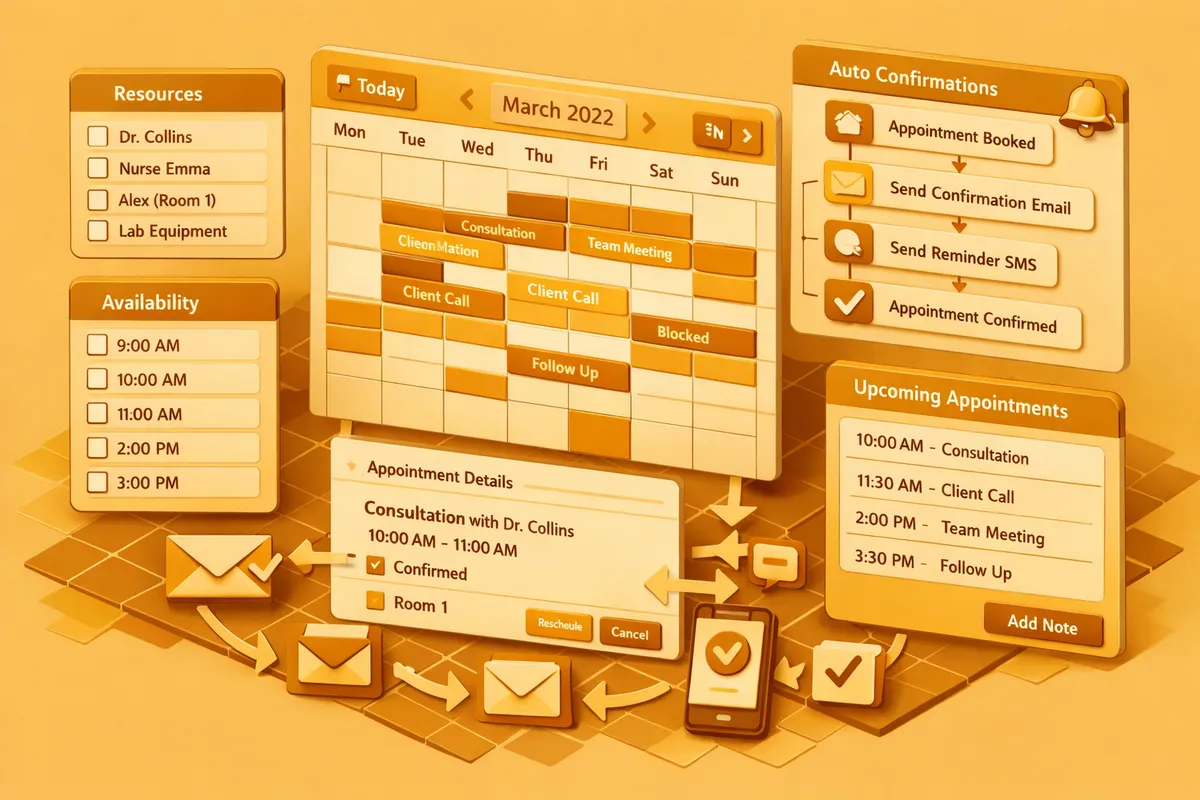
How AI Appointment Scheduling Works
AI scheduling operates on three technology layers that work together to handle the full booking lifecycle.
Natural language understanding. The AI processes booking requests in natural conversation, whether through chatbot interfaces, SMS, email, or voice. A customer can say "I need a 45-minute consultation sometime next Thursday afternoon" and the system understands the service type, duration requirement, day preference, and time-of-day preference. It then checks availability across relevant staff calendars and proposes options.
Modern natural language scheduling handles complex requests: "Move my Tuesday appointment to later in the week, preferably morning," "Book me and my partner for back-to-back cleanings on the same day," or "I need the earliest available slot with Dr. Chen that is not during my lunch break."
Machine learning optimization. The AI learns from historical data to optimize scheduling decisions. Which time slots have the highest no-show rates for specific service types? Which appointment durations consistently run over? Which customers tend to arrive late? Which days of the week have the highest cancellation rates?
This intelligence feeds into scheduling decisions automatically. High-risk appointments receive more aggressive reminder sequences. Overbooking algorithms (similar to airlines) account for predicted no-shows to maintain schedule density. Buffer time adjusts dynamically based on which practitioner and service type are booked.
Workflow automation. Booking triggers downstream actions automatically. Confirmation emails with calendar invitations. Intake forms sent 24 hours before the appointment. Reminder SMS messages at 48 hours, 24 hours, and 2 hours. Preparation checklists for staff. Post-appointment feedback surveys. Revenue tracking and analytics updates.
Each of these actions previously required someone to remember, execute, and track. AI scheduling handles the entire chain without human intervention while maintaining the personalized feel that builds customer loyalty.
Key Features and Capabilities
Conversational booking across channels. Customers schedule through whatever channel they prefer. Chat widgets on your website, SMS conversations, email replies, social media DMs, or voice calls handled by AI. No portals to log into. No forms to fill out. Just a conversation that ends with a confirmed appointment.
Intelligent time optimization. AI clusters similar appointments to minimize transition time between service types. It groups geographic areas for mobile service businesses to reduce drive time. It protects focus blocks for practitioners who need uninterrupted time. Your daily schedule becomes progressively more efficient as the system learns from real patterns.
No-show prediction and prevention. Machine learning identifies appointments at high risk of no-show based on historical patterns: time since booking, day of week, weather forecast, customer history, and appointment type. High-risk bookings receive targeted reminders through the customer's preferred channel at the optimal time. Some systems escalate to phone confirmations for the highest-risk appointments.
Dynamic rescheduling and waitlist management. When cancellations occur, AI immediately contacts waitlisted customers and offers the newly available slot. Fill rates for cancelled appointments improve from under 10% (manual) to 40-60% (AI-managed) because the outreach happens within minutes of cancellation rather than hours.
Capacity balancing across staff. AI distributes appointments across team members based on skills, certifications, customer preferences, workload, and utilization targets. No practitioner gets overbooked while others sit idle. The system respects individual scheduling constraints like lunch breaks, administrative time, and continuing education blocks.
Multi-location coordination. For businesses with multiple locations, AI handles cross-location availability, customer location preferences, and resource sharing. If a customer's preferred location is fully booked, the system offers alternatives at nearby locations with availability.
Integration With Your Existing Tools
AI scheduling connects to the tools your business already uses, creating a unified booking ecosystem rather than another standalone platform.
Calendar systems. Google Calendar, Microsoft 365, Apple Calendar. Real-time bidirectional sync ensures that manually booked appointments appear in the AI system and AI-booked appointments appear in personal calendars.
Practice management and industry software. Medical EHR systems, salon management platforms, legal practice management tools, and fitness studio software. The AI handles the customer-facing experience while your industry platform remains the system of record.
Communication platforms. Email via your existing provider, SMS through Twilio or similar, and chat through your website or social channels. All appointment communications come from your business identity, not a third-party scheduling brand.
Payment processing. Collect deposits, copays, or full payment at booking time through Stripe, Square, or your existing payment processor. For high no-show businesses, requiring a deposit at booking reduces no-show rates by an additional 30-50% beyond reminder-based improvements.
CRM and marketing tools. When a customer books, their CRM record updates automatically. Appointment data feeds into marketing segmentation: customers who book certain services, customers who have not visited in 90 days, or customers who frequently cancel. This data powers targeted email marketing campaigns that drive rebooking.
Our booking and scheduling solutions include full integration architecture so your scheduling system connects seamlessly with your existing operations rather than creating a data silo.
Custom AI Scheduling vs. Off-the-Shelf Tools
Calendly, Acuity, and similar tools work well for straightforward scheduling: one person, standard time slots, basic calendar sync. They serve millions of businesses effectively at $10-$50 per month.
These tools break down when your booking logic gets complex:
Multi-resource appointments. A medical procedure that requires a doctor, a nurse, a specific room, and specific equipment. All four resources must be available simultaneously. Standard tools cannot coordinate this.
Variable durations. A consultation that takes 30 minutes for new clients and 15 minutes for returning clients, with duration determined by intake form responses. Standard tools offer fixed time slots.
Geographic routing. A home service business where technician assignment depends on the customer's address, current technician locations, drive time optimization, and equipment on each truck. This requires custom logic.
Insurance or eligibility verification. A healthcare practice that needs to verify insurance coverage before confirming a booking. The scheduling system must call a third-party API, interpret the response, and proceed or redirect based on coverage status.
Conditional booking flows. A legal practice where the intake questionnaire determines which attorney type handles the case, which then determines available slots from a different pool. The booking flow branches based on user inputs.
When your scheduling needs exceed what Calendly handles, custom AI solutions become the more cost-effective path because they eliminate the workarounds, manual interventions, and error-prone processes that off-the-shelf tools force.
Measuring ROI From AI Scheduling
Track these five metrics to quantify the return on your scheduling investment:
No-show rate reduction. Baseline your current no-show rate before implementation. AI scheduling typically reduces no-shows by 25-40%. Multiply the improvement by your average appointment value and daily appointment count to calculate recovered revenue.
Booking conversion rate. What percentage of website visitors or inquiries result in a confirmed appointment? AI scheduling improves this by making booking frictionless and available 24/7. Track this before and after implementation.
Time-to-book. How long between first contact and confirmed appointment? Manual scheduling often takes 24-48 hours of back-and-forth. AI scheduling completes in minutes. Faster booking means fewer lost prospects to competitors.
Schedule utilization. What percentage of available appointment slots are filled? AI optimization and dynamic rescheduling push utilization from 65-75% (typical manual) to 80-90%. Each percentage point of improved utilization is direct revenue recovery.
Staff time recaptured. Hours previously spent on scheduling tasks are now available for revenue-generating or customer-facing work. At $25-$50/hour, 8-12 recaptured hours per week equals $10,400-$31,200 annually.
Most service businesses see full ROI on AI scheduling within 3-4 months through the combined impact of reduced no-shows, improved utilization, and recaptured staff time.
Frequently Asked Questions
How much does AI appointment scheduling cost?
Custom AI scheduling systems range from $12,000 to $50,000 for initial build depending on complexity. A single-location service business with straightforward booking rules falls in the $12,000-$20,000 range. Multi-location operations with complex resource allocation, geographic routing, and deep system integrations require $30,000-$50,000+. Monthly operating costs (hosting, SMS, API fees) run $200-$1,000 depending on volume. Off-the-shelf tools cost $10-$50/month but lack the customization for complex booking logic.
How long does implementation take?
Most AI scheduling projects launch within 6-12 weeks. Simple implementations with standard calendar integrations and basic conversational booking ship in 6 weeks. Complex builds with multi-resource scheduling, custom booking logic, insurance verification, and conversational AI interfaces across multiple channels take 10-12 weeks. We deploy incrementally so you see value from core functionality early while advanced features roll out in subsequent weeks.
What data do I need to get started?
Historical appointment data helps the AI learn your patterns: which slots fill first, which get cancelled, which run over time, and which customer segments have the highest no-show rates. Twelve months of booking history is ideal. If you are starting fresh, the system begins with your business rules (service catalog, staff availability, booking constraints) and learns from real bookings within the first 4-6 weeks. Performance improves continuously as data accumulates.
Will this replace my receptionist or front desk staff?
AI scheduling replaces the scheduling function, not the person. Most front desk roles include greeting customers, handling payments, managing physical space, answering non-scheduling questions, and handling situations that require human judgment. AI scheduling frees 40-60% of their time from calendar management, allowing them to focus on customer experience and operational tasks that genuinely require a human. For solo practitioners without front desk staff, AI scheduling eliminates the need to hire for that function.
How do I handle customers who prefer to call?
AI scheduling supports voice channels through conversational AI phone systems that handle booking requests over the phone. The customer experience feels like speaking with a knowledgeable receptionist. For customers who insist on speaking to a human, calls route to your staff with the AI handling all other channels. Most businesses find that 60-70% of customers willingly adopt chat, SMS, or web booking once available, dramatically reducing phone volume without forcing a channel change.
What happens if the AI makes a scheduling error?
Conflict detection runs on every booking attempt, checking all relevant calendars, resources, and constraints before confirming. If the system cannot find a conflict-free slot matching the request, it offers alternatives rather than force-booking. Error rates for properly configured AI scheduling are under 0.5%, compared to 2-5% for manual scheduling. When errors do occur, automatic monitoring flags them for staff review within minutes, and the AI contacts affected customers to reschedule immediately.