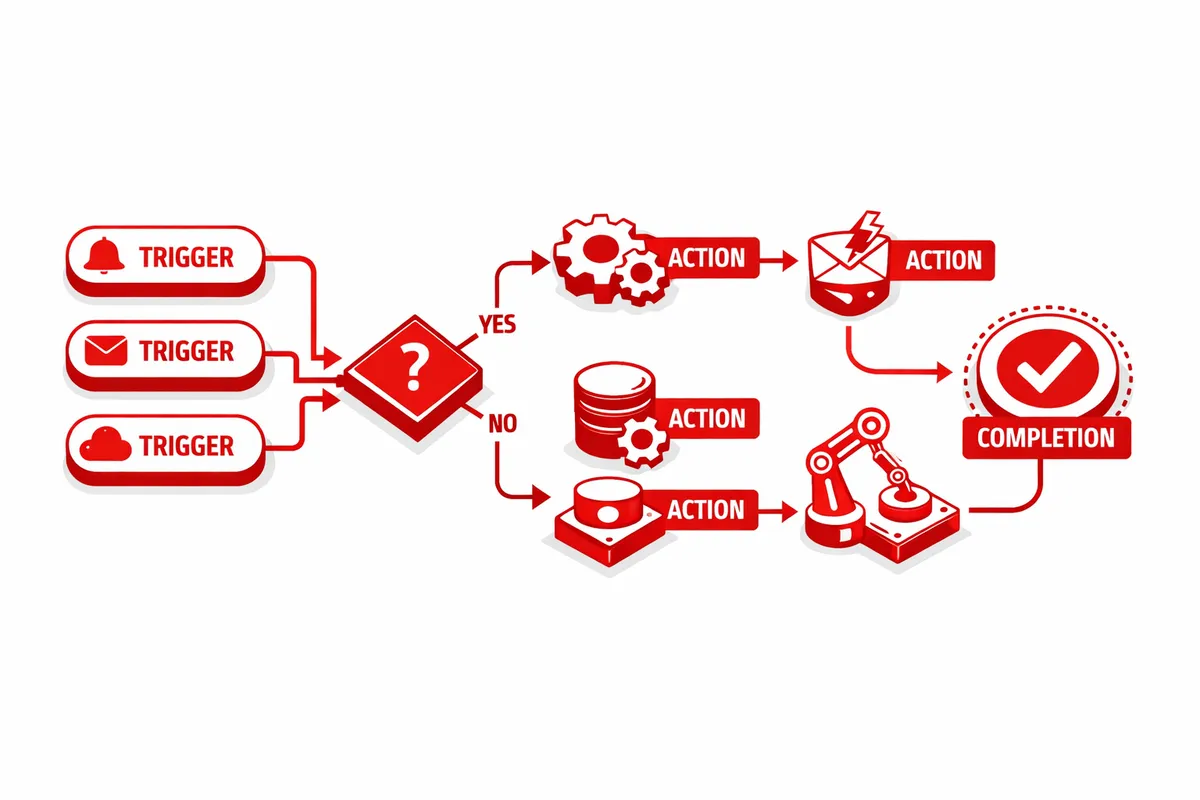
Our Workflow Automation Work in New York
- Financial services automation: trade processing, reconciliation, compliance documentation, and client onboarding for Wall Street and Midtown firms under SEC and FINRA oversight
- Legal workflow automation: matter intake, document routing and approval chains, deadline tracking, conflict check processing, and billing entry for FiDi and Midtown South law firms
- Invoice processing and accounts payable automation with ERP integration for New York enterprises
- Data entry, form processing, and intelligent document extraction from contracts, applications, and structured forms
- Approval workflow design: purchase order routing, contract review chains, exception handling, and escalation paths with configurable logic
- Customer and client onboarding automation integrating CRM, billing, provisioning, and communication systems
- Lead routing, lead scoring, and CRM synchronization across New York sales operations
- Report generation, data aggregation, and scheduled distribution to management, clients, and regulators
- System integration: connecting CRM, ERP, billing, EHR, legal practice management, and media management platforms
- HR workflow automation: new hire onboarding, offboarding, benefits administration, and performance review cycles
- Media and editorial workflow automation: content approval chains, distribution scheduling, rights management, and analytics reporting
- Healthcare authorization, eligibility verification, and claims processing automation with Epic, Cerner, and Athenahealth integration for New York health systems
Industries We Serve in New York
Financial Services and Fintech: Wall Street broker-dealers, Midtown asset managers, FiDi hedge funds, and Silicon Alley fintech companies process transaction volumes and compliance documentation under regulatory scrutiny that make automation economically and legally essential. We build financial workflow automation with complete audit logging of every action, timestamps, and input and output data; proper access controls so automation only touches data it is authorized to handle; and exception handling that escalates correctly when edge cases require human review. For firms under SEC, FINRA, and state financial regulator oversight, compliance documentation automation reduces examination preparation burden while improving record completeness. Trade reconciliation, client onboarding documentation, AML screening integration, and compliance report generation are common automation targets.
Legal and Professional Services: New York's legal community, concentrated in FiDi, Midtown South, and Midtown, bills time at rates that make administrative workflow overhead extraordinarily expensive. Partner-level compensation hours spent on document routing, deadline tracking, and billing entry represent a direct cost that automation eliminates. We build legal workflow automation for matter intake and conflict check processing, document review and approval chain management, court filing deadline tracking with multi-level alerts, billing entry from timekeeper notes, and client onboarding sequences. For the consulting, accounting, and advisory firms throughout Midtown and the outer boroughs, similar administrative automation applies with appropriate customization.
Media, Publishing, and Entertainment: New York's media companies, from the publishing houses in Midtown to the digital media companies in SoHo and Hudson Square to the production companies in Midtown West, manage content workflows that involve approvals across editorial, legal, compliance, and business teams before any content publishes. Editorial approval chain automation, content rights management workflows, distribution scheduling automation, advertising operations reporting, and analytics report generation are all automation candidates that reduce the coordination overhead that slows publishing cycles and consumes senior editorial and business staff time.
Healthcare Systems and Medical Practices: The major New York health systems including NYU Langone, Mount Sinai, NewYork-Presbyterian, and Northwell Health, along with the network of specialty practices serving all five boroughs, manage administrative workflow volumes that grow faster than administrative headcount can. HIPAA-aware automation for insurance eligibility verification, prior authorization submission and follow-up, patient intake data processing, claims submission and status monitoring, and payment posting typically delivers positive ROI within the first year through staff time savings alone, before accounting for error reduction and claims denial rate improvement.
Technology Companies and Startups: Silicon Alley companies, the Brooklyn Tech Triangle's growing startup ecosystem, and the enterprise technology vendors selling to New York's financial and professional services sectors compete nationally and globally from New York bases. Customer onboarding automation, support ticket routing and SLA management, billing and subscription management, and the internal operational workflows that determine whether a scaling startup can grow revenue without proportional headcount growth are all automation opportunities. For companies selling into regulated industries, building compliance-grade documentation into their own operational processes signals the maturity their enterprise clients expect.
Real Estate and PropTech: New York's real estate market, the most complex and highest-value in the world, generates administrative workflows at every stage of the transaction and property management lifecycle. Lease processing and tenant onboarding, rent collection exception handling, maintenance request routing and vendor coordination, regulatory filing management for rent-stabilized properties, and property management reporting automation all reduce the administrative overhead of managing New York's exceptionally complex property portfolio requirements.
What to Expect
Process Discovery and Mapping: We begin by mapping your current process landscape systematically. Structured interviews with the people doing the work, observation of actual process execution where possible, documentation of the rules and exceptions that govern each workflow, and quantification of volume and labor cost. In New York, the volume and labor cost numbers move fast because of the cost structure, and getting them right is critical to building an honest automation ROI case. Process mapping produces the evidence base that determines which processes to automate first and in what order.
Automation Opportunity Assessment: With processes mapped, we assess automation feasibility and expected ROI for each candidate. Not every manual process should be automated, and sequence matters. We prioritize by volume, labor cost at New York rates, error rate and consequence, and regulatory or compliance impact. For financial services and healthcare clients, compliance documentation value is factored explicitly into the prioritization because it has value independent of labor cost. The output is a phased automation roadmap that starts with the highest total-value opportunities.
Build and Integration: We design the automation logic and build using the appropriate tooling: native API integration for systems that support it, RPA for legacy platforms that do not, custom application development for complex orchestration, or configurable workflow platforms for approval-routing and document management use cases. New York's financial services and legal sectors frequently use industry-specific platforms (Bloomberg, Reuters, legal practice management systems, trading platforms) that require custom integration approaches. We design for reliability and maintainability from the start, not as an afterthought.
Testing, Deployment, and Monitoring: Automation is tested against historical process data before production deployment. For financial services clients, testing against real transaction samples and compliance scenarios is mandatory before go-live. We deploy monitoring and alerting so failures surface immediately rather than accumulating invisibly. Post-deployment support covers the optimization period where edge cases discovered in production with real data are addressed. For New York's regulated industries, the monitoring and audit logging configuration is treated as a primary deliverable, not a secondary operational concern.
Ready to Automate Your New York Business Workflows?
New York's cost structure means every hour of manual labor for routine work is expensive, and every hour redirected toward analytical, strategic, or client-facing work creates compounding value. Running Start Digital builds workflow automation that converts your team's time from process execution to process oversight and higher-value work. The firms and companies that automate operational overhead in this market compete more effectively, retain better people, and scale revenue without proportional cost growth. Schedule a consultation to map your current processes and identify where automation delivers the most measurable value for your New York business.