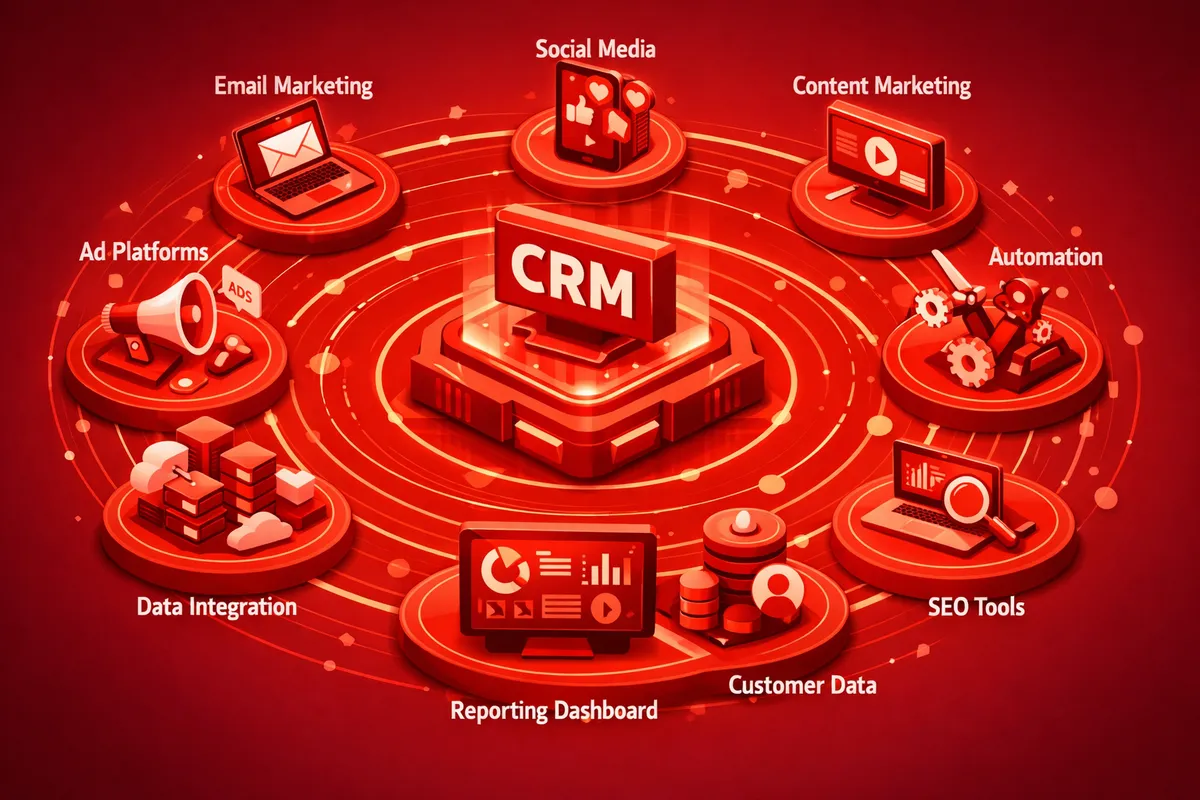
Our CRM & MarTech Consulting Services in New York
- MarTech stack audits identifying redundancy, wasted spend, and capability gaps across your full tool ecosystem
- CRM platform selection and implementation: Salesforce, HubSpot, and enterprise-grade solutions with New York market experience
- Marketing automation implementation with sophisticated segmentation and nurture workflows for complex buying cycles
- Data governance programs restoring contact database quality and maintaining it going forward
- Account-based marketing (ABM) technology implementation for New York enterprise B2B companies targeting named accounts
- Financial services CRM compliance configuration: communication archiving, audit trail design, and data handling for NYDFS-regulated firms
- Revenue attribution and multi-touch reporting for marketing and sales leadership conversations about ROI
- Team training and adoption programs for New York's demanding sales and marketing organizations
- Ongoing optimization retainers for continued stack performance and capability expansion
Industries We Serve in New York
Financial Services and Fintech (FiDi, Midtown, Hudson Yards). New York's financial sector requires CRM implementations built with compliance requirements as first-class design constraints. Communication archiving for FINRA-member firms, contact data handling under NYDFS cybersecurity regulations, and the audit trail requirements of SEC-registered advisers all require specific configuration that standard implementations skip. We also work with fintech companies scaling their sales motions, building the pipeline infrastructure that supports enterprise sales processes at growth-stage and beyond.
Technology and SaaS (Silicon Alley, Brooklyn Tech Triangle). Silicon Alley's enterprise SaaS companies manage complex multi-stakeholder sales cycles involving technical evaluators, economic buyers, and executive sponsors. CRM for these companies needs to reflect multi-contact opportunity management, stakeholder mapping, and the qualification criteria that distinguish serious opportunities from ones worth deprioritizing. We configure CRM for enterprise SaaS sales with the deal structure and reporting that supports accurate pipeline forecasting.
Media, Publishing, and Advertising. New York's media and advertising sector manages client, partner, and vendor relationships at a complexity level that standard CRM data models handle poorly. We build custom data architectures for media companies that reflect advertiser relationships, agency agreements, platform partnerships, and content distribution arrangements. Marketing automation for media companies also serves very different purposes than for product businesses, including subscriber acquisition, advertiser prospecting, and talent recruitment, and we configure accordingly.
Legal Services (Midtown). Large New York law firms manage long-duration client relationships where CRM's primary function is relationship intelligence, not deal pipeline. Client history, matter associations, relationship map across contact networks, and business development activity tracking are all needs that generic CRM configurations address inadequately. We configure CRM for professional services with relationship-centric data models that reflect how legal and consulting work is won and retained.
Healthcare and Life Sciences. New York's healthcare sector requires CRM configurations that handle physician referral network management, healthcare professional communication compliance, and patient data handling under HIPAA. The marketing and business development functions of large health systems serve distinct audiences, including referring physicians, potential patients, academic partners, and payer relationships, each requiring different communication approaches and data models.
Fashion and Retail. New York's fashion brands use CRM and marketing automation to manage wholesale buyer relationships, direct consumer relationships, and media and influencer relationships simultaneously. These are distinct relationship types with different data models, communication cadences, and automation logic. We build configurations that serve all three without forcing them into a single generic model.
What to Expect
Discovery. Two weeks inventorying every tool your company is paying for, auditing its configuration state, assessing utilization and integration quality, and mapping data flow across the stack. We categorize each tool as essential and well-configured, essential but misconfigured, redundant, or unnecessary. Most New York companies save meaningful monthly subscription spend and improve performance from the audit recommendations alone.
Strategy. A prioritized action plan with platform recommendations, implementation sequencing, and data architecture design. For regulated industries, compliance requirements are mapped into the design during this phase. ROI projections for the primary improvements are presented before any implementation begins.
Implementation. Phased delivery with a working core system within six to eight weeks and complexity added incrementally. Training follows configuration so your team learns on the system they will actually use. For New York clients with complex compliance requirements, we build the compliance review process into the implementation timeline.
Results. Baseline metrics established before implementation. Progress tracked and reported throughout. Ongoing optimization on retainer keeps the system evolving with your business.