What We Build for Handyman Companies
AI Job Matching and Skill-Based Dispatch
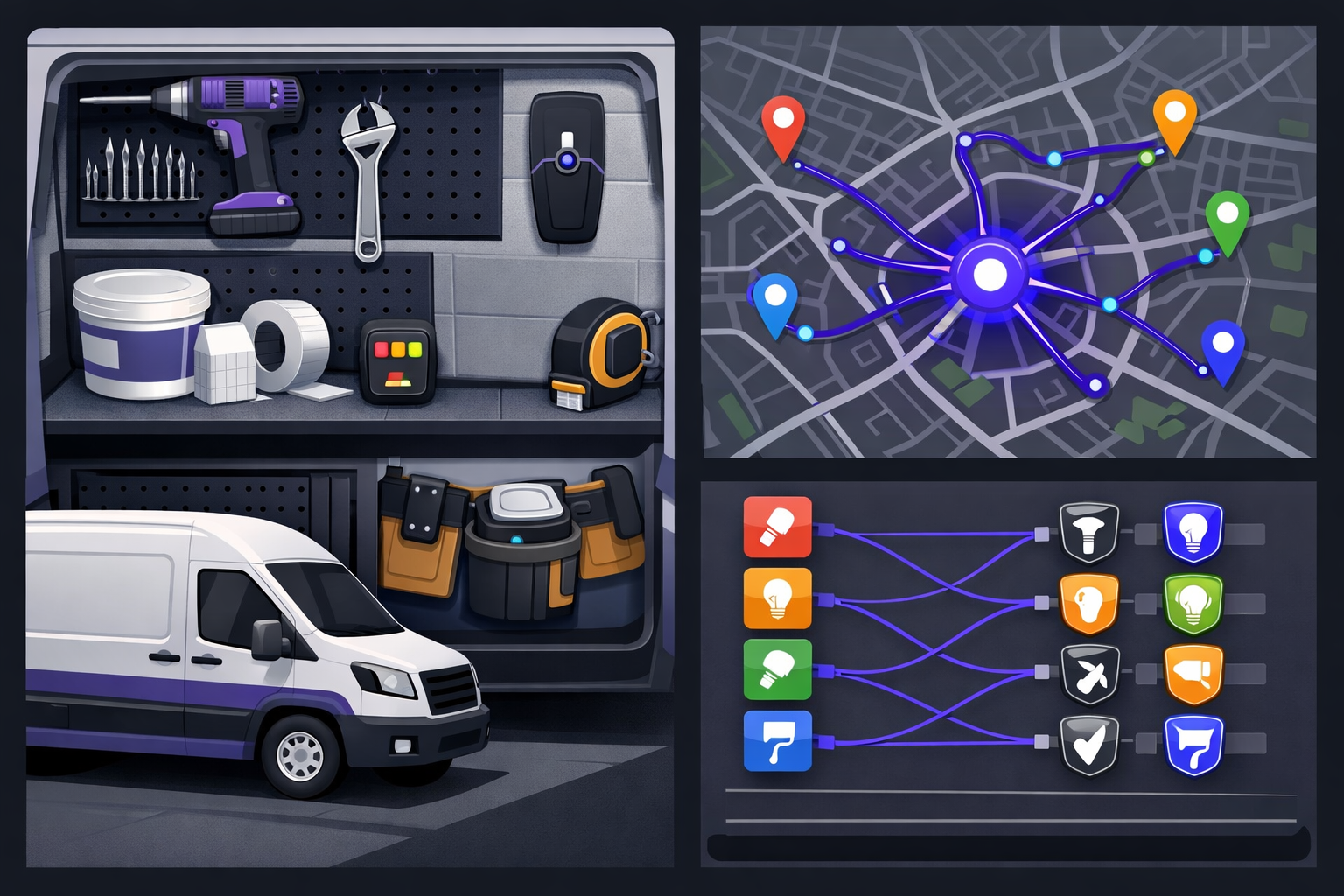
The core of handyman productivity is getting the right person to the right job. Our dispatch system goes beyond simple geographic optimization to match jobs with technicians based on a comprehensive skill and efficiency profile.
Every technician in your company has a skill matrix. Some are excellent carpenters. Some are fast at plumbing. Some are comfortable with minor electrical work. Some excel at painting and finishing. The dispatch system tracks each technician's capabilities, certifications, speed ratings by job type, and customer satisfaction scores across different service categories. When a drywall repair job comes in, the system does not just find the nearest available technician. It finds the nearest available technician who is rated highest for drywall work and has the required materials on their truck.
The matching algorithm weighs multiple factors. Skill match: how well does this technician's profile fit the job requirements? Proximity: how far is the technician from the job site, accounting for real-time traffic? Schedule fit: does this job fit cleanly into the technician's day without creating dead time between stops? Tool and material availability: does this technician have what they need, or will they need to make a supply stop? Customer history: has this technician served this customer before, and if so, how was the experience?
The result is a daily schedule for each technician that maximizes their strengths, minimizes windshield time, and ensures they arrive prepared for every job. When conditions change mid-day (a job runs long, a customer cancels, an emergency call comes in), the system reoptimizes the remaining schedule in real time, notifying affected customers of updated arrival windows automatically.
Dynamic Multi-Stop Route Optimization
Handyman work is inherently multi-stop. A productive technician completes five to eight jobs per day, each at a different location. The order in which they visit those locations and the time windows assigned to each stop determine how many jobs fit into a workday.
Our routing system builds each technician's daily route by solving a constrained optimization problem. The constraints include customer-requested time windows, job duration estimates, drive times between stops (adjusted for time of day and traffic patterns), supply stop requirements, and break periods. The objective is to maximize completed jobs while honoring every constraint.
The system handles the complexity that human schedulers cannot. It knows that the 11 AM to 1 PM window has lighter traffic in certain corridors. It knows that a supply house stop between two jobs in the same commercial district adds only 12 minutes to the route. It knows that a job estimated at 90 minutes with Technician A would take only 60 minutes with Technician B based on historical performance data. These micro-optimizations compound across a full day and a full crew into substantial productivity gains.
Real-time optimization continues throughout the day. When a job finishes early, the system can pull forward the next stop and notify the customer of earlier availability. When a job runs over, subsequent stops are adjusted and customers are notified of the delay before they start wondering where their handyman is. This proactive communication eliminates the most common source of customer frustration in the handyman industry: uncertainty about when the technician will arrive.
Learn more about our scheduling solutions
AI-Powered Photo Quoting
Speed of response is the single biggest factor in winning handyman jobs. The customer who submits a request and receives a quote in 15 minutes hires that company. The customer who waits 24 hours for a response has already called someone else.
Our photo quoting system lets customers submit job requests with descriptions and photos through your website, text message, or a dedicated app. The AI processes the submission immediately. It analyzes the photos to identify the scope of work, recognizing common handyman tasks like drywall damage (size and type), plumbing fixtures (brand and condition), door alignment issues, painting scope, and hardware installation requirements.
The system matches the submitted job against your database of completed work. A photo of a 6-inch drywall hole in a bedroom is compared against your history of similar repairs, pulling average labor time, material cost, and common complications. The quote factors in the customer's location (some areas have higher travel time costs), the complexity assessment from the photos, and your company's pricing structure.
For straightforward jobs, the system generates a firm quote that the customer can approve instantly, scheduling the job in the same interaction. For complex or ambiguous jobs, it produces a range estimate with clear explanations of what factors could shift the price. In either case, the customer receives a response within minutes of their request, placing your company first in line while competitors are still checking voicemail.
The quoting system learns continuously. Every completed job where the actual cost is recorded against the original quote feeds back into the model. After processing 500 to 1,000 completed jobs, the system achieves quote accuracy within 10% of actual cost for standard handyman work, reducing the margin erosion that plagues companies relying on phone estimates.
Parts and Supply Inventory Management
A handyman truck is a mobile warehouse carrying hundreds of items. Screws, anchors, caulk, tape, connectors, common fixtures, paint touch-up supplies, and specialized tools for different job types. When a technician arrives at a job and does not have the right supply, they face a choice. Drive to the hardware store (killing 30 to 45 minutes of productive time) or improvise with what they have (which may compromise quality).
Our inventory management system tracks what is on each truck and what each job requires. When the dispatch system assigns a job, it checks the material requirements against the assigned technician's truck inventory. If the technician is missing a specific item, the system can either reassign the job to a technician who has it, add a supply stop to the route at the nearest source, or flag the shortage for the technician to address during their morning preparation.
The system maintains running inventory counts updated by technician input after each job. When consumable supplies (caulk tubes, drywall compound, common fasteners) drop below threshold levels, the system generates a restocking list for each truck. Restocking can happen at the end of each day or at a scheduled weekly interval, depending on your preference.
For companies with a central warehouse or supply relationship, the inventory system coordinates ordering based on aggregate truck needs. Rather than each technician making individual hardware store runs, supplies are ordered in bulk at contractor pricing and distributed to trucks during morning staging. The cost savings on materials alone, from bulk pricing versus retail, typically runs 15% to 25% on consumable supplies.
Learn more about our business software solutions
Customer Communication and Trust Building Automation
In the handyman industry, the customer experience between booking and arrival is where trust is built or broken. A customer who books a handyman and then hears nothing until someone shows up at their door feels anxious. A customer who receives confirmation, preparation instructions, a technician profile, an en-route notification, and arrival confirmation feels taken care of.
Our communication system automates the trust-building touchpoints that professional handyman companies deliver inconsistently when handled manually. Booking confirmation includes the job summary, date, time window, and estimated cost. The day before, a reminder goes out with preparation tips specific to the job type (clear the area under the leaky faucet, remove items from the wall where shelves will be installed). One hour before arrival, the customer receives a technician profile with photo, name, years of experience, and relevant certifications. This small detail dramatically reduces the anxiety of having a stranger come to your home.
During the job, the technician logs progress through a simple app interface. Upon completion, the customer receives a summary of work performed, photos of the completed job, care or maintenance notes, and the final invoice. A satisfaction check follows within 24 hours, routing to either the review generation flow or the service recovery flow based on the response.
For recurring customers, the system tracks service history and proactively suggests maintenance. A customer who had their deck stained 18 months ago receives a reminder that reapplication may be due. A customer who had a faucet repaired gets a follow-up six months later checking whether the fix is holding up. These touchpoints generate repeat business and reinforce the reliability that wins long-term customer relationships.
Reputation and Review Management
Reviews are the lifeblood of handyman businesses. The difference between a company with 50 reviews averaging 4.2 stars and a company with 300 reviews averaging 4.8 stars is not just visibility. It is the difference between a customer who calls you confidently and one who keeps searching.
Our review management system turns every completed job into a review opportunity. The process is calibrated to maximize positive reviews while catching negative experiences before they go public. After the post-job satisfaction check, customers who rate their experience 4 or 5 stars receive a direct link to Google (or the platform of your choice) with a simplified review flow. Customers who rate 3 or below are connected to your service manager for resolution before any public review is posted.
The system generates review volume consistently rather than in bursts. Steady review accumulation signals to Google and customers that your business is active and consistently delivering quality work. Review responses are drafted by AI in your brand voice and queued for your approval. Positive reviews get warm, specific thank-you responses that mention the work performed. Critical reviews get professional, solution-oriented responses that demonstrate accountability.
Beyond individual review management, the system analyzes review content for operational insights. If multiple customers mention that a specific technician is particularly skilled or friendly, that information feeds into the dispatch system for matching high-value customers with high-performing technicians. If reviews mention recurring issues like scheduling delays or incomplete work, those patterns are flagged for operational improvement.
What to Expect
Phase 1: Assessment (Weeks 1-2)
We map your current operations from customer inquiry through job completion and follow-up. We analyze your dispatch methods, quoting process, scheduling efficiency, and customer communication touchpoints. We review your technician roster's skill profiles and service history. We examine your review presence across Google, Yelp, Nextdoor, and Angi. We interview dispatchers, technicians, and office staff to understand pain points. We analyze a sample of completed jobs to benchmark current quoting accuracy and job completion rates.
Phase 2: System Design (Weeks 3-4)
Based on the assessment, we design your AI integration stack prioritized by impact. For most handyman companies, dispatch optimization delivers the fastest ROI, followed by quoting automation and communication systems. We present the plan with projected improvements in jobs per technician per day, quoting speed and accuracy, customer satisfaction metrics, and review generation volume. You review and approve before build begins.
Phase 3: Build and Integration (Weeks 5-10)
Systems are built and deployed in priority order. Dispatch and scheduling go live first, immediately improving technician productivity. We load your technician skill profiles, service area data, and historical job data to train the matching algorithms. Photo quoting launches next, with initial calibration based on your pricing and historical job records. Communication automation is configured and tested with real job scenarios. Review management goes live last, building on the improved customer experience the other systems create.
Phase 4: Optimization and Scaling
After 30 days of live operation, we analyze dispatch efficiency by comparing jobs per technician per day against the pre-AI baseline. Quoting accuracy is measured by comparing estimates against actual job costs. Communication effectiveness is tracked through customer response rates and satisfaction scores. Review generation volume and ratings are monitored against historical trends. Monthly optimization refines every system, with the dispatch and quoting algorithms becoming increasingly accurate as they process more of your operational data.
Industry Connections
Handyman services overlap with nearly every home improvement trade. Plumbing companies and electricians refer overflow work for minor repairs that do not justify a specialized service call. Painting contractors collaborate on projects where handyman prep work (drywall repair, caulking, trim replacement) precedes professional painting. General contractors subcontract handyman-scope punch list work on renovation projects. HVAC companies refer filter changes, thermostat installations, and minor ductwork repairs to handyman partners.
Stop Juggling. Start Scaling.
Every minute your best technician spends driving to a job that does not match their skills is a minute of wasted potential. Every estimate that takes 24 hours to deliver is a customer who hired someone faster. Every completed job that does not generate a review is trust left unbuilt.
AI integration for handyman companies turns the operational complexity that limits most businesses into a system that scales. Smart dispatch that matches the right person to the right job. Route optimization that fits more stops into every day. Photo quoting that responds to customers in minutes instead of hours. Inventory tracking that keeps every truck stocked. Communication automation that builds trust at every touchpoint. And review management that turns satisfied customers into public advocates.
Schedule a consultation and let us show you how AI tools can transform your handyman operation from chaotic to systematic.