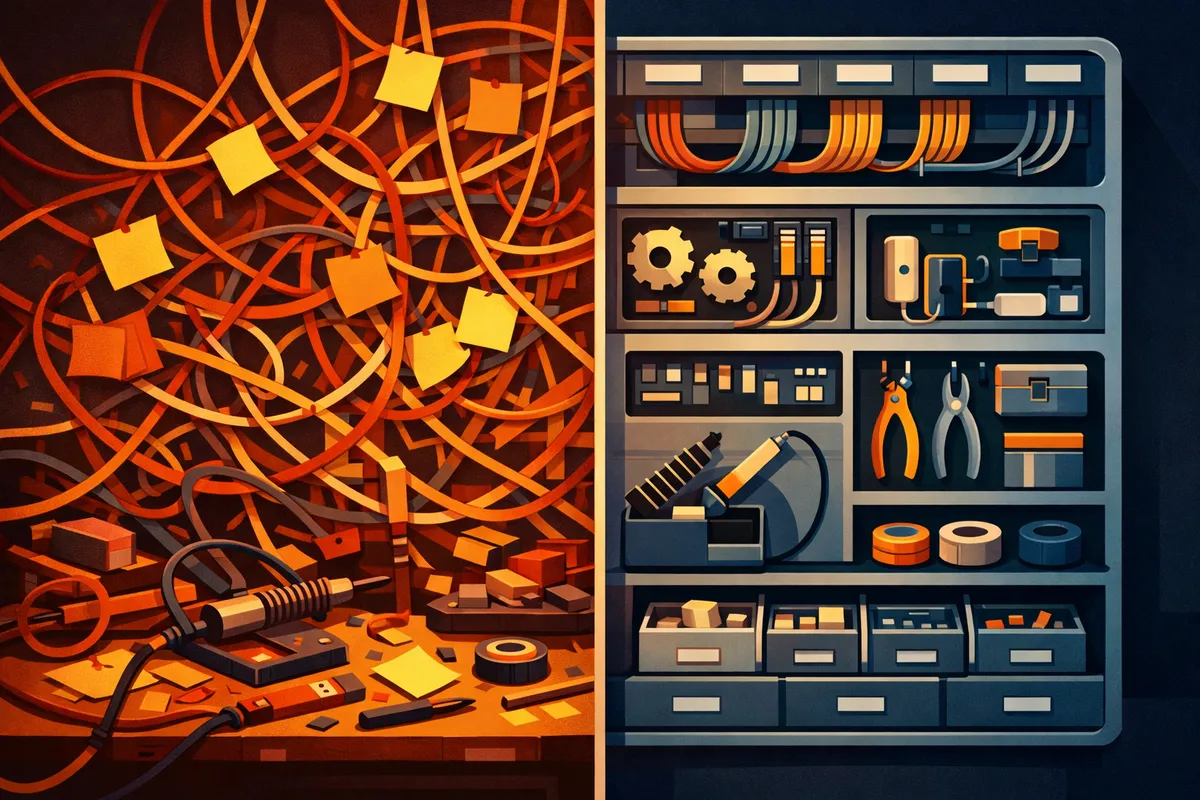
The Breaking Point: When Chaos Becomes a Liability
A startup can run on chaos until roughly ten people. Below that, everyone talks to everyone. Decisions happen at lunch. Knowledge is tribal. Information moves at the speed of conversation. It's inefficient but it works because the group is small enough to hold everything in collective memory.
At ten to fifteen people, that stops working:
- Not everyone talks to everyone anymore
- Specialist roles create information silos
- Meetings happen in smaller groups without full visibility
- The informal network breaks down
By twenty or thirty, a completely informal operation becomes a liability:
- Work gets duplicated because people don't know what others are doing
- Decisions get remade because someone didn't see the original decision
- Context is lost. Institutional knowledge walks out the door when someone quits.
Most founders try to solve this by hiring faster or having more meetings. Both are mistakes. More people doesn't fix the problem; it creates more of it. More meetings just slow you down.
The solution is to implement systems before you need them. Not when you're on fire. When you still have time to build them right.
System 1: Communication Architecture
Communication needs structure. Not rigidity. Structure. The structure prevents important information from disappearing. It creates trails of decisions so you don't remake them. It lets new people understand what's happening without asking fifty questions.
Layer 1: Channels with clear purposes
Not a single Slack workspace where everything gets mixed together. Channels with defined scope:
- #general for company-wide announcements
- #random for casual conversation
- #product-updates for what shipped and what's coming
- #ops-decisions for operational choices that affect everyone
- #team-engineering, #team-sales, etc. for function-specific work
- #customer-issues for patterns and escalations
This matters because your brain can't track everything in a firehose. Channels let people opt into the conversations that matter to their role.
Layer 2: Structured synchronous time
You still need meetings. But those meetings need:
- An agenda sent 24 hours before
- A time limit (30 minutes default, 60 minutes maximum)
- Clear outcomes documented
- Notes posted in your documentation system so people who weren't there can read what was decided
Layer 3: Written decisions
Every decision that affects how you work should be written down. Not as a long memo that no one reads. As a short answer to "why did we decide this?" written in a place where future employees can find it.
The async force multiplier
Asynchronous communication recovers real time. A ten-person startup holding multiple meetings a day is burning maybe twenty hours a week just on synchronous coordination. That's a full person's worth of productivity. Moving 60-70% of communication to async lets you recover most of that time.
Recommended tools: Slack ($0-$8/person/month), Loom for async video updates ($12/person/month), Notion for written decisions ($8/person/month).
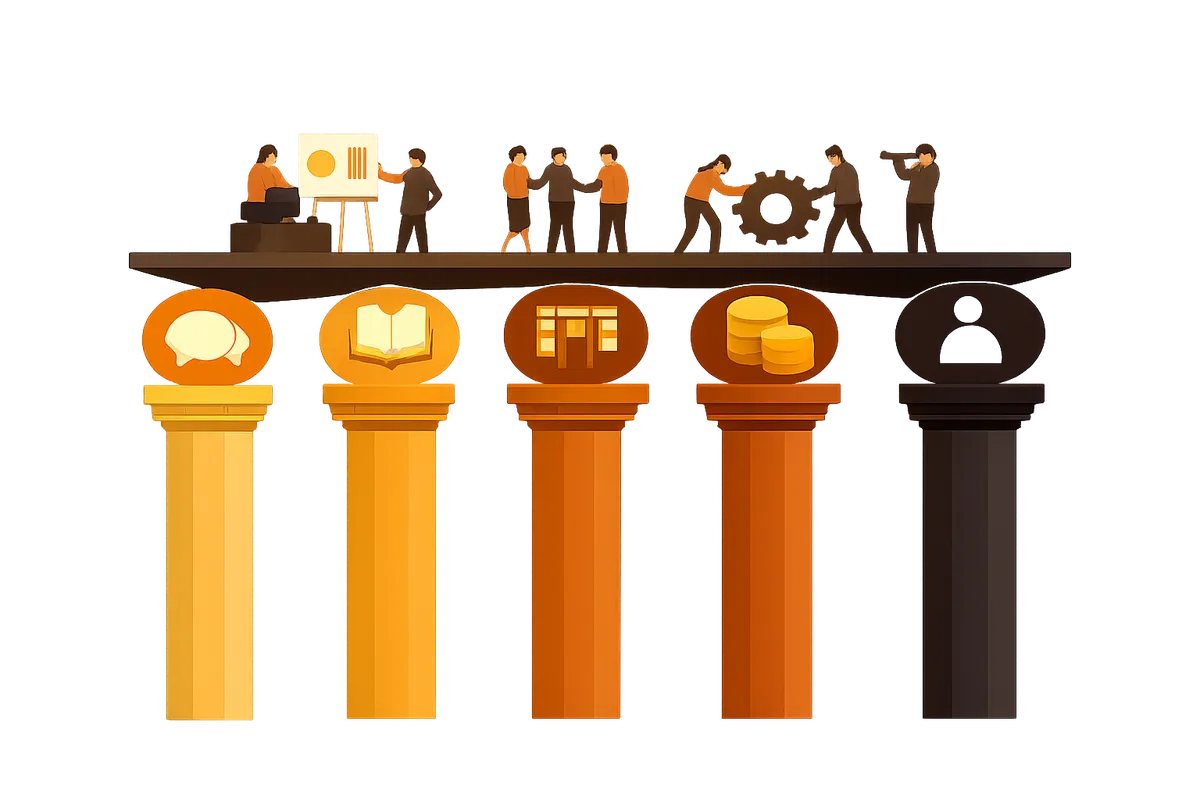
System 2: Documentation as Infrastructure
Documentation is not a nice-to-have. It's infrastructure. It's how knowledge survives when people leave. It's how new people onboard faster. It's how you prevent the same question from being answered five times.
Three levels of documentation
Level 1: Company wiki. Not beautiful. Not fancy. Boring and functional. A place where anyone can write down knowledge and anyone can find it later. You document how to do things, who does what, how decisions get made, what your policies are.
Level 2: Decision documentation. Every major decision gets a short write-up:
- What problem were we solving?
- What options did we consider?
- What did we choose and why?
This prevents the situation where someone asks why you did something six months ago and nobody remembers.
Level 3: Process documentation. If there's something someone does repeatedly, there's a process doc:
- How to onboard a customer (step by step)
- How to deploy the application
- How to handle a customer support escalation
- How to run payroll
The goal is not perfection. It's clarity. Someone new should be able to follow the process and get the same result the expert gets.
The documentation culture shift
Don't wait for perfect documentation. Document the current process as it actually is, even if you know it's imperfect. The documentation of an imperfect process is better than no documentation. You can improve the process and update the docs later.
Create the expectation: If someone asks the same question twice, the answer goes in the wiki. This is not a burden on the person who knows the answer. It's an investment in moving information from memory to infrastructure.
Recommended tools: Notion ($8/person/month), Confluence ($6/person/month), or even a well-organized Google Drive (free). The tool matters less than the habit.
System 3: Project Management and Visibility
When you're small, you can hold everything in your head. You know what everyone is working on, what's blocked, what needs to happen this week. That works until you can't hold it anymore.
What the system needs to show
- A list of projects with current status
- Who is doing what
- What's blocked and why
- What's coming next
That's it. You don't need twenty features. You need visibility.
How to run it
- Weekly updates: Team members update their projects once a week. Status is current. Everyone can see what's happening.
- Weekly standup: Fifteen minutes. Each person says what they finished, what they're working on, what's blocking them. Boring. Repetitive. Necessary.
- The board is not for control. It's for coordination. When someone asks "are we on track for launch?" you look at the board and know. When someone is overloaded, you can see it and redistribute work.
Recommended tools: Linear ($8/person/month) for engineering-heavy teams, Asana ($11/person/month) for cross-functional teams, Trello (free) for simple needs. Don't overthink this. Pick one and start using it.
System 4: Financial Operations
You can run a startup on a spreadsheet for maybe six months. After that, a spreadsheet becomes a liability. You need systems that give you visibility into your money.
The five financial pieces
1. Accounting software. QuickBooks ($30/month), FreshBooks ($17/month), or Wave (free). Tracks income and expenses. Your accountant or bookkeeper will thank you. Your taxes will be easier. You'll know your actual financial position instead of guessing.
2. Runway tracking. At any given moment, you know: - How much cash you have - How much you're spending monthly (burn rate) - How many months you have left (runway) - Whether you need to raise more money
This should be a simple spreadsheet updated monthly. Or a dashboard in your accounting tool.
3. Invoicing and payment collection. If you're selling something, you need a system for getting paid. Stripe, Square, or your accounting software's built-in invoicing. Every payment that requires a manual bank transfer is friction that costs you money.
4. Expense management. Employees spend money. They need a way to get reimbursed that doesn't involve chasing the founder for three months. Tools like Brex ($0 for startups), Ramp ($0), or Expensify ($5/person/month) handle this cleanly.
5. Payroll. If you have employees, payroll needs to be automated. Gusto ($40/month + $6/person), ADP, or Rippling. Taxes paid on time. Deposits hit on time. Records for audits. Payroll chaos is demoralizing. A reliable payroll system is cheap relative to the morale benefit.
What you're building is visibility and reliability. You know where the money is. You know where it's going. Employees get paid on time. Taxes are filed. The system removes dozens of small stressors and gives you actual numbers to make decisions with.
System 5: Hiring Pipeline and Onboarding
You will need to hire. You will need to do it faster than feels comfortable. Having a system prevents hiring from becoming chaotic.
The five hiring pieces
1. Clear job descriptions. Not a long document. A paragraph about the role: What does the person do? What problems do they solve? What skills are non-negotiable vs. nice-to-have?
2. Candidate tracking. A central place where every candidate is tracked. Who referred them? What stage are they in? What did they say in interviews? You should never lose a good candidate because communication fell through the cracks. Tools: Ashby ($300/month), Lever, or even a structured Notion database (free).
3. Structured interview process. What questions do you ask? Who interviews? What are you evaluating? If every person on the team interviews differently, you get inconsistent hires. A structured process is more predictive. Create a scorecard with 4-5 criteria and use it consistently.
4. Fast offer process. When you decide to hire someone, don't make them wait two weeks for paperwork. Have a template offer letter. Have all the documents ready. Get it done in two days.
5. Structured onboarding. The first week is critical. New people should have:
- A clear plan for their first five days
- Introductions to key people
- Access to all necessary systems (set up before day one)
- A clear first task they can complete and ship
- A buddy they can ask questions
- Links to the documentation they should read
Make it repeatable
When you hire your second person, you follow the same process. When you hire your tenth, same process. Consistency over time means you get better at it. You learn what questions predict good hires. You refine the process based on experience.
The Cost of Not Having Systems
- You lose velocity. A small task that should take an hour takes three because information is scattered.
- You leak knowledge. The person with the most institutional knowledge leaves. Entire systems go dark. New people have to rediscover things the company already learned.
- You get surprised. You think you have six months of runway until you realize you've been spending more than you thought. You think a project is on track until you realize nobody knows the actual deadline.
- You can't grow. You can add people but not productivity. Hiring more people actually makes things slower because there's no infrastructure for them to plug into.
When to Install Each System
| System | Install At | Why Then |
|---|---|---|
| Communication structure | 5 people | This is when you stop naturally coordinating |
| Documentation | 5 people (light), expand at 15 | A few key processes first, then build the habit |
| Project management | 10 people | Below that, it's overhead. Above that, it's essential. |
| Financial operations | 10 people or first investment | Investors require it. Employees expect it. |
| Hiring systems | Before your 3rd hire | You're past the "hire my friend" stage |
Building the System, Then Stepping Out
The founder's job is to build the system. Not to run it forever.
- Communication working? You're not in every channel. You're spot-checking that norms are followed. Someone else keeps meetings on track.
- Documentation working? Other people document their own domains. You review for consistency, not creating from scratch.
- Project management working? Team members update their own work. You look at the board once a week to spot problems.
- Financial operations running? Your bookkeeper handles daily transactions. You review monthly statements and spending trends.
The system's job is to free you from operational minutiae so you can think about strategy and product.
For how these systems evolve as you scale, see From Chaos to Process: Scaling Operations at 10, 50, and 100. For what parts of your systems to automate, see Automating Operations: Build vs. Buy.
Ready to design systems for your specific stage? Contact us to map your operational needs.
Related Guides
Automating Operations: What to Build vs. What to Buy
Automation isn't about replacing people. It's about freeing them from work that doesn't require judgment. Know what to build, buy, or leave manual.
Decision-Making Frameworks for Founders Under Pressure
Speed matters more than perfection. Three decision-making frameworks that help founders move fast without moving stupid.
Running Effective Board Meetings as a First-Time CEO
Board meetings shouldn't be a performance review you dread. Make them the most useful two hours of your quarter.