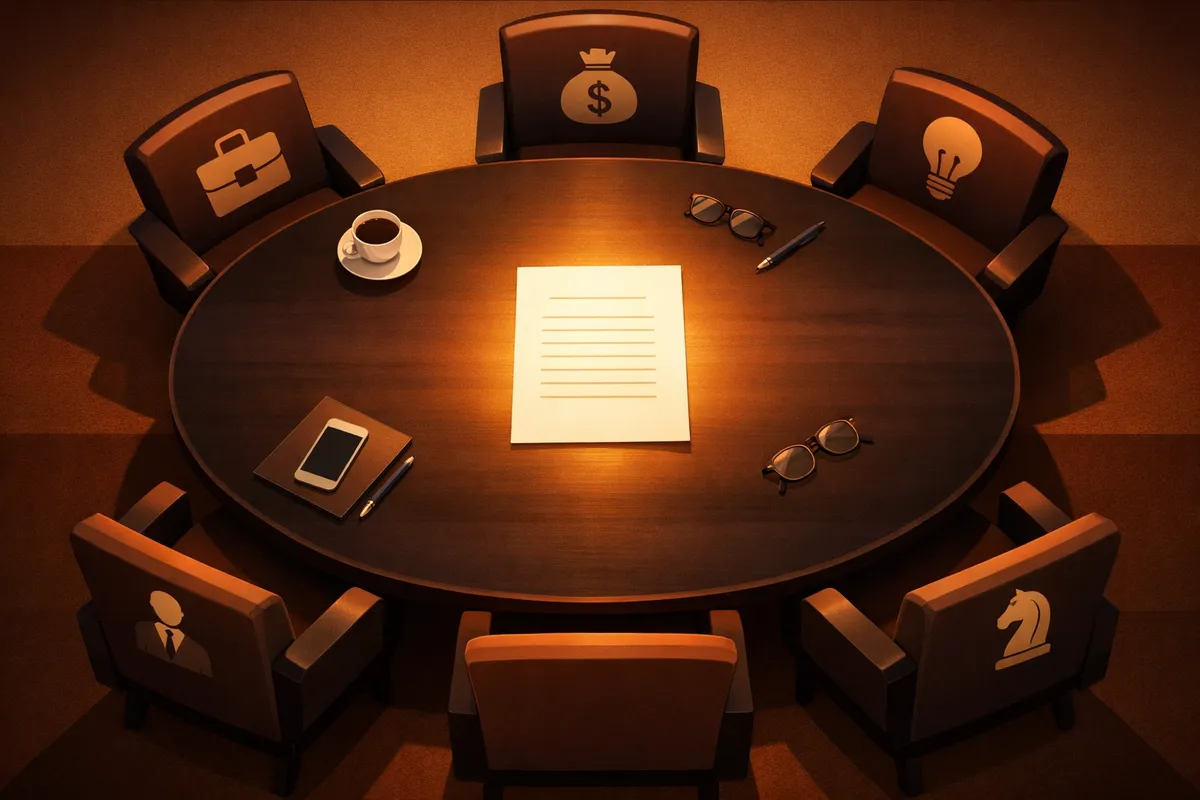
The Board Deck Structure
The board deck is the skeleton. Everything else hangs on it. Keep the structure simple and logical.
The six sections
1. One-sentence state of the business. This is your opening line. It sets the tone for everything.
Examples: - "We're on track to hit our Series B targets with 15% month-over-month revenue growth." - "We discovered a critical retention issue that's changing our go-to-market approach." - "We're winning in healthcare but struggling to expand into fintech."
Everything after that sentence is context.
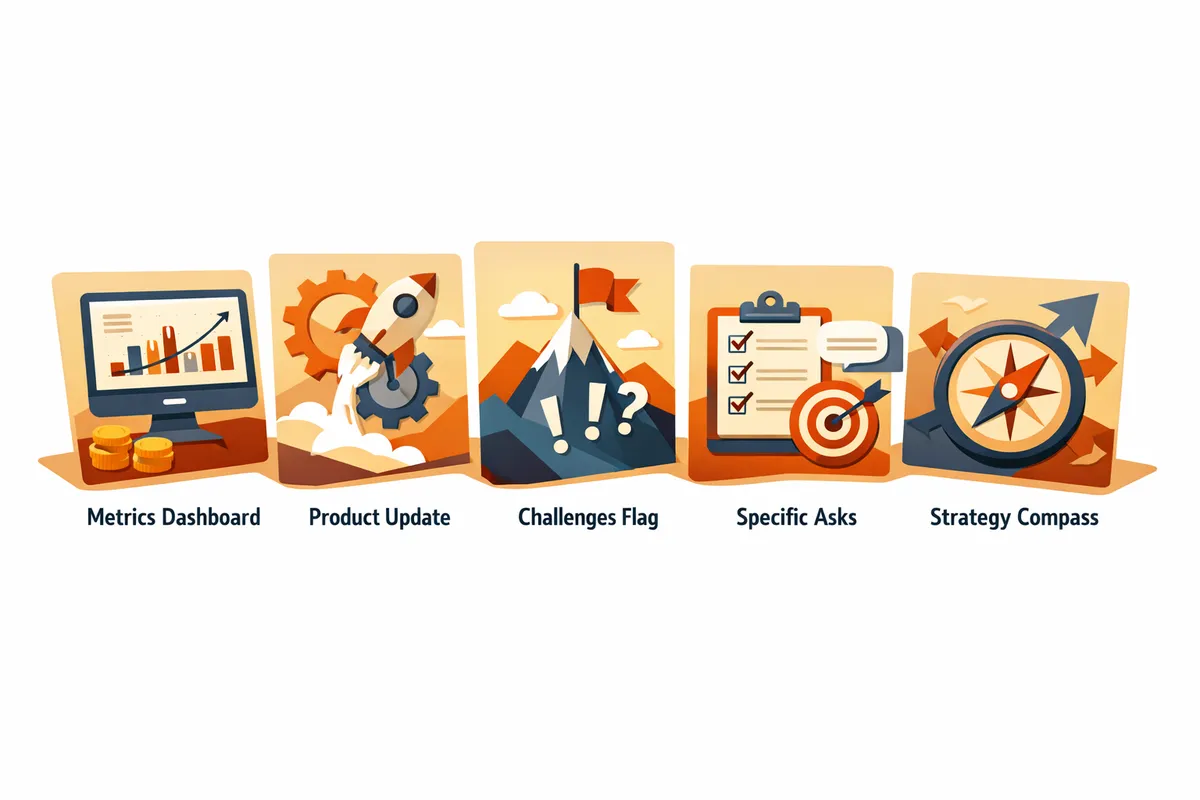
2. Metrics. Show the numbers that matter for your business on a trend line:
- Monthly recurring revenue (MRR) or annual recurring revenue (ARR)
- Customer acquisition and churn rates
- Net revenue retention
- Growth rate (month-over-month and year-over-year)
- Burn rate and runway
Are they going up? Down? Why? This is the health check. Don't make them figure it out. Tell them directly: "The business is healthy" or "We have a problem here."
3. Product and execution updates. What did you ship? What's working? What's not? Keep this quick. You're showing momentum and conviction about where to go next. Don't walk through every feature.
4. Challenges. This is the most important section and the one most founders skip. Be honest:
- What's hard right now?
- What might kill the business?
- What do you not understand?
- What's the scariest thing you're thinking about?
This is not asking for help. This is transparency. This is showing that you see the problems and you're thinking about them.
5. Asks. What do you actually need from the board? Be specific:
- "We need an introduction to the VP of Partnerships at Shopify."
- "We need advice on whether to hire a VP of Sales now or wait until Q3."
- "We need permission to extend our runway by cutting the team from 18 to 14."
Not "we'd like advice on sales." Specific asks get specific help.
6. Strategy. Show the path forward for the next quarter. What's the milestone you're trying to hit? What needs to happen? This is not a five-year plan. This is what matters in the next thirteen weeks.
Format rule
The deck should fit on one page. Actually one page. Printed out, single-sided, everything navigable at a glance. If you need more detail, that's what the pre-read is for.
How to Present Bad News
You will have bad news. You will miss targets. You will lose customers. That's normal. The question is how you present it.
Don't bury it. The instinct is to put bad news deep in the deck and hope they don't notice. To package it with good news so the overall impression is positive. That backfires. When they find the bad news, they see that you tried to hide it. That destroys trust.
Lead with it. Make the bad news the first thing you discuss:
1. Here's the problem. 2. Here's why it happened. 3. Here's what we're doing about it. 4. Here's what we're learning.
Then move on to everything else. By facing it directly, you show that you're not hiding. You're dealing with it. The action plan matters more than the bad news itself.
The Pre-Read: Sending Materials in Advance
Send the deck and materials before the meeting. At least 48 hours in advance. Here's why:
- Board members are busy. They can't read dense materials live in the meeting.
- The pre-read changes the dynamic. If they arrive without context, the first hour is them reading while you stand there watching. If they arrive having read the materials, they have questions ready. They're prepared to engage at a higher level.
- The quality of conversation improves dramatically. You skip the catch-up and go straight to substance.
Pre-read format
- Text and numbers, not design slides
- Readable on a screen in 15 minutes
- Answers the basic questions: How is the business doing? What happened this quarter? What's next?
- Include a "questions to discuss" section so board members can prepare their thinking
Running the Meeting: A Sample Agenda
Here is a practical 2-hour board meeting structure:
| Time | Section | Duration |
|---|---|---|
| 0:00 | One-sentence summary and opening context | 5 min |
| 0:05 | Metrics review and Q&A | 20 min |
| 0:25 | Product and execution updates | 15 min |
| 0:40 | Challenges discussion (the real conversation) | 30 min |
| 1:10 | Break | 5 min |
| 1:15 | Specific asks | 15 min |
| 1:30 | Strategy and path forward | 20 min |
| 1:50 | Open floor for board topics | 10 min |
Key principles:
- Start on time. Don't wait for latecomers. Respect the time of people who showed up.
- Assume they've read the pre-read. Elaborate, don't repeat. Don't read your slides.
- Spend the most time on challenges. This is where the conversation gets real. Listen to their reactions. Answer honestly. Don't defend. Don't spin.
- Reserve time at the end for topics they want to raise. You've been driving. Give them a turn.
- Everyone on video or everyone in person. Mixed meetings are painful. Everyone should be able to see everyone else.
Managing Board Dynamics
Boards are people. People have dynamics. The best CEOs recognize them and work with them.
- The talkative person. They're engaged. That's good. But don't let them dominate. After three minutes: "That's really helpful. Let me make sure everyone else has a chance to weigh in." They're not offended. They respect clear facilitation.
- The quiet person. They're thinking. They probably have valuable perspective. Ask them directly: "Jane, what's your take on this?" You've brought out a viewpoint that wouldn't have emerged on its own.
- The person who asks hard questions. They're not hostile. They're being rigorous. Answer the question directly. If you don't know the answer, say so and commit to finding it before the next meeting. That person's scrutiny makes you sharper.
- The supportive person. They're your ally. Don't lean on them too much. If you're only listening to your allies, you're in an echo chamber. Diversify whose input you seek.
Monthly Investor Updates
Between board meetings, send a monthly update. Not a board deck. Something lightweight. One page covering:
- What happened this month (3-5 bullet points)
- Are we on track? (Yes/no with brief explanation)
- One thing I need help with (specific ask)
- Key metric snapshot (MRR, customers, runway)
The monthly update is a relationship maintenance tool. It keeps people engaged. It prevents surprises. If something goes wrong in month nine, they already know it was coming because you flagged it in month three. When you need them to move fast, they're already primed with context.
Most investors appreciate monthly updates. A few prefer less frequent communication. Ask them what they want. Respect their preference. But default to monthly.
Getting Real Value From Your Board
Board members are usually successful operators. They've built companies. They understand markets. They're there partly as a governance requirement but also because they want to help. Here's how to extract that value:
Ask specific questions
Not "what should we do?" That's too open-ended. Instead:
- "We're deciding between these three options. Which do you think is smartest given our constraints?"
- "We need to hire a VP of Engineering. Have you worked with anyone great who might be open?"
- "We're considering raising a bridge round. What are you seeing in the current funding environment?"
Surface genuine uncertainty
You don't need their input on things you're confident about. But the decisions where you're torn, the strategic bets you're unsure about. Those are places where outside perspective helps most.
Ask for introductions
Board members have networks. You have a customer you need to land. Do any of them have a relationship there? You have a person you're trying to hire. Does anyone know them? These asks are concrete. They're actionable. You get results faster than you would alone.
Common Mistakes
- Hiding problems. Bad news is better out early. Every time.
- Too many slides. Your deck should be one page. Not one page per topic. One page total. Detail goes in the pre-read.
- No clear ask. You spent two hours talking but didn't ask for anything. The board leaves wondering what they're supposed to do.
- Defensive answers. When someone asks a tough question, explain the thinking. Acknowledge the risk. Show that you've considered the perspective. Defensiveness suggests you haven't.
- Going off-road. You have an agenda. Stick to it. If something important comes up mid-meeting, note it. Handle it next meeting or in a separate conversation. Don't go into a two-hour tangent.
How Board Meetings Evolve
Seed and early stage: Informal. Your investors are deep in the business. The conversation is wide-ranging. More advisory than governance.
Series A: More formal. You have fiduciary duties. More investors around the table. The reporting becomes more structured and systematic.
Series B and beyond: Formal governance. Documented agendas. Compliance requirements. Less about day-to-day strategy advising, more about ensuring the company is on the path to a strong outcome.
No matter the stage, the principles stay the same: transparency, honesty, specific asks, respect for time. The stage just determines the formality.
For how to make better decisions with board input, see Decision-Making Frameworks for Founders Under Pressure. For the operational infrastructure that supports clean board reporting, see The Systems Your Startup Needs Before It Breaks.
Ready to structure your next board meeting? Contact us for help designing the deck and strategy.
Related Guides
Automating Operations: What to Build vs. What to Buy
Automation isn't about replacing people. It's about freeing them from work that doesn't require judgment. Know what to build, buy, or leave manual.
Decision-Making Frameworks for Founders Under Pressure
Speed matters more than perfection. Three decision-making frameworks that help founders move fast without moving stupid.
From Chaos to Process: Scaling Operations at 10, 50, and 100
What works at 10 people breaks at 50. Map the operational transitions your company will face and evolve your systems at each stage.