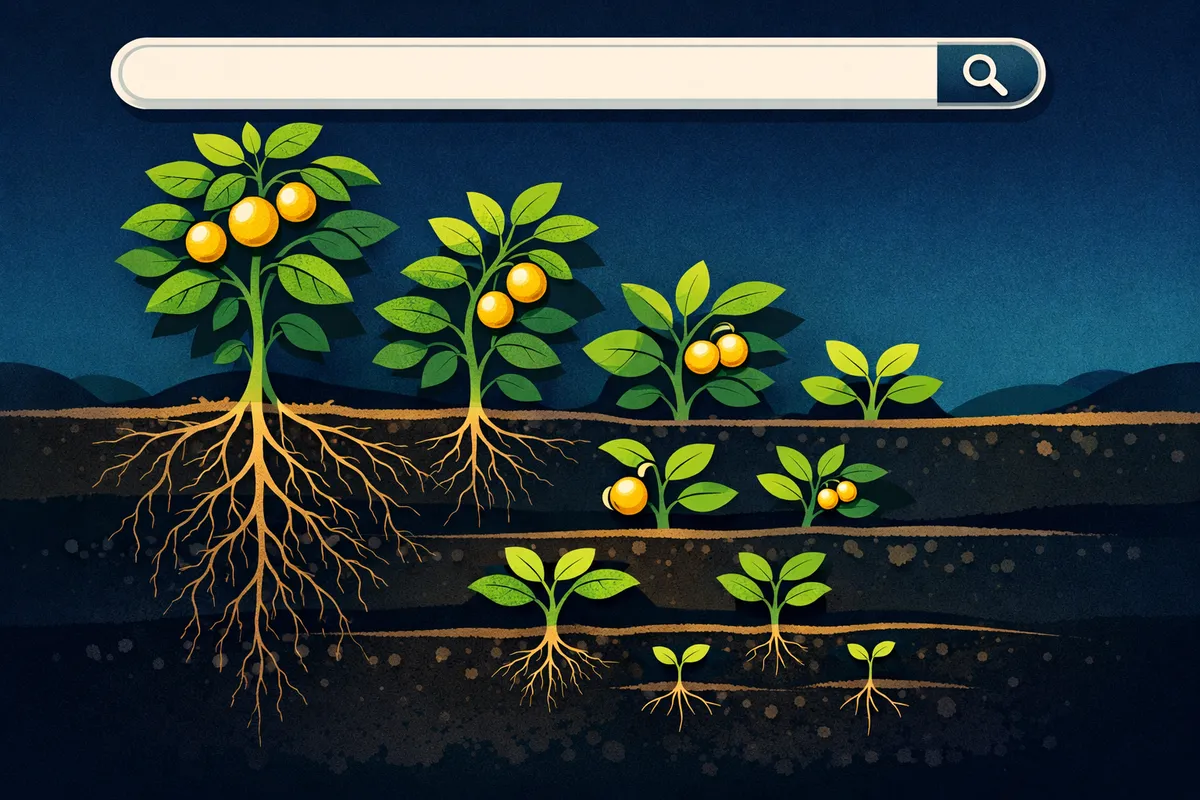
Why Early-Stage Startups Have an Advantage
Focus
You're not trying to serve every use case. You're not responsible for thousands of pages across a massive website. You're not constrained by legacy technical decisions. You can build for SEO from day one.
Differentiation
You're not competing on the same keywords as established companies yet. There's a whole layer of undercompeted keywords where people are actively searching and established players haven't bothered showing up. You can own these keywords.
Speed
Your product is new. Your perspective is fresh. You can write better content about your space faster than incumbents because you're not weighed down by outdated thinking. You understand the newest problems. You can articulate them better than the company that's been selling the same solution for ten years.
Community
Startups have fans. When you create great content, those fans share it, link to it, mention it, drive traffic to it. This accelerates your SEO progress because Google sees signals that people are engaging with your content.
These advantages are real but temporary. In three to five years, an established competitor will probably beat you on the big keywords. But in year one and year two, you can absolutely own specific segments of search.
Keyword Research: Finding Low-Competition, High-Intent Terms
The biggest mistake early-stage founders make with SEO is trying to rank for high-volume keywords. "Email marketing tool" has tens of thousands of searches a month. Mailchimp ranks number one. You will not beat Mailchimp.
Instead, look for keywords where three things are true:
1. People are actually searching for it (100+ monthly searches) 2. There's not a dominant, entrenched result blocking you 3. The search intent matches what you're selling (informational or transactional)
Example: Email Marketing for Nonprofits
| Keyword | Monthly Searches | Competition | Your Chance |
|---|---|---|---|
| "email marketing" | 90,000 | Impossible | Skip |
| "email marketing for nonprofits" | 1,200 | High | Possible in 6-12 months |
| "how to grow a nonprofit mailing list" | 320 | Low | Own it in 8-12 weeks |
| "donor email templates" | 210 | Very low | Own it in 4-8 weeks |
| "nonprofit newsletter best practices" | 180 | Low | Own it in 6-10 weeks |
The Research Process
1. Start with your customer. Who are they? What problems do they have? What are they searching right now? 2. Use free tools. Google Search Console (if you have traffic), Google Keyword Planner, Ubersuggest free tier, AnswerThePublic 3. Use paid tools if available. Ahrefs, SEMrush, or Moz for competition analysis 4. Talk to customers. What did they search before finding you? What language do they use to describe the problem?
Long-tail keywords are your friend. "How to build" has massive competition. "How to build a community without hiring" has almost no competition and somebody searches for it every day.
The paradox of early-stage SEO is that the biggest opportunities are often the least obvious keywords. Not "my industry is broken." Instead: "how to fix the specific problem in my industry when you're a solo founder with no budget." Someone searching for that is your customer. Nobody else is trying to rank for it. You can own it in eight weeks.

Topical Authority: Owning a Niche
Google's algorithm no longer just looks at a page in isolation. It looks at your domain as a whole. It asks: is this website an authority on this topic? Does every page add depth? Is this a coherent library of knowledge or just random content?
Building Topical Authority in Three Steps
Step 1: Pick your topic. Choose one that's central to your product. - For a nonprofit email platform: community building and donor engagement - For an AI content tool: content creation with AI - You're not covering everything. You're covering one domain deeply.
Step 2: Create a pillar page. This is a comprehensive, long-form guide on the main topic. 3,000 to 5,000 words. Covers the big picture. Links to all your detailed content.
Step 3: Create cluster content. Go deep on specific subtopics. Each cluster article links back to the pillar page. The pillar page links to all cluster articles. You're creating a web of connected content.
Why the Math Works
If you have one pillar page and twenty cluster articles all about the same topic and all connected to each other, Google learns you're an authority. You start ranking for not just individual keywords but broader keywords within that space.
Timeline: You can establish authority on a niche topic in six to twelve months if you're strategic. That's 2-4 articles per month, consistently, on the same topic.
The Pillar-Cluster Content Model
The pillar-cluster model is the architectural pattern that builds topical authority.
Structure
Pillar page (the centerpiece): Covers the topic at the highest level. For a nonprofit email platform, the pillar page might be "The Complete Guide to Email Fundraising for Nonprofits." Every aspect covered: list building, segmentation, writing emails, measuring performance, automation.
Cluster articles (the depth): Each one goes deep on a specific subtopic:
- "Donor Segmentation Strategies That Actually Work"
- "Email Subject Lines That Get Opens From Donors"
- "Avoiding Spam Filters: A Nonprofit Guide"
- "How to Write Thank-You Emails That Increase Repeat Donations"
- "Monthly Newsletter Templates for Small Nonprofits"
Linking Structure
The linking is deliberate and non-negotiable:
- Pillar page links to every cluster article
- Every cluster article links back to the pillar page
- Cluster articles link to related cluster articles
- You're creating a tightly connected network
Benefit for users: They land on one article, see links to deeper articles, learn more. Benefit for Google: It sees the structure, understands the hierarchy, knows the pillar page is important.
Timeline
Building a pillar-cluster structure with one pillar and fifteen cluster articles takes two to three months of consistent effort. By month four, you start seeing SEO results. By month twelve, you're seeing significant traffic.
Technical SEO Basics Every Founder Should Handle
Technical SEO is the foundation. Without it, great content doesn't rank. But it's not complicated.
The Technical Checklist
- [ ] Page speed: Load time under 3 seconds. Use Google PageSpeed Insights to check. Optimize images, minimize code, enable caching.
- [ ] Mobile-friendly: Test on a real phone. Everything readable, buttons clickable, experience good on small screens. Google prioritizes mobile-friendly sites.
- [ ] Clean URL structure: `/blog/donor-email-templates` not `/blog/post?id=472&cat=3`. Use descriptive, keyword-rich URLs.
- [ ] Proper header hierarchy: One H1 per page. H2s for main sections. H3s for subsections. Headers help both readers and Google understand structure.
- [ ] HTTPS: Non-negotiable. Almost all hosting providers offer free SSL certificates.
- [ ] XML sitemap: Tells Google what to crawl. Most CMS platforms generate this automatically.
- [ ] robots.txt: Tells Google what not to crawl. Standard file, configure once.
- [ ] Schema markup: Code that tells Google what your content is about (product, article, FAQ, etc.). Helps you earn rich snippets in search results.
Implement these once and stop thinking about them. They're essential foundation, not ongoing work.
On-Page SEO: The Elements That Matter
On-page SEO is the optimization you make on each individual page. Not magic, but it matters.
Title Tags
The headline that shows up in search results. Rules:
- Include your target keyword
- Keep under 60 characters (longer gets cut off)
- Make it clear and click-worthy
- "Donor Email List Strategies for Nonprofits" beats "Our Guide"
Headers (H1, H2, H3)
- One H1 per page with your target keyword
- H2s for main sections, H3s for sub-sections
- Headers should clearly describe what the section covers
Internal Linking
Link from one page on your website to another. Two benefits:
1. Helps Google understand site structure and page importance 2. Helps users navigate to related content
When writing about nonprofit email strategies, link to your article about donor segmentation. Google sees the relationship. Users can read deeper.
Meta Descriptions
Short summaries under your title in search results. Not a ranking factor directly, but they affect click-through rate:
- Include your target keyword
- Keep to 155-160 characters
- Make someone want to click
- Accurately describe the content
Building Backlinks Without a Brand
Backlinks are links from other websites pointing to yours. Google uses backlinks as a signal of authority. More high-quality backlinks means more authority and better rankings.
Three Strategies That Work at Zero Budget
1. Original research. Conduct a survey of your target market. Publish the results with interesting insights. Industry blogs link to your research because it's valuable primary data.
Example: You're building a nonprofit email tool. You survey 200 nonprofits about their email practices. You publish a report: "The State of Nonprofit Email Marketing: 2026 Benchmarks." Nonprofit blogs, publications, and consultants link to it as a reference.
2. Expert commentary. Journalists need sources. Sign up for HARO (Help a Reporter Out) or similar platforms. When a journalist writes about your industry, pitch yourself as an expert. They include your quote and link to your site.
3. Linkable resources. Create something so useful that people reference it naturally:
- A comprehensive guide that becomes the go-to reference
- A free template or spreadsheet for your target audience
- An original framework or methodology with a memorable name
Building backlinks without a brand takes time. But it's compounding. Once you have authority on your topic, getting links gets easier because you're relevant and credible.
Local SEO If You Serve Specific Markets
If you serve specific geographic markets, local SEO matters. When people search for your service in their area, you want to appear.
Local SEO requirements: - Google Business Profile (free, essential) - Consistent NAP (Name, Address, Phone) across all directories - Local content mentioning your service areas - Reviews from local customers - Listings in local business directories
If you're not serving specific geographic markets, skip this section entirely.
Measuring SEO: What to Track and When to Expect Results
Metrics That Matter
| Metric | What It Tells You | When to Expect Movement |
|---|---|---|
| Keyword rankings | Are you becoming visible? | Month 2-4 |
| Organic impressions | Is Google showing your pages? | Month 3-6 |
| Organic traffic | Are people clicking through? | Month 4-8 |
| Organic conversions | Is traffic turning into leads? | Month 6-12 |
| Organic revenue | Is SEO driving business? | Month 9-18 |
Track monthly. SEO metrics don't change daily or weekly. Monthly tracking is sufficient and less anxiety-inducing.
Realistic Timeline
- Months 1-3: Build content. Expect minimal traffic. This is the planting phase.
- Months 3-6: Get indexed. Start ranking for long-tail keywords. See trickles of organic traffic.
- Months 6-12: Meaningful organic traffic. Pillar content ranking. Cluster articles supporting each other.
- Year 2: Conversions and revenue from organic search. SEO becomes a primary acquisition channel.
If you're not seeing results after twelve months, your keyword strategy is probably wrong. You're either targeting keywords with too much competition or keywords with no search volume. Go back to the foundation and focus on one niche topic.
Common SEO Mistakes Startups Make
1. Targeting big keywords too early. You're not beating the incumbents on "email marketing." Own "email marketing for nonprofits who are understaffed" first.
2. Spreading across too many topics. You write about email marketing, fundraising, donor retention, volunteer management. You're not an authority on any of them. Be ruthlessly focused on one topic.
3. Publishing without technical foundation. Great content on a slow, non-mobile-friendly site with broken links. Technical foundation matters. Fix it before you scale content.
4. Treating SEO as a side project. SEO requires consistency. Publishing every week for months. Building links. Optimizing. It's not a few hours here and there.
5. Changing strategy every month. SEO is a long game. Commit to a strategy. Execute for six months. Measure. Then adjust. Not before.
Related Guides
AI-Resistant Careers: Why the Trades Are the Opportunity of a Generation
Skilled trades are among the most AI-resistant careers in the economy. Here's why the labor shortage, wage growth, and data center boom make this the decade for trade businesses.
Content Systems That Scale: From First Post to Content Machine
One post is a start. A content system is an asset. Build a repeatable content operation that compounds without depending on any single creator.
Distribution Strategy: How Your Product Shapes Your Channels
The right marketing channel is a function of your product and customer. Learn how to match what you sell to how you reach people.