Our AI Customer Service Work in Detroit
- AI chatbot deployment for Metro Detroit automotive dealerships managing service appointment scheduling, recall status inquiries, parts availability questions, and financing FAQ responses across web, mobile, and SMS channels
- Virtual agent development for Detroit healthcare organizations providing after-hours patient communication, appointment scheduling, insurance accepted inquiries, and general health information within HIPAA-compliant architecture
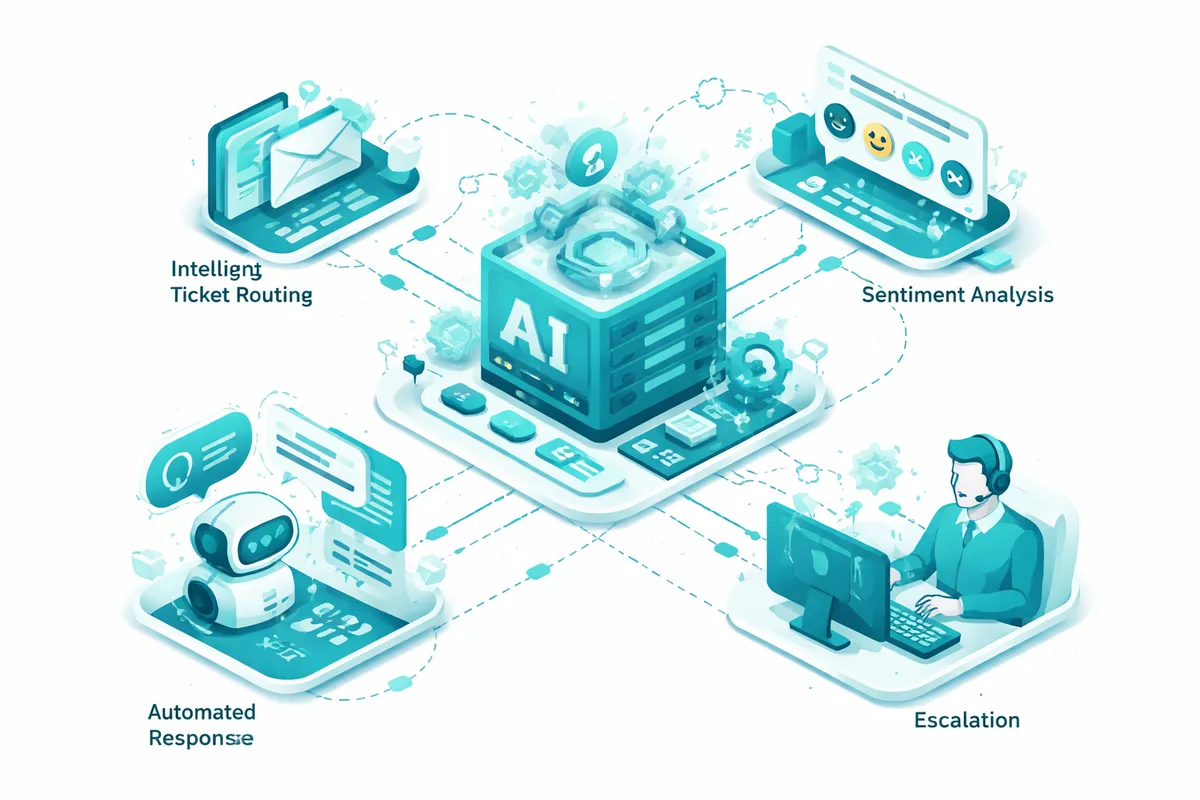
- Intelligent ticket routing and prioritization for Detroit manufacturers handling technical support inquiries from production line customers, distributors, and OEM program managers
- Multilingual customer service AI for Detroit businesses serving Spanish-speaking communities in Southwest Detroit and Arabic-speaking communities in Dearborn, with language-specific knowledge bases rather than generic translation
- Self-service portal development for Detroit residential property management companies handling tenant maintenance requests, lease questions, and rent payment inquiries around the clock
- Agent assist tools that deliver real-time knowledge suggestions to Detroit customer service teams during live conversations, reducing handle time and improving response consistency
- Sentiment detection and escalation triggers that identify frustrated or distressed customers from conversation signals and route them to priority human attention
- Integration with Dealertrack, CDK Global, Reynolds and Reynolds, Salesforce Service Cloud, and other platforms used by Metro Detroit automotive and business customers
Industries We Serve in Detroit
Automotive. Detroit dealerships and automotive suppliers handle enormous volumes of service scheduling, recall inquiry, parts availability, and technical support questions. AI manages routine interactions instantly, routing complex warranty disputes or engineering questions to the specialists equipped to handle them. For dealerships in the Tri-County area, AI customer service extends the effective service hours without overnight staffing costs and handles the high call volume that leaves customers on hold during peak periods.
Healthcare. Henry Ford Health, Detroit Medical Center, Beaumont Health, and the region's community health centers and urgent care networks need after-hours patient communication, appointment management, and care navigation that reduces call center burden without reducing patient access. AI handles pre-authentication inquiries and administrative questions efficiently, routing anything involving PHI or clinical judgment to authenticated channels or human staff. All implementations include HIPAA-compliant architecture and BAA coverage across every vendor.
Manufacturing. Detroit manufacturers with B2B customer service needs use AI to handle technical specification questions, order status inquiries, and first-tier troubleshooting for production customers and distributors. When a customer needs to know whether a component meets a specific tolerance requirement at 7 AM before a production run, AI provides the answer from your documented specifications instantly. Complex questions route to application engineers with the appropriate context already captured.
Real Estate and Property Management. Detroit's residential property management sector, growing with the city's development activity in Midtown, Corktown, and across the neighborhoods undergoing revitalization, uses AI for tenant inquiry management, maintenance request intake, and lease question resolution. A tenant who needs to report a maintenance issue at midnight gets an immediate logged response rather than waiting until business hours.
Technology. TechTown and Michigan Central campus tech companies use AI customer service to scale their support operations as their customer bases grow. For startups signing enterprise customers, AI ensures the support experience those customers receive is professional and responsive from day one, before a full support team is in place.
Retail. Detroit retailers, from Eastern Market vendors with growing online stores to downtown shops expanding their digital presence, use AI for order status, product questions, and return inquiries outside business hours.
What to Expect
Discovery. We review your existing support ticket data, FAQ content, and product documentation to understand the inquiry types your customers bring most frequently and the knowledge your team uses to resolve them. We identify the inquiries AI can handle immediately, those requiring escalation logic, and those that should always route to humans. For automotive clients, we assess dealer management system integrations. For healthcare clients, we map PHI boundaries and BAA requirements before any other step.
Design and Training. We build conversation flows from real customer scenarios in your support history, not hypothetical templates. We train the AI on your specific products, your policies, and the language your customers use. For Detroit multilingual requirements, we build separate language-specific knowledge bases. We design escalation paths that are prominent and easy to use, so customers who need a human can reach one immediately at any point.
Implementation and Testing. We deploy first in a test environment, running real customer scenarios through the system before any customer sees it. We conduct structured testing with your support team to validate that common scenarios are handled correctly. For automotive clients, we test scheduling workflows end-to-end with your DMS integration. We do not go live until the system performs accurately on your most common inquiry types.
Launch and Optimization. We monitor closely through the first weeks of live operation, identify failure patterns, and improve the AI based on real interaction data. Sentiment escalation thresholds are calibrated against actual customer interaction signals. We review performance monthly and evolve the system as your products and policies change.
Detroit Customers Need Fast, Accurate Answers. AI Delivers Them.
Running Start Digital builds AI customer service that matches the reliability and precision Detroit businesses are known for. Contact us to start the conversation about your customer support operation.