Our Business Intelligence Services in Atlanta
- Data source audit mapping every system in your technology stack, the data each system generates, the quality of that data, and the integration requirements for consolidation
- Data warehouse design and implementation: selecting the right architecture for your data volumes, query requirements, and growth trajectory; common choices for Atlanta clients include Snowflake, BigQuery, and Redshift
- ETL and data pipeline development: building the automated data flows that extract from source systems, transform and clean data, and load it into your data warehouse on schedules appropriate to your refresh requirements
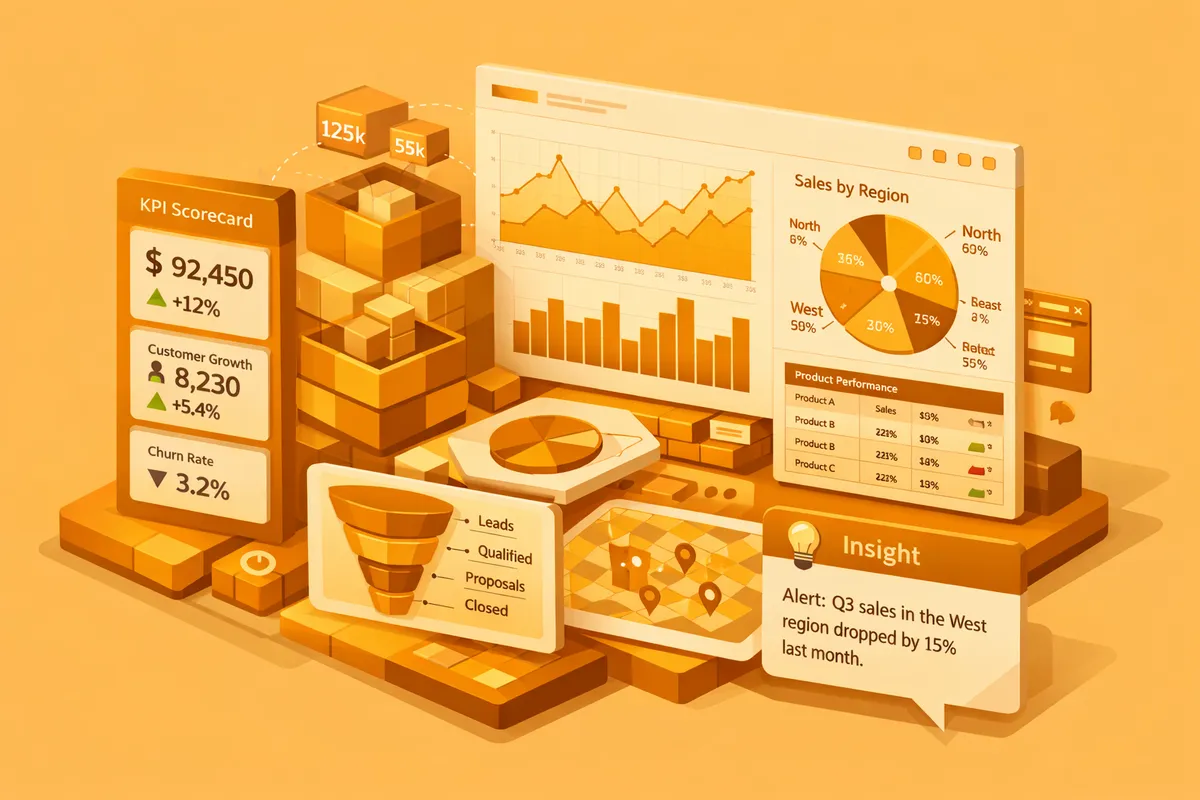
- Executive KPI dashboard design: working with your leadership team to identify the five to ten metrics that drive the most important decisions, then building dashboards that show those metrics clearly with current data
- Operational dashboards for Atlanta-specific business functions: patient flow and capacity for healthcare clients, production and quality metrics for manufacturers, shipment velocity for logistics companies, and revenue attribution for marketing-intensive businesses
- Financial performance analytics: revenue trending, margin analysis, cost center performance, and the financial KPIs that Atlanta's investor and board communities expect in board packages
- Sales pipeline and performance reporting: deal stage conversion rates, rep performance benchmarks, win/loss analysis, and forecasting models for Atlanta B2B and enterprise sales organizations
- Marketing attribution: connecting digital marketing spend across Google, Meta, LinkedIn, and other channels to actual revenue generated using proper multi-touch attribution models
- Healthcare analytics for Atlanta practice networks and health systems: patient acquisition by channel, appointment conversion rates, referral pattern analysis, and HIPAA-compliant clinical outcomes reporting
- Self-service analytics implementation: enabling business users to explore data, answer ad-hoc questions, and create their own views without engineering support, using tools like Looker, Metabase, or Power BI's self-service layer
- KPI framework design: defining the specific metrics, calculation methodology, update frequency, and accountability ownership for every key performance indicator in your organization
Industries We Serve in Atlanta
Fintech and Financial Services Atlanta's Midtown fintech corridor and Buckhead financial services community operate at the intersection of high-growth ambition and regulatory accountability that makes business intelligence both strategically valuable and technically complex. Fintech companies need BI that tracks customer acquisition cost, activation funnel conversion, feature engagement, churn prediction, and lifetime value simultaneously across customer segments. Financial services firms need BI that satisfies both management reporting requirements and regulatory reporting obligations. We build financial services BI with the appropriate data governance and access controls that regulated industries require alongside the analytical power that competitive advantage demands.
Healthcare Systems and Life Sciences Atlanta's healthcare ecosystem, anchored by Emory Healthcare, Piedmont Healthcare, Northside Hospital, Children's Healthcare of Atlanta, and Grady Memorial, plus the health technology companies building around them, requires business intelligence that navigates HIPAA constraints while delivering the operational and clinical insights that health system leadership needs. Healthcare BI must separate PHI appropriately in the data architecture, implement role-based access controls that limit data visibility to appropriate personnel, and build analytical capabilities that improve operational performance without creating privacy or regulatory risk. We have built healthcare BI for Atlanta-area clients with these requirements as design foundations.
Logistics and Supply Chain Atlanta's logistics sector, serving the Southeast from the Hartsfield-Jackson corridor and the I-85/I-75 distribution network, needs BI that provides real-time operational visibility across freight volumes, carrier performance, warehouse capacity, and delivery performance simultaneously. Logistics BI must handle the data volumes generated by high-transaction operations, refresh frequently enough to support operational decisions, and aggregate across carriers, warehouses, and customers in ways that give operational managers the situational awareness their roles require.
SaaS and Technology Companies The companies building at Tech Square, ATDC, and Atlanta Tech Village need product and business analytics infrastructure that tracks the metrics defining SaaS business health: trial conversion, feature activation, cohort retention, churn, and net revenue retention. We build SaaS BI for Atlanta technology companies that connects marketing acquisition data to product usage behavior to revenue outcomes, giving founders and growth teams the complete picture they need to make product, marketing, and sales decisions confidently.
Retail and Consumer Brands Atlanta's consumer brands, from DTC companies with national aspirations to established retail businesses with multiple metro-area locations, need BI that connects sales performance, inventory levels, marketing spend, and customer behavior data into a unified operational view. Retail BI must handle the seasonality and promotional complexity that characterizes consumer businesses and must surface insights about customer lifetime value, product mix, and channel performance that inform both tactical and strategic decisions.
Real Estate and Property Management Atlanta's active real estate market, spanning commercial development, residential property management, and the growing proptech sector, needs BI that tracks portfolio performance, occupancy rates, lease economics, and maintenance costs across properties and portfolios. We build real estate BI for Atlanta property companies that gives asset managers and operators the performance visibility their investors and lenders expect.
What to Expect
Discovery and Data Audit We begin by mapping your complete data landscape: every system generating data, the quality and completeness of that data, the frequency of updates, and the integration requirements for each source. We also interview your leadership and operational teams to understand the decisions they currently make without sufficient data visibility, which drives the BI prioritization.
Architecture Design We design the data warehouse architecture, ETL pipeline structure, and dashboard framework before building anything. For Atlanta healthcare and financial services clients, we include data governance and access control design at this stage. You review and approve the architecture before implementation begins.
Phased Development We build in phases, delivering working dashboards at each milestone rather than waiting for the complete system. This gives your team immediate value and creates feedback loops that ensure the final system matches your actual analytical needs.
Training and Adoption Every BI implementation includes training for the teams who will use the dashboards and, for self-service deployments, training on how to explore data independently. Adoption is the metric that matters; dashboards nobody opens produce no value.
Ongoing Support Monthly maintenance retainers cover pipeline monitoring, platform updates, new metric additions, and dashboard refinements. Quarterly strategy reviews assess what new analytical capabilities would deliver the most value as your business evolves.