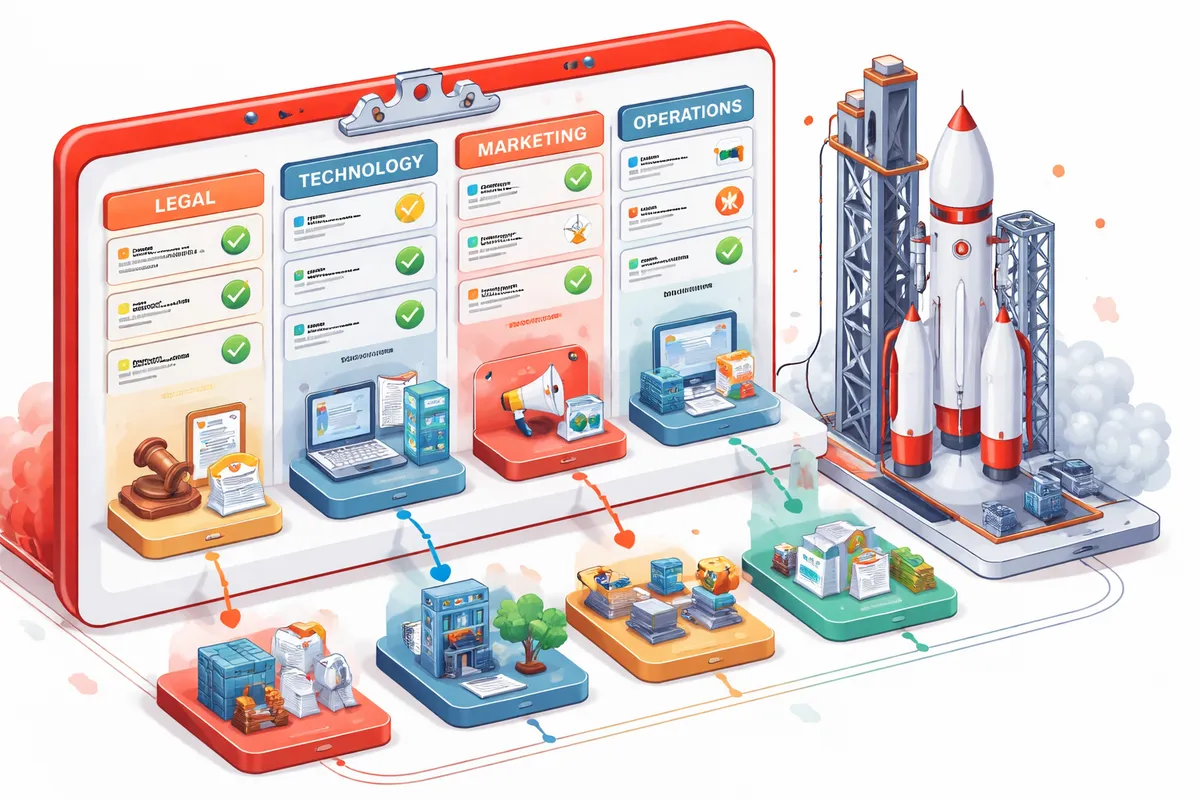
Pre-Launch: Marketing Preparation (4 to 6 Weeks Before)
Content and SEO Setup
Search engine visibility starts before launch. Every week you wait to set up SEO foundations is a week of lost compounding.
- [ ] Publish your marketing website with core pages: home, features or product, pricing, about, and contact
- [ ] Set up Google Search Console and submit your XML sitemap
- [ ] Set up Google Analytics 4 with conversion tracking for signups and demo requests
- [ ] Publish 3 to 5 blog posts targeting your primary keywords (focus on problems your product solves)
- [ ] Create your Google Business Profile if your startup serves local customers
- [ ] Write and schedule launch-day social media posts across all planned platforms
- [ ] Prepare your launch announcement email with clear value proposition and call to action
- [ ] Draft your Product Hunt listing with compelling tagline, description, and media assets (if applicable)
- [ ] Set up Open Graph and Twitter Card meta tags so your pages look professional when shared
Audience Building
Your launch audience determines your launch results. Start building it 4 to 6 weeks before launch day, not the day before.
- [ ] Set up email capture on your marketing site with a compelling incentive (early access, discount, or exclusive content)
- [ ] Build a pre-launch waitlist or beta program and promote it across your channels
- [ ] Identify and personally reach out to 20 to 50 potential beta users who match your ideal customer profile
- [ ] Connect with 5 to 10 journalists, bloggers, or newsletter writers who cover your space
- [ ] Join relevant communities on Reddit, Discord, Slack, and X where your target customers spend time
- [ ] Begin posting valuable, non-promotional content in your niche communities to build credibility
- ] Start a [social media presence with consistent posting 3 to 4 weeks before launch
- [ ] Reach out to 10 potential launch day supporters who will share, comment, and engage on your launch posts
Sales and Support Infrastructure
When new users sign up on launch day, your systems need to handle them automatically. Manual onboarding does not scale past the first 20 signups.
- ] Set up your [CRM (HubSpot free tier, Attio, or Close for early-stage startups)
- ] Create automated [email sequences for new signups: welcome, onboarding steps, and check-in at day 3 and day 7
- [ ] Write help documentation and FAQ covering the top 20 questions new users will have
- [ ] Set up customer support channel: email inbox, live chat (Intercom or Crisp), or help desk (Linear, Freshdesk)
- [ ] Create internal playbooks for handling common customer questions and issues
- [ ] Prepare your pricing page with clear plan names, features per tier, and a recommended plan highlighted
- [ ] Test the complete signup-to-onboarding flow by going through it yourself on a fresh browser and device
Launch Week
Final Checks (5 to 7 Days Before)
These checks catch the problems that would embarrass you on launch day. Do not skip them.
- [ ] Run through the entire user journey manually: landing page to signup to onboarding to core feature usage to payment
- [ ] Test signup, payment, and core features on mobile devices (both iOS and Android)
- [ ] Verify all automated emails trigger correctly with proper content and formatting
- [ ] Confirm analytics is tracking all key events: page views, signups, activation, and payment
- [ ] Brief your team on launch day roles: who monitors errors, who responds to support, who handles social media
- [ ] Prepare a "known issues" document with workarounds for bugs you are aware of but chose not to fix pre-launch
- [ ] Schedule all launch communications: emails, social posts, community posts, and personal outreach
- [ ] Verify that your server can handle at least 3x your expected launch traffic
- [ ] Prepare a simple launch day metrics dashboard showing signups, activations, errors, and server health
Launch Day Execution
Launch day is execution, not strategy. Everything should be prepared. Your job is to press buttons and respond fast.
- [ ] Deploy the final production build at least 2 hours before your planned announcement time
- [ ] Verify the production environment is working by completing a full signup and payment flow
- [ ] Send your launch announcement to your email list
- [ ] Publish launch posts on all social media platforms
- [ ] Submit to Product Hunt at 12:01 AM Pacific if planned (this is when the daily listing resets)
- [ ] Post in relevant communities with authentic, non-spammy messages explaining what you built and why
- [ ] Send personal emails to your top 20 contacts asking them to try the product and share feedback
- [ ] Monitor error tracking (Sentry) and server health every 30 minutes throughout the day
- [ ] Respond to every piece of user feedback within 2 hours
- [ ] Document every bug report, feature request, and piece of feedback in a single spreadsheet or issue tracker
Post-Launch (Days 2 Through 7)
The week after launch determines whether your initial momentum converts to sustained usage.
- [ ] Send a personal follow-up email to everyone who signed up on launch day within 48 hours
- [ ] Address the top 5 bugs and issues reported by users (ship fixes daily during launch week)
- [ ] Reach out to your most engaged early users and ask for testimonials or reviews
- [ ] Analyze launch metrics: total signups, activation rate (percentage who completed onboarding), day-1 retention, and revenue
- [ ] Write a launch retrospective documenting what worked, what did not, and what you would change
- [ ] Thank everyone who supported the launch publicly on social media
- [ ] Set 30-day goals based on launch performance data
Post-Launch: First 30 Days
Product Iteration
Your MVP is just the starting point. The first 30 days are about learning what matters and shipping fast.
- [ ] Ship fixes for the top 5 user-reported issues within the first two weeks
- [ ] Implement the single most-requested feature from user feedback
- [ ] Set up automated user feedback collection (in-app surveys using Canny, UserVoice, or a simple Typeform)
- [ ] Establish a weekly release cadence so users see consistent improvement
- [ ] Review your activation funnel: where do users drop off between signup and experiencing core value?
Growth Foundation
Launch-day traffic fades fast. Start building sustainable acquisition channels in week two.
- [ ] Analyze which acquisition channels drove the most signups and which produced the most activated users
- [ ] Double your investment in the top 2 performing channels
- ] Set up retargeting ads for website visitors who did not sign up ([PPC advertising can recapture 10 to 15% of lost visitors)
- [ ] Publish 2 to 3 more blog posts targeting keywords your customers search for
- [ ] Reach out to 10 potential partners, integration partners, or complementary products for co-marketing
- [ ] Begin building a referral program if your product has natural sharing mechanics
Operations and Finance
Operational discipline from day one prevents painful cleanups later.
- [ ] Review and optimize your onboarding email sequence based on open rates, click rates, and activation data
- [ ] Document your most common customer support interactions and create template responses
- [ ] Set up basic financial reporting: monthly recurring revenue (MRR), burn rate, and runway in months
- [ ] Schedule monthly metrics reviews with your co-founder or team
- [ ] Review your tech infrastructure costs and right-size any over-provisioned services
Launch Budget Breakdown
Here is a realistic budget breakdown for a bootstrapped startup launch:
| Category | Budget Range | Notes |
|---|---|---|
| Legal (LLC, trademark, ToS) | $500 to $2,500 | DIY legal is cheaper but riskier |
| Domain and hosting | $20 to $200/month | Vercel free tier covers most MVPs |
| Email tools | $0 to $50/month | Most tools have generous free tiers |
| Analytics and monitoring | $0 to $100/month | PostHog and Sentry have free tiers |
| Design and branding | $0 to $5,000 | DIY with Figma or hire a designer |
| Launch marketing | $0 to $2,000 | Organic channels first, ads second |
| Total pre-launch | $520 to $9,850 | Most bootstrapped launches fall under $3,000 |
Frequently Asked Questions
When is a startup ready to launch?
When your core feature works reliably for your target user. Not when every feature is built. Not when the design is pixel-perfect. Launch when you can deliver your primary value proposition without critical bugs. Everything else can be improved post-launch based on real user feedback. If you have been building for more than 3 months without launching, you are likely over-building.
Should I do a soft launch or a big coordinated launch?
Both. Soft launch to a small beta group of 10 to 30 users 2 to 4 weeks before your public launch. Use that period to find and fix issues, refine your onboarding flow, and collect early testimonials. Then execute a coordinated public launch with your full marketing push, community posts, and Product Hunt submission.
How much should I spend on launch marketing?
For a bootstrapped startup, budget $0 to $2,000 for launch marketing. Your primary launch channels should be free: your email waitlist, social media accounts, communities you have been active in, and your personal network. Save your paid marketing budget for post-launch when you have data showing which channels convert.
What if my launch does not go well?
Most launches are underwhelming. This is normal and expected. The median Product Hunt launch generates fewer than 100 signups. The goal of launch day is not viral growth. The goal is getting real users into your product who give you feedback. If 10 people use your product on launch day and 3 come back the next day, you have validated that something is working. Build from there.
How long should the active launch period last?
Active launch promotion should run 1 to 2 weeks. After that, shift from launch mode to sustained growth mode. The launch gets you initial users and attention. Your product quality, ongoing content marketing, and customer experience keep them and attract more. Do not stay in "launch mode" for months. It is not sustainable and signals to the market that you are still trying to get off the ground.
What are the biggest mistakes founders make during launch week?
The three most common mistakes are: (1) not having analytics set up, so you cannot tell what is working, (2) not responding to user feedback fast enough, causing early adopters to lose interest, and (3) spending all their energy on acquisition and none on activation, resulting in high signup numbers but low retention. Track your activation rate (the percentage of signups who complete onboarding and use your core feature) as closely as you track total signups.