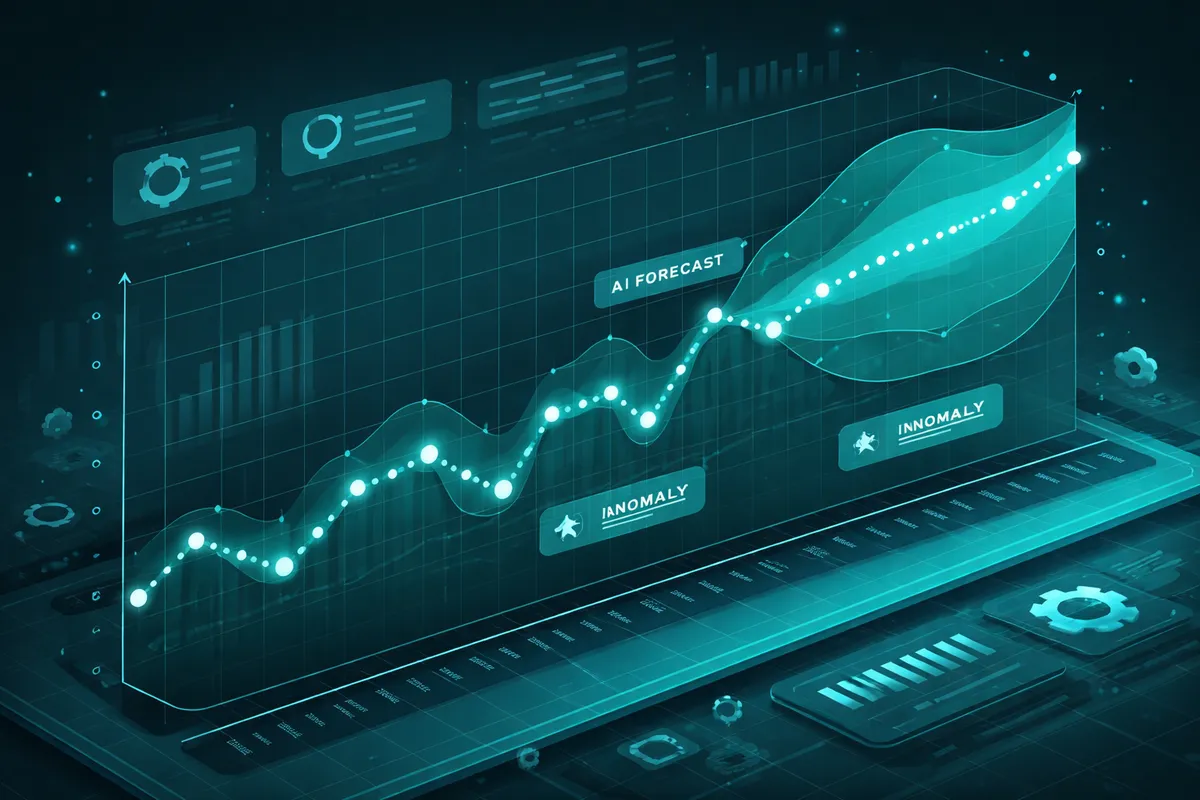
What Is Predictive Analytics?
Predictive analytics uses statistical algorithms, machine learning, and data mining to forecast future outcomes based on historical data. It goes beyond reporting what happened to identifying patterns and projecting them forward with quantified confidence levels.
Applications span every business function. Demand forecasting predicts how much inventory you need next month. Customer churn prediction identifies which subscribers are likely to cancel before they do. Lead scoring ranks prospects by their probability of converting. Fraud detection flags suspicious transactions in real-time. Price optimization calculates the price point that maximizes revenue or margin. Workforce planning anticipates hiring needs based on growth trends.
The power of predictive analytics lies in proactive decision-making. Instead of reacting to last quarter's churn numbers, you intervene with at-risk customers before they leave. Instead of discovering a stockout after it happens, you adjust inventory before demand spikes. Businesses using predictive analytics consistently outperform those relying on backward-looking reports alone because they act on what is coming rather than what has already passed.
What Predictive Analytics Looks Like in Practice
A B2B SaaS company using predictive analytics might have a churn model that scores every customer on a 0 to 100 risk scale each week. Customers scoring above 70 trigger automatic outreach from the customer success team. The model considers usage frequency, support ticket volume, contract renewal timing, engagement with emails, and feature adoption patterns.
The result: the company reduces monthly churn from 4.2% to 2.8%, which for a business with $2M in monthly recurring revenue represents $336,000 in preserved annual revenue. The predictive model cost $60,000 to build and $12,000 per year to maintain. The ROI is clear within the first quarter.
The Machine Learning Pipeline
Predictive analytics is not a single tool. It is a pipeline that includes data collection and cleaning, feature engineering (selecting which variables matter), model training and validation, deployment into production systems, monitoring for accuracy drift, and periodic retraining as new data accumulates.
Each step requires expertise. Data scientists design the models. ML engineers deploy them. Data engineers maintain the pipelines. This infrastructure is the primary cost driver and the reason predictive analytics requires meaningful investment.
Side-by-Side Comparison
| Factor | Business Intelligence | Predictive Analytics |
|---|---|---|
| Primary Question | What happened? | What will happen? |
| Cost | $500 to $5,000/month for platforms | $20K to $150K+ for custom models |
| Implementation Time | 2 to 6 weeks for dashboards | 6 to 16 weeks for initial models |
| Data Requirement | Structured historical data | 12+ months of clean historical data |
| Team Required | BI analyst, data engineer | Data scientist, ML engineer, data engineer |
| Customization | Dashboard configuration | Models built for specific outcomes |
| Scalability | Scales with data sources | Models improve as data volume grows |
| Maintenance | Dashboard updates, pipeline management | Model retraining, accuracy monitoring |
| Time to Value | Days to weeks | Weeks to months |
| ROI Visibility | Immediate (better decisions from visibility) | Delayed but often larger (prevented losses, optimized outcomes) |
When to Choose Business Intelligence
BI is the right starting point for businesses in several situations.
You lack visibility into basic metrics. If you cannot answer "What were last month's sales by channel?" in under 60 seconds, you need BI before anything else. Predictive models built on poorly understood data produce unreliable predictions.
Your team needs a single source of truth. When different departments report different numbers for the same metric, BI creates alignment. A unified dashboard eliminates the "my spreadsheet says X" problem that wastes hours in every meeting.
You are still building data infrastructure. Predictive models require clean, centralized, well-structured data. BI projects naturally create the data pipelines, cleaning processes, and warehousing that predictive analytics depends on. Building BI first creates the foundation.
Stakeholders need visual reporting. Board members, investors, and department heads need clear performance data. BI dashboards provide this in a format that is accessible to non-technical audiences.
Budget constraints make predictive modeling premature. If your data budget is under $5,000 per month, invest in BI. You will get more decision-making value per dollar from dashboards than from predictive models at this spending level.
Your primary need is understanding what happened and why. Root cause analysis, trend identification, and performance benchmarking are BI strengths. Many businesses operate effectively for years with nothing more than well-designed dashboards and a team that reviews them weekly.
When to Choose Predictive Analytics
Predictive analytics earns its investment when specific conditions exist.
You have at least 12 months of clean historical data. Machine learning models need training data. Less than 12 months rarely provides enough signal for reliable predictions. Some applications (like demand forecasting with strong seasonality) need 24 to 36 months.
Decisions have significant financial impact worth optimizing. If a 5% improvement in churn prediction saves $500,000 annually, the $80,000 model development cost is easy to justify. If a 5% improvement saves $5,000, the math does not work.
You are ready to act on predictions. A prediction without action is a statistic. Before investing in predictive models, ensure your organization has processes to act on the output. A churn prediction is worthless if no one contacts the at-risk customers.
Your market moves fast and reactive decisions cost money. Inventory-heavy businesses, subscription companies, and financial services firms all face situations where being 30 days ahead of a trend translates directly to revenue or loss prevention.
You have outgrown what BI can tell you. When your dashboards consistently show "what happened" but your team keeps asking "what should we do next," that gap is what predictive analytics fills.
Competitive advantage depends on anticipation. In markets where multiple competitors have access to the same data, the company that predicts best wins. BI puts everyone on equal footing. Predictive analytics creates separation.
Building Both: The Recommended Path
BI is the foundation. Predictive analytics is the next floor. You need the first before the second works properly. Here is how to build both systematically.
Phase 1: BI Foundation (Months 1 to 3)
Week 1 to 2: Audit existing data sources. Identify where business data lives (CRM, accounting software, marketing platforms, spreadsheets) and assess quality.
Week 3 to 4: Build data pipelines. Connect data sources to a centralized warehouse. Clean and standardize formats. Establish automated refresh schedules.
Week 5 to 8: Design and deploy dashboards. Start with executive overview, then build department-specific dashboards for marketing, sales, operations, and finance.
Week 9 to 12: Refine and adopt. Train teams on dashboard usage. Incorporate feedback. Establish weekly data review rhythms.
Investment: $15,000 to $40,000 for setup, $500 to $3,000 per month ongoing.
Phase 2: Identify High-Value Predictions (Months 4 to 6)
With BI in place, you can see your business clearly. Now identify where predictions would add the most value. Common high-ROI prediction targets include:
Churn prediction: For subscription businesses. Typical ROI: 3 to 5x development cost in prevented revenue loss.
Demand forecasting: For inventory or capacity-constrained businesses. Typical ROI: 15 to 25% reduction in carrying costs or stockout losses.
Lead scoring: For sales teams with more leads than they can work. Typical ROI: 25 to 40% improvement in sales team efficiency.
Price optimization: For businesses with pricing flexibility. Typical ROI: 5 to 15% revenue increase with the same volume.
Rank opportunities by potential financial impact divided by implementation complexity. Start with the highest-impact, lowest-complexity prediction.
Phase 3: Predictive Model Development (Months 7 to 12)
Build your first predictive model targeting the highest-value opportunity identified in Phase 2. Follow the standard ML pipeline: data preparation, feature engineering, model training, validation, and deployment.
Start with a simple model. A logistic regression that predicts churn with 75% accuracy deployed in month 8 is more valuable than a deep learning model with 90% accuracy deployed in month 14. You can improve accuracy iteratively once the prediction pipeline is operational.
Investment: $20,000 to $80,000 for initial model, $5,000 to $15,000 per year for maintenance and retraining.
Phase 4: Expand and Optimize (Year 2+)
With one successful predictive model in production, expand to additional prediction targets. Each subsequent model is cheaper and faster to build because the data infrastructure, monitoring tools, and deployment pipelines already exist.
By the end of year two, a typical mid-market business might have BI dashboards covering all departments and 2 to 3 predictive models targeting their highest-impact business decisions. The combined data practice produces measurable ROI across revenue growth, cost reduction, and operational efficiency.
Industry-Specific Applications
E-Commerce and Retail
BI tracks sales by product, channel, and customer segment. Predictive analytics forecasts demand by SKU, identifies which customers will respond to promotions, and optimizes pricing in real-time. Retailers using predictive analytics reduce overstock waste by 20 to 30% and increase promotional campaign ROI by 15 to 25%.
SaaS and Subscription
BI monitors MRR, churn rate, expansion revenue, and feature adoption. Predictive analytics identifies at-risk accounts before they cancel, scores upsell opportunities, and forecasts revenue with 90%+ accuracy for the next quarter. The combination of BI visibility and predictive intervention is the standard for high-performing SaaS companies.
Professional Services
BI tracks project profitability, utilization rates, and pipeline value. Predictive analytics forecasts project timelines and budget overruns, identifies which proposals are most likely to close, and optimizes resource allocation across the team.
Manufacturing
BI reports on production output, quality metrics, and supply chain performance. Predictive analytics anticipates equipment failures before they happen (predictive maintenance), forecasts raw material needs, and optimizes production scheduling based on demand signals.
Common Mistakes When Building a Data Practice
Skipping data quality. Garbage in, garbage out applies to both BI and predictive analytics. Invest 30% of your data project budget in data cleaning and quality processes. It is not glamorous, but it determines whether everything built on top actually works.
Building models before understanding the data. BI reveals patterns, anomalies, and data quality issues that directly affect predictive model performance. Teams that skip BI and jump straight to prediction consistently struggle with unreliable models.
Ignoring organizational readiness. The best dashboard in the world is worthless if nobody looks at it. The most accurate prediction is wasted if nobody acts on it. Invest in training, process integration, and cultural change alongside technical implementation.
Over-engineering early. Start simple. A well-designed spreadsheet connected to three data sources is better than a $50,000 BI platform nobody uses. A basic prediction model in production is better than a complex one stuck in development.
Frequently Asked Questions
Can I start with BI and add predictive analytics later?
This is the recommended path. BI establishes the data pipelines, cleaning processes, and warehousing that predictive models depend on. Businesses that skip BI and jump straight to prediction often struggle because their underlying data is not reliable enough to train models on. Plan for BI first, then layer in predictive capabilities as your data matures and you identify high-value prediction opportunities.
What is the total cost of ownership for each approach?
BI platforms run $6,000 to $60,000 annually depending on users and data volume, plus $5,000 to $20,000 for initial setup. Predictive analytics costs $20K to $150K+ for initial model development, plus $5K to $20K annually for monitoring and retraining. Many businesses spend $30K to $80K total annually running both, with BI handling daily reporting and predictive models supporting strategic decisions.
Which option is better for small businesses?
Start with BI. Small businesses often lack the data volume that predictive models need to perform well. A clean dashboard showing your actual performance metrics drives more immediate value than a prediction model trained on limited data. As your data grows and you identify specific decisions where prediction would add significant value, predictive capabilities become viable and valuable.
How long before I see results with each approach?
BI dashboards deliver insights within 2 to 4 weeks of setup. The value compounds as your team builds the habit of checking data before making decisions. Predictive models take 6 to 16 weeks to build and validate, but the first accurate prediction that prevents a costly mistake or identifies a revenue opportunity justifies the entire investment. Most businesses report clear predictive analytics ROI within the first two quarters of deployment.
Does Running Start Digital help with both options?
Yes. We design BI dashboards and data infrastructure for businesses beginning their data journey. For businesses ready for the next level, we build custom predictive models that integrate with existing tools and workflows. We also help bridge the gap between the two, identifying exactly when and where predictive analytics will deliver meaningful ROI for your specific business. Our business software team can build the dashboards and our data science team builds the predictive models.
What tools does Running Start Digital use for BI and predictive analytics?
For BI, we work with whatever platform fits your existing stack and budget: Metabase for cost-conscious startups, Power BI for Microsoft-heavy organizations, Tableau for enterprises needing advanced visualization, and Looker for Google Cloud environments. For predictive analytics, we build custom models using Python, scikit-learn, TensorFlow, or PyTorch depending on the complexity of the problem. All models deploy into your infrastructure with monitoring dashboards so you can track accuracy over time.
Start Your Data Strategy
Whether you need visibility into what is happening today or predictions about what comes next, the right data strategy depends on where your business stands and what decisions need better information.
Running Start Digital builds both BI foundations and predictive analytics solutions. We help businesses start with the right approach, build incrementally, and achieve measurable ROI from their data investments.