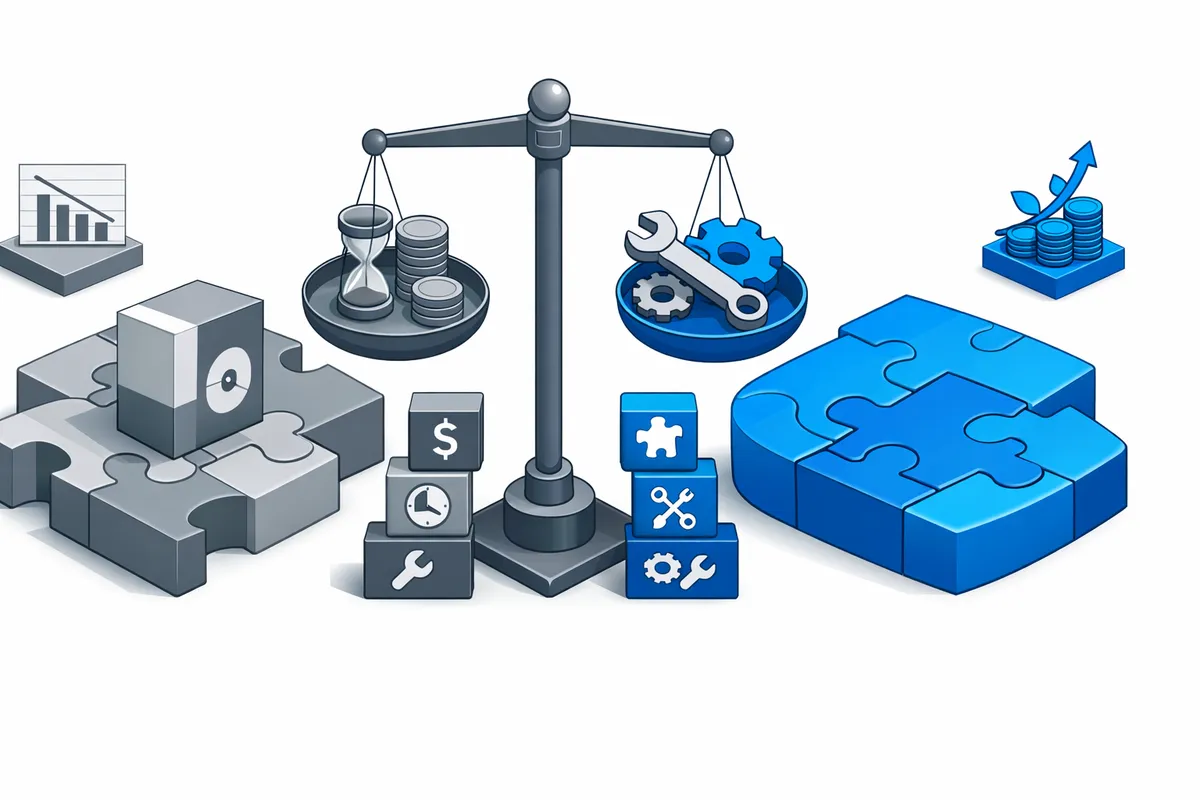
When Custom Software Creates Advantage
Custom software makes sense when your core business processes are unique and that uniqueness creates competitive advantage. If your workflow is fundamentally different from what off-the-shelf tools assume, forcing your team into standard workflows costs you efficiency and differentiation.
Strong Indicators for Custom Development
Your process IS your product. Companies where the software is the business (SaaS platforms, marketplaces, portals) need custom development by definition. But this also applies to service businesses where proprietary processes delivered through software create the customer experience. A financial advisory firm with a unique client onboarding process builds a custom portal. A logistics company with proprietary routing algorithms builds custom dispatch software.
You have outgrown existing tools. When your team has tried 3+ off-the-shelf solutions and each one fails on the same critical requirements, that is a signal. The market is telling you that your needs fall outside the standard use case. Common symptoms: excessive workarounds, manual processes that negate the tool's efficiency, and team frustration that drives low adoption.
Data is your competitive advantage. Businesses that collect unique data and use it to make better decisions than competitors need custom systems to capture, process, and act on that data. A retailer with proprietary demand forecasting, a healthcare provider with outcome prediction models, or a manufacturer with quality prediction systems all benefit from custom software built around their specific data.
Integration depth matters. When you need deep, bidirectional integration with legacy systems, proprietary databases, or specialized hardware, off-the-shelf tools struggle. Their integrations are designed for common platforms, not your custom ERP from 2012 or your proprietary manufacturing control system.
Vendor dependency is unacceptable. You control the roadmap, the data, and the integrations. No surprise price increases. No discontinued features. No forced migrations. No vendor acquisition that changes the product direction. For businesses where technology is core to operations, this control is worth the investment.
Examples of Custom Software That Creates Value
Internal operations platform. A 150-person professional services firm replaced 7 SaaS tools (project management, time tracking, resource allocation, invoicing, reporting, client portal, and document management) with one custom platform. Annual SaaS spend dropped from $180,000 to $35,000 in hosting and maintenance. More importantly, processes that required 4 tools and manual data transfer now happen in one system, saving an estimated 400 hours per month across the organization.
Customer-facing portal. A B2B manufacturer built a custom ordering portal that integrated with their inventory management, pricing engine, and shipping systems. Customers place orders, check availability, and track shipments in real time. The portal reduced order processing time from 48 hours to 15 minutes and cut order errors by 85%.
Proprietary analytics. A marketing agency built a custom reporting platform that pulls data from 12 different advertising and analytics platforms, applies proprietary attribution models, and generates client reports automatically. What previously took analysts 6 hours per client per month now takes 20 minutes of review. The custom analytics became a selling point that differentiated the agency from competitors using generic dashboards.
Cost Analysis: Short-Term vs Long-Term
Year 1 Comparison
| Factor | Off-the-Shelf (10 users) | Custom Software |
|---|---|---|
| Software/Development | $12,000 to $60,000 | $50,000 to $250,000 |
| Implementation/Setup | $5,000 to $15,000 | Included in development |
| Integration Work | $5,000 to $20,000 | Built into architecture |
| Training | $2,000 to $5,000 | $3,000 to $8,000 |
| Total Year 1 | $24,000 to $100,000 | $53,000 to $258,000 |
Off-the-shelf wins in year 1 by a significant margin in most cases.
5-Year Total Cost of Ownership
| Factor | Off-the-Shelf (10 to 20 users) | Custom Software |
|---|---|---|
| Subscriptions (cumulative) | $100,000 to $400,000 | $0 |
| Hosting/Infrastructure | Included | $30,000 to $60,000 |
| Maintenance/Updates | Included | $50,000 to $150,000 |
| Feature Development | $0 (accept what vendor ships) | $30,000 to $100,000 |
| Integration Maintenance | $15,000 to $50,000 | $10,000 to $30,000 |
| Productivity Cost of Workarounds | $50,000 to $150,000 | Minimal |
| Total 5-Year | $165,000 to $600,000 | $173,000 to $598,000 |
Over 5 years, the costs converge. Custom software has higher upfront costs but lower ongoing costs. Monthly subscription fees for business software compound, especially as you add users and require tier upgrades. The breakeven point typically falls between year 2 and year 4, depending on the complexity of the custom solution and the number of SaaS tools it replaces.
The productivity cost of workarounds is the most underestimated line item. It does not appear on any invoice, but it is real. Ten people spending 30 minutes per day on manual workarounds costs $65,000 per year at $35/hour.
When Custom Is Clearly Cheaper
Custom development becomes the financially obvious choice when: - You are replacing 5+ SaaS subscriptions with one system - Your team exceeds 20 users (per-seat SaaS pricing compounds) - You plan to use the software for 5+ years - Workaround costs exceed $50,000 annually - You need integrations that SaaS vendors do not support natively
The Hybrid Approach
Most businesses benefit from a combination. Use off-the-shelf tools for standard functions and build custom solutions for competitive differentiators. This approach minimizes total cost while maximizing the value of custom development investment.
What to Buy vs. What to Build
Buy these. Accounting (QuickBooks, Xero), email (Google Workspace, Microsoft 365), team chat (Slack), file storage (Google Drive, Dropbox), basic marketing (Mailchimp). These are commodity functions where custom development adds no competitive value.
Build these. Customer-facing portals, proprietary workflow tools, internal platforms that encode your unique processes, analytics dashboards with proprietary metrics, and integration layers that connect disparate systems. These are where your investment creates differentiation.
Evaluate case-by-case. CRM, project management, support tools, and booking systems. Sometimes off-the-shelf works perfectly. Sometimes your process is unique enough to warrant custom. The answer depends on how central the function is to your competitive advantage.
Making Hybrid Work
Integration between off-the-shelf and custom tools is critical. APIs, webhooks, and data synchronization ensure your systems work together seamlessly. We design architectures that combine the best of both approaches.
A typical hybrid architecture might include: - QuickBooks for accounting (off-the-shelf) - Custom client portal for customer interactions (custom) - HubSpot for marketing automation (off-the-shelf, integrated via API) - Custom analytics dashboard pulling from all systems (custom) - Slack for internal communication (off-the-shelf)
The custom components connect to the off-the-shelf tools through well-documented APIs. Data flows automatically. Your team works in one custom interface for their primary workflow while specialized functions (accounting, marketing) live in purpose-built tools.
For businesses that need help designing and implementing these integrations, our workflow automation services specialize in connecting systems that were not built to work together.
Making the Decision: A Practical Framework
Step 1: Audit Your Current Stack
List every software tool your team uses. For each one, note: - Monthly cost per user - Number of users - How well it fits your workflow (1 to 10) - Hours per week spent on workarounds - Integration pain points
This audit reveals where off-the-shelf tools serve you well and where they create friction.
Step 2: Identify Your Differentiators
Which business processes make you different from competitors? Which workflows create the most value for your customers? These are your candidates for custom development. Everything else can remain off-the-shelf.
Step 3: Calculate True Costs
Project total cost of ownership for both approaches over 3 to 5 years. Include subscriptions, per-seat costs at your projected team size, integration work, training, maintenance, and the productivity cost of workarounds. Many businesses are surprised to find that custom development is cheaper over a 3-year horizon when they account for all costs.
Step 4: Assess Your Technical Readiness
Do you have internal developers who can maintain custom software? If not, do you have a trusted development partner who can provide ongoing support? Custom software without maintenance capacity becomes a liability rather than an asset.
Step 5: Start Small
If the analysis points toward custom development, start with one high-impact module rather than replacing your entire tech stack. Build the custom client portal. Build the custom analytics dashboard. Prove value in one area before expanding. This reduces risk and generates internal buy-in for larger investments.
Frequently Asked Questions
At what company size does custom software make sense?
There is no universal size threshold, but patterns emerge. Companies with 10 to 20 employees typically start feeling the pain of off-the-shelf limitations. Companies with 20 to 50 employees often find that SaaS costs and workaround inefficiencies justify custom investment. Companies with 50+ employees almost always have at least one custom system. The real trigger is not size but process uniqueness and SaaS spend. A 15-person company spending $80,000 per year on SaaS tools with significant workarounds has a strong case for custom development.
How long does custom software development take?
Timeline depends on scope. A focused single-purpose application (customer portal, internal dashboard) takes 2 to 4 months. A comprehensive business platform replacing multiple SaaS tools takes 4 to 9 months. Complex systems with AI, real-time processing, or extensive integrations take 6 to 12+ months. We recommend phased delivery: launch a core version at the 3-month mark and add features in subsequent releases rather than waiting 9 months for a complete system.
What if my requirements change after development starts?
Requirements always change. Good development practices account for this through modular architecture, iterative development with regular review cycles, and clear change management processes. A change made in week 3 costs far less than the same change in month 6. This is why we use 2-week sprint cycles with demos and feedback sessions. Course corrections happen frequently and cheaply rather than rarely and expensively.
Can custom software integrate with our existing off-the-shelf tools?
Yes. Modern software development uses APIs (Application Programming Interfaces) to connect systems. Most SaaS tools provide APIs specifically for this purpose. A custom platform can read from and write to your CRM, accounting software, email platform, and other tools. Some legacy systems without APIs require custom integration approaches, but this is solvable in virtually every case. Integration is a standard part of custom development, not an afterthought.
What happens if the development company goes out of business?
This risk is real and manageable. Protect yourself by: ensuring all code lives in a repository you own (not the vendor's), maintaining documentation of the architecture and deployment process, avoiding proprietary frameworks that only one vendor understands, using common technologies with large developer communities, and getting deliverable code that any competent developer can understand and maintain. If you follow these practices, transitioning to a new development partner is straightforward.
Should I build custom software or hire more people to handle the manual work?
Compare the math directly. If manual processes require 2 people at $50,000/year each ($100,000 annually), and custom software costs $75,000 to build with $15,000/year in maintenance, the software pays for itself in under 12 months. Software also scales without proportional cost increases. Handling 2x the volume does not require 2x the software investment, but it does require 2x the people. For repetitive, rule-based processes, software almost always wins on cost and consistency.