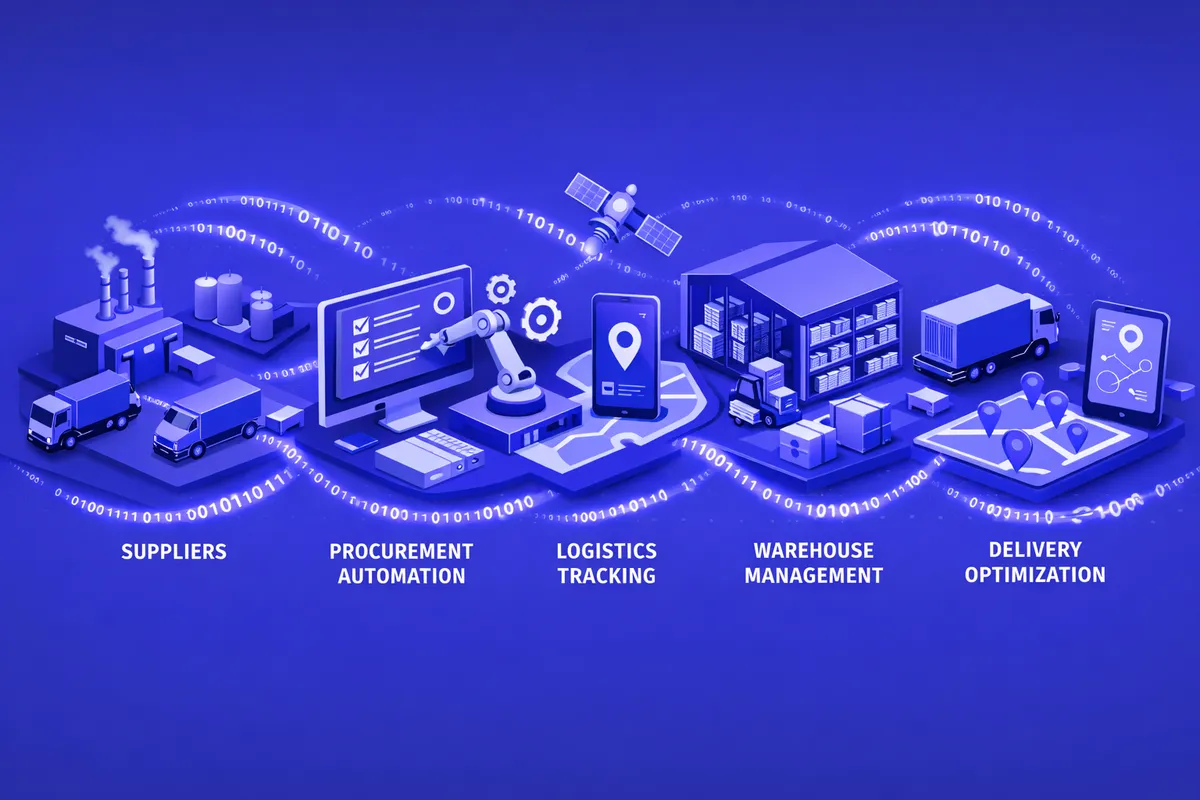
How AI Supply Chain Optimization Works
Machine learning models ingest data from every node in your supply chain: suppliers, warehouses, transportation networks, and demand signals. The system identifies patterns, predicts bottlenecks, and recommends actions before problems become visible to your team. The underlying architecture typically combines gradient-boosted decision trees (XGBoost, LightGBM) for demand forecasting, reinforcement learning for routing decisions, and anomaly detection models for disruption prediction. None of this is exotic. What matters is connecting the models to clean data and to the workflows where decisions actually get made.
Predictive analytics forecast demand at granular levels and propagate those forecasts through your supply network. Instead of a single quarterly demand forecast, AI generates daily forecasts by SKU, by region, by channel. These granular predictions improve accuracy from the typical 60 to 70 percent range to 85 to 92 percent. For a beverage distributor we worked with, moving from weekly regional forecasts to daily SKU-level forecasts reduced stockouts by 41 percent and cut emergency shipping costs from $180,000 to $42,000 per quarter.
AI optimizes order quantities, shipping routes, warehouse allocation, and supplier selection simultaneously. It factors in constraints that humans cannot balance mentally: cost targets, lead time variability, carbon goals, service level requirements, carrier capacity, and seasonal patterns. A human planner considers 3 to 5 variables when making a routing decision. The AI evaluates 30 or more simultaneously. The resulting recommendations are not magic. They are the output of an optimizer that can hold dozens of constraints in memory at once, which humans cannot.
The system learns continuously. Every shipment, every delay, every demand signal refines the models. After 6 months of operation, prediction accuracy typically improves another 5 to 10 percent beyond initial deployment. This continuous learning is why off-the-shelf solutions trained on generic data underperform custom models trained on your actual flow. Your supply chain has patterns that no aggregated dataset captures.
We build these capabilities as custom AI solutions designed around your specific supply chain topology, supplier relationships, and business constraints. Our AI integration services team also handles the connection layer between forecasting, your ERP, and the operational systems where decisions land.
Key Features and Capabilities
Disruption Prediction. AI monitors supplier performance, weather patterns, geopolitical signals, port congestion data, and logistics networks to predict disruptions days or weeks before they impact your operations. When a typhoon forms in the Pacific, the system calculates the probability of port delays in affected regions and recommends alternative routing before your competitors even notice the weather. Signals come from sources like project44, FourKites, and Everstream Analytics for logistics visibility, combined with your internal supplier performance data. Early warnings enable proactive mitigation that saves an average of $12,000 to $45,000 per avoided disruption for a mid-size importer, and 6-figure savings per event for larger operations.
Route and Carrier Optimization. Machine learning analyzes cost, speed, reliability, and capacity data to recommend optimal shipping routes and carriers for every shipment. A typical implementation evaluates 15 to 20 carrier options per shipment, factoring in real-time fuel costs, port congestion, and seasonal rate changes. Dynamic recommendations adjust as conditions change, saving 8 to 12 percent on total freight costs. For a distributor moving $4 million in freight annually, that is $320,000 to $480,000 returned to operating margin. Failure modes here are real: models that optimize cost without factoring in carrier reliability produce short-term savings and long-term customer service problems. Good implementations explicitly penalize carrier volatility.
Supplier Risk Scoring. AI evaluates supplier reliability based on historical performance, financial health indicators, geographic risk factors, and dependency concentration. Risk scores update continuously and inform sourcing decisions. If a key supplier's on-time delivery rate drops from 94 to 87 percent over three months, the system flags the trend and suggests backup suppliers before a critical failure occurs. Data sources include D&B financial health scores, Interos and RapidRatings resilience data, and your own PO and receipt records. The most common failure is scoring based solely on past performance, which misses forward-looking risks like supplier acquisitions, financial distress, or geographic exposure changes.
Demand-Supply Matching. Real-time optimization aligns production schedules, inventory positions, and procurement orders with current demand signals. The system processes point-of-sale data, web traffic trends, marketing campaign calendars, and seasonal patterns to generate forecasts that drive purchasing decisions. Excess inventory decreases 15 to 25 percent while service levels improve. The operational payoff shows up fastest in fast-moving SKUs. Slow-movers with long lead times require different model architectures, typically Bayesian approaches that handle sparse demand signals better than standard ML.
Scenario Planning. AI simulates supply chain scenarios: supplier failures, demand spikes, transportation disruptions, tariff changes. You see the impact of each scenario and prepare contingency plans with data instead of guesses. Before committing to a new supplier in Southeast Asia, the system models 50 scenarios including port closures, currency fluctuations, and demand variations. You make the decision with full visibility into the risk profile. The practical output is a set of pre-computed playbooks: "if X happens, switch to supplier Y and reroute through port Z," ready to execute in hours instead of weeks.
Integration With Your Existing Systems
AI supply chain optimization connects to your ERP, warehouse management system, transportation management system, and supplier portals. SAP S/4HANA, Oracle NetSuite, Microsoft Dynamics 365, Infor, or custom systems all integrate. Supplier data flows from EDI connections, API feeds, and portal scraping. A realistic integration project touches 8 to 15 systems for a mid-size company, and the data cleaning work typically consumes 40 percent of the project timeline. This is not glamorous, and it is not optional. Models trained on dirty data produce dirty predictions.
Through our workflow automation services, every system in your supply chain shares data with the optimization engine. Purchase orders, shipment tracking, inventory levels, and demand forecasts flow bidirectionally. Recommendations appear in your existing tools where your team makes decisions. A planner should not have to log into a new system to see optimized reorder quantities. The quantity should appear in the ERP screen they already use, with an explanation of why the system recommended it.
Your business software environment stays intact. We build the AI layer on top of your current systems rather than replacing them. This preserves your team's existing workflows while adding intelligence to every decision point. The integration typically uses a combination of direct database connections, REST APIs, and message queues (Kafka, RabbitMQ) for higher-volume data flows.
Measuring Supply Chain AI Performance
Track these metrics to quantify the impact of AI optimization.
Forecast accuracy. Measure at the SKU level, weekly and monthly. Baseline your current accuracy before deployment. Most businesses improve from 65 percent accuracy to 88 percent or higher within the first year. Use MAPE (mean absolute percentage error) and weighted MAPE at the revenue level so the metric reflects business impact, not just statistical fit.
Inventory turns. Higher turns mean less capital tied up in stock. AI optimization typically increases inventory turns by 1.5 to 3.0 points, freeing significant working capital. For a business carrying $10 million in inventory turning 6 times per year, moving to 8 turns frees $2.5 million in working capital.
Perfect order rate. The percentage of orders delivered complete, on time, undamaged, and with correct documentation. AI-driven supply chains achieve 95 to 98 percent perfect order rates versus the industry average of 85 to 90 percent. Each percentage point typically correlates to a 0.5 to 1 percent lift in customer retention.
Cost per order. Total supply chain cost divided by number of orders fulfilled. This captures the combined impact of better routing, reduced inventory, and fewer expedited shipments. Watch for shifts in category mix that can distort the metric.
Disruption recovery time. How quickly your supply chain returns to normal after an unexpected event. AI-optimized supply chains recover 40 to 60 percent faster because contingency plans are pre-calculated. Measure from the moment of disruption detection to restored service level, not from when the internal response team starts meeting.
Why Build Custom vs. Off-the-Shelf
Enterprise supply chain platforms like Kinaxis, Blue Yonder, o9 Solutions, and SAP IBP offer powerful features at enterprise prices. Kinaxis implementations typically cost $500,000 to $2 million with 12 to 18 month deployment timelines. Blue Yonder and o9 come in similar ranges. They require lengthy implementations and force your processes to adapt to their workflow. Smaller businesses get priced out entirely, and mid-market businesses often end up paying for features they never deploy.
Custom AI supply chain optimization fits your scale, your processes, and your budget. It starts with your most critical bottleneck and expands as you see results. You own the models and the data. A focused implementation targeting your highest-impact area delivers measurable results in 12 to 16 weeks at a fraction of the enterprise platform cost. For businesses under $100 million in revenue, custom is almost always the right answer. Above $500 million, the question becomes more nuanced and often involves hybrid approaches where enterprise platforms handle core planning while custom models handle specific optimization layers the platform does poorly.
For businesses evaluating their options, our predictive analytics services provide the analytical foundation that powers supply chain intelligence.
How to Evaluate Your Options
Start by quantifying your biggest pain point. Is it excess inventory, stockouts, freight cost, or disruption response? The highest-impact area for you determines the first model to build. Companies that try to boil the ocean with a full platform replacement typically abandon projects 12 months in. Companies that start with a single well-scoped model in their worst-performing area ship in 12 weeks and build credibility for expansion.
Evaluate your data readiness honestly. You need at least 18 months of clean historical data across demand, supplier performance, and logistics to train models that outperform your current planning process. If your data is fragmented across 12 spreadsheets and 3 ERPs that do not talk to each other, budget an extra 4 to 6 weeks for data infrastructure work before modeling starts. Skipping this step is the single most common reason supply chain AI projects disappoint.
Consider your team's capacity to act on recommendations. A forecasting model that predicts demand with 92 percent accuracy is worthless if your procurement team ignores it. Change management matters as much as model accuracy. Plan for 20 to 40 hours of training for the planning team during rollout, plus a 60-day period where AI recommendations run in parallel with current processes so the team builds trust before switching over.
Implementation Roadmap
Phase 1: Data Integration (Weeks 1 to 5). Connect your ERP, WMS, TMS, and supplier systems. Clean and normalize historical data. Establish the data pipeline that feeds the optimization engine.
Phase 2: Model Development (Weeks 6 to 11). Build and train demand forecasting, route optimization, and supplier risk models using your historical data. Backtest against known events to validate accuracy.
Phase 3: Pilot Deployment (Weeks 12 to 16). Deploy on a subset of your supply chain. Run AI recommendations in parallel with existing processes. Measure accuracy and refine models based on real-world performance.
Phase 4: Full Rollout (Weeks 17 to 20). Expand to full supply chain coverage. Automate routine decisions while keeping human oversight for high-stakes choices. Establish continuous improvement processes.
Frequently Asked Questions
How much does AI supply chain optimization cost?
Custom AI supply chain optimization projects range from $25,000 to $100,000 depending on supply chain complexity, number of nodes, and integration requirements. Businesses with straightforward supplier-to-warehouse-to-customer flows fall on the lower end. Complex multi-tier supply chains with global logistics and dozens of suppliers require more investment. Monthly optimization and model maintenance runs $2,000 to $6,000. Compare this to enterprise platforms at $500,000 and up with multi-year commitments.
How long does implementation take?
Most projects take 12 to 20 weeks from kickoff to production. Data integration across supply chain systems takes three to five weeks. Model development and backtesting require four to six weeks. Pilot deployment on a subset of your supply chain validates the approach before full rollout. You will see initial optimization recommendations within the first two months, and full value typically by month 6 as the models accumulate enough live data to tune against.
What data do I need to get started?
You need historical procurement data, supplier performance records, shipment tracking data, and demand or sales history. At least 12 to 24 months of data across these categories provides the foundation. Supplier lead time records, transportation cost data, and inventory snapshots improve model accuracy. We handle data cleaning and integration as part of the project. Data quality matters more than quantity. 12 months of clean data beats 36 months of inconsistent, gap-filled records every time.
Will this replace my supply chain team?
No. AI handles the data processing, pattern recognition, and scenario modeling that exceed human cognitive capacity. Your supply chain team makes strategic decisions, manages supplier relationships, negotiates contracts, and handles exceptions. AI gives them better information faster so every decision is grounded in data rather than gut instinct. The typical outcome is that planners spend 40 percent less time on routine reordering and 40 percent more time on supplier development, risk mitigation, and strategic sourcing.
How do I measure ROI from AI supply chain optimization?
Track logistics cost reduction (typically 8 to 15 percent), inventory carrying cost reduction (10 to 20 percent), on-time delivery improvement, and disruption response time. Also measure stockout frequency and excess inventory levels. Most businesses see ROI within 6 to 9 months through a combination of cost reduction and service level improvement. The easiest way to build the ROI case is to calculate the working capital released by inventory optimization and compare it against the full project cost. That single metric usually pays back the project before any cost savings are counted.
What industries benefit most from supply chain AI?
Manufacturing, retail, ecommerce, food and beverage, and healthcare all see significant benefits. Any business with 10 or more suppliers, multiple distribution points, or seasonal demand variability has enough complexity for AI to deliver measurable improvements. The more variables in your supply chain, the greater the advantage AI provides over manual planning. Businesses with highly perishable inventory, complex compliance requirements, or global sourcing see the fastest payback.