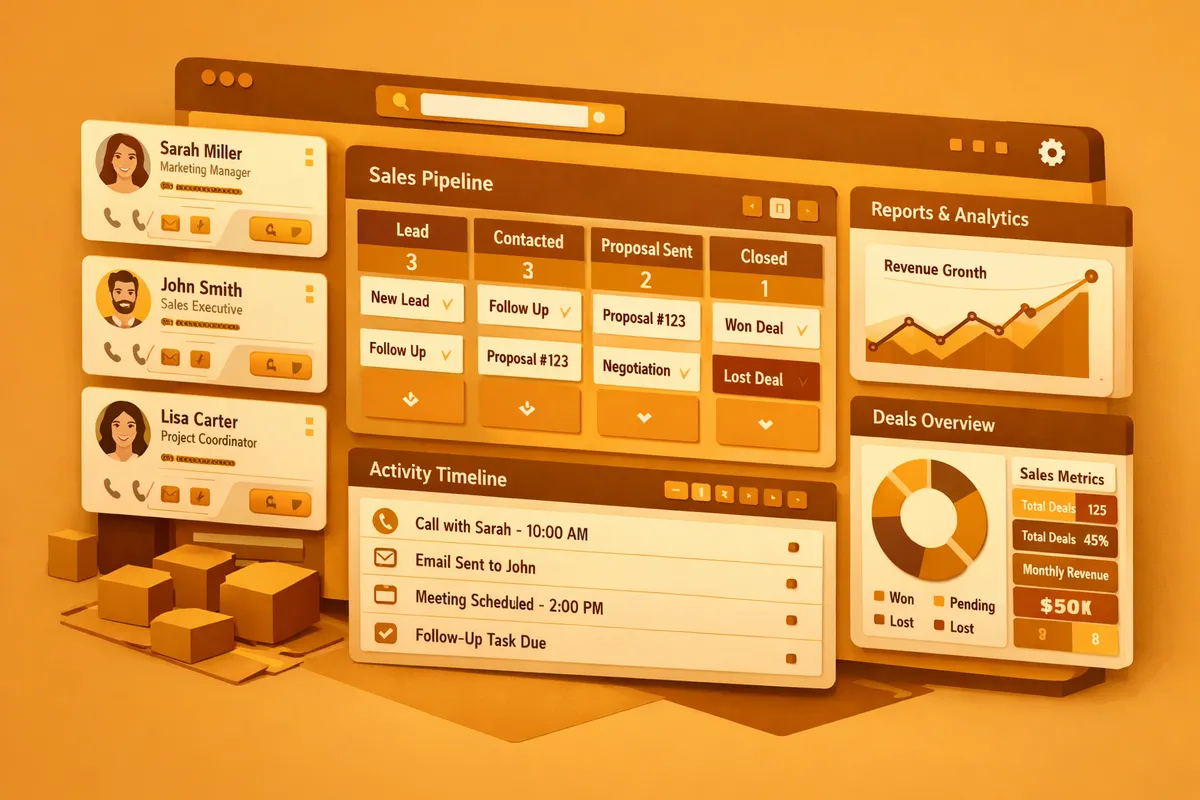
How AI-Powered CRM Works
AI transforms your CRM from a passive record system into an active business partner. Natural language processing captures and categorizes every interaction automatically. Emails, calls, meeting notes, and chat messages flow into the right contact record without manual entry.
The AI listens to (or reads transcripts of) sales calls and automatically extracts key information: what the prospect needs, what objections they raised, what competitive solutions they're evaluating, what their timeline looks like, and what the agreed next steps are. All of that information populates the CRM record within minutes of the call ending.
Machine learning models analyze historical deal data to predict which opportunities will close, which accounts are at risk, and which prospects need attention. The system learns from your team's behavior and improves over time. After analyzing 500 closed deals, the AI can tell you with 80%+ accuracy which current opportunities will close this quarter and which are likely to slip.
We build these capabilities through our CRM and martech consulting practice, tailoring every AI model to your industry and workflow. No generic features you'll never use. Every model trains on your data and reflects your business logic.
Key Features and Capabilities
Automatic Data Capture. AI extracts contact details, action items, and sentiment from emails, calls, and meetings. Your CRM stays current without manual effort. When a prospect mentions their budget range in an email, the AI captures it and updates the opportunity record. When a call reveals a new decision-maker, the AI creates the contact and links them to the deal. Reps save 45 to 90 minutes per day on data entry.
Predictive Lead Scoring. Machine learning ranks prospects based on engagement patterns, firmographic data, and historical conversion rates. Your team focuses on the leads most likely to close. The scoring model learns from every outcome: when a low-scored lead unexpectedly converts, the model adjusts. When a high-scored lead stalls, the model recalibrates. After 90 days, most models achieve 75-85% accuracy in predicting which leads will close within the quarter. Our lead generation services integrate directly with AI scoring for end-to-end pipeline intelligence.
Relationship Intelligence. AI maps connections between contacts, companies, and deals. Surface warm introductions and identify champions inside target accounts. The system analyzes email patterns, meeting attendance, and communication frequency to determine who your strongest relationships are with at each target account. If your CEO exchanged 12 emails with a VP at your target company last quarter, the AI surfaces that connection for the rep working the deal.
Smart Pipeline Forecasting. Replace spreadsheet guesses with AI models that predict close dates, deal values, and quarterly revenue with measurable accuracy. Traditional forecasting relies on reps' self-reported probability estimates, which are notoriously inaccurate. AI-based forecasting analyzes actual deal behavior: email velocity, meeting frequency, stakeholder engagement, and comparison to patterns from deals that closed in the past. The result is forecasts that fall within 10-15% of actual revenue compared to the 30-40% variance typical of manual forecasting.
Automated Follow-Up Sequences. AI triggers personalized outreach based on prospect behavior. The right message reaches the right person at the right time. If a prospect visits your pricing page twice in one week, the system sends a relevant case study. If a deal has gone 14 days without activity, the system suggests a re-engagement email with a personalized talking point based on the prospect's recent company news.
Integration With Your Existing Tools
Your CRM doesn't exist in isolation. We connect your AI-powered CRM with the tools your team already uses. Salesforce, HubSpot, or a fully custom build. Email platforms like Gmail and Outlook. Calendar systems. Communication tools like Slack and Teams. Marketing automation platforms.
Data flows both ways through robust API integrations. When a prospect opens a proposal in your document tool, your CRM knows. When a deal closes in your CRM, your billing system creates the invoice. When a customer submits a support ticket, the CRM updates the account health score.
The integration layer is what separates a useful AI CRM from a gimmick. Isolated AI features in a disconnected CRM provide marginal value. An AI CRM connected to every customer touchpoint provides exponential value because the model sees the complete picture.
Our business software integration capabilities ensure that every system your team touches feeds into and receives data from the CRM. The result is a single source of truth that requires zero manual synchronization.
Custom AI CRM vs. Off-the-Shelf Solutions
Off-the-shelf CRMs like Salesforce Einstein and HubSpot AI offer AI features, but they're generic. They don't understand your sales process, your industry terminology, or your unique qualification criteria. You pay for features you don't need and customize around limitations that shouldn't exist.
Here is how the approaches compare:
Data model flexibility. Off-the-shelf CRMs force your process into their data model. Custom CRM builds the data model around your process. If your sales cycle has a unique qualification stage between "demo" and "proposal" that doesn't exist in standard CRMs, a custom build handles that natively.
AI model training. Generic CRM AI trains on aggregate data from all users. Your custom AI trains on your deals, your customers, and your win/loss patterns. Generic models predict the average business. Custom models predict your business.
Cost structure. Salesforce with AI add-ons costs $150 to $300 per user per month. For a 15-person team, that is $27,000 to $54,000 annually before customization. A custom AI CRM has higher upfront development cost but lower per-user ongoing costs, and you own the system entirely.
Integration depth. Off-the-shelf integrations are surface-level. They sync basic fields but miss the nuanced data flows that make AI truly valuable. Custom integrations capture everything: email sentiment, call duration, proposal engagement time, support ticket patterns. That depth is what makes AI predictions accurate.
Measuring CRM AI Impact
Track these metrics to quantify the return on your AI CRM investment:
Time saved on data entry. Measure hours per rep per week spent on manual CRM tasks before and after implementation. Target: 40-60% reduction. At $50/hour fully loaded cost for a rep saving 6 hours per week, that's $15,600 per rep per year in recovered selling time.
Pipeline accuracy. Compare forecasted quarterly revenue to actual closed revenue before and after AI forecasting. Target: forecast variance under 15% (down from the typical 30-40% with manual forecasting).
Lead conversion rate. Track the conversion rate of leads that AI scores as high-priority versus leads from the previous manual process. Target: 20-40% improvement in conversion rate for AI-prioritized leads.
CRM adoption rate. Measure daily active users and records updated per user. AI CRM tools that eliminate manual work typically increase adoption from 60% to 90%+ because the system provides value to reps rather than just creating work for them.
Revenue influenced. Track deals where AI-surfaced insights (relationship mapping, re-engagement triggers, risk alerts) contributed to the outcome. This is harder to measure precisely but even directional data proves AI's impact on revenue.
Frequently Asked Questions
How much does AI CRM development cost?
Custom AI CRM projects typically range from $15,000 to $75,000 depending on complexity, number of integrations, and the depth of AI features. A basic AI CRM with automated data capture and lead scoring starts around $15,000 to $25,000. A full-featured system with predictive forecasting, relationship intelligence, and multi-system integration runs $40,000 to $75,000. We scope every project individually and provide fixed-price quotes so there are no surprises.
How long does implementation take?
Most AI CRM builds take 8 to 16 weeks from kickoff to launch. Simple implementations with fewer integrations and standard AI features ship in 8 to 10 weeks. Complex enterprise builds with multiple data sources, custom ML models, and extensive integrations take 12 to 16 weeks. We deliver in phases so your team starts seeing value within the first month: automated data capture typically launches in Week 4, with predictive features following in Weeks 8 to 12.
What data do I need to get started?
At minimum, you need historical customer and deal data. Ideally, 12+ months of CRM records with clear outcomes (won, lost, or still active). The more data you have, the smarter the AI models become. We work with whatever you have today: spreadsheets, existing CRM exports, email archives, call logs. Our onboarding process includes a data audit to identify what's available, what gaps need filling, and what quality improvements are needed before model training begins.
Will this replace my existing CRM?
It can, but it doesn't have to. Many clients start by adding AI capabilities on top of their current CRM through custom integrations. If your existing system is fundamentally limiting your team (poor data model, excessive manual work, inadequate reporting), we build a replacement that migrates your data and improves every workflow in the process. If your CRM is solid but lacks AI features, we extend it with AI layers that enhance what's already working.
How do I measure ROI from AI CRM?
Track three primary metrics: time saved on data entry (measured in hours per rep per week, multiplied by fully loaded hourly cost), pipeline accuracy (forecast vs. actual close rates and revenue), and revenue influenced by AI-surfaced insights (deals where AI alerts, relationship mapping, or scoring contributed to the outcome). Most clients see a 20-40% reduction in administrative CRM work within the first quarter and measurable forecast improvement within six months. A team of 10 reps saving 5 hours each per week at $50/hour recovers $130,000 annually in productive selling time.
Can AI CRM work with my existing Salesforce or HubSpot setup?
Yes. We frequently build AI layers that sit on top of existing CRM platforms. Your team continues using the interface they know while AI handles data capture, scoring, and predictions behind the scenes. Scores and insights surface directly in Salesforce or HubSpot records, dashboards, and workflows. This approach preserves your existing investment while adding the AI capabilities that make the system dramatically more useful.